Tony Blair stuck his nose into Labour party politics this week, declaring a change in leadership as irrelevant without a total strategic pivot. He urged the party to ditch its aggressive net-zero acceleration and instead exploit remaining North Sea oil and gas, to scrap structurally unaffordable spending commitments like the pension triple lock, and to halt business tax hikes. Going further, he called for a total reorganisation of the state around AI to automate public services and court private-sector growth. Maybe next, he’ll be joining the Reform Party.
Andy Burnham dismissed Blair as a voice from a bygone era, a sentiment we all share, even if we probably are more inclined to agree with Blair’s views here, dare we admit it. Let’s hope that’s the last of the input from these two:

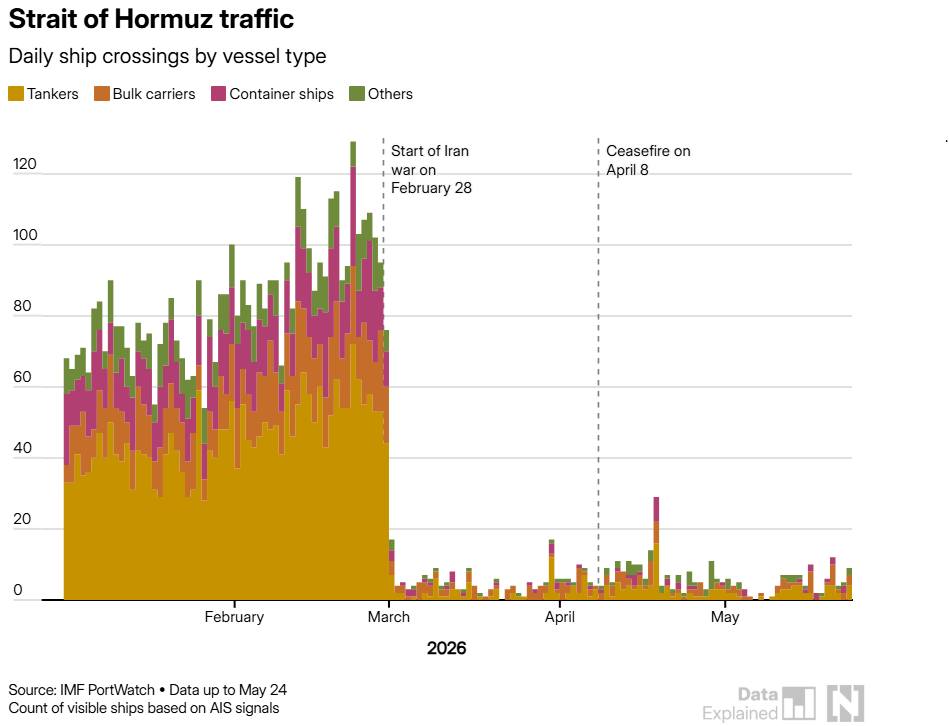
Israel and Lebanon have agreed to a conditional ceasefire; could this be a leading indicator of a deal between the US and Iran? Transit through the Strait of Hormuz is making a tentative recovery with the US successfully coordinating the passage of c. 70 commercial vessels in recent weeks, but the numbers are a mere blip compared to pre-war volumes:
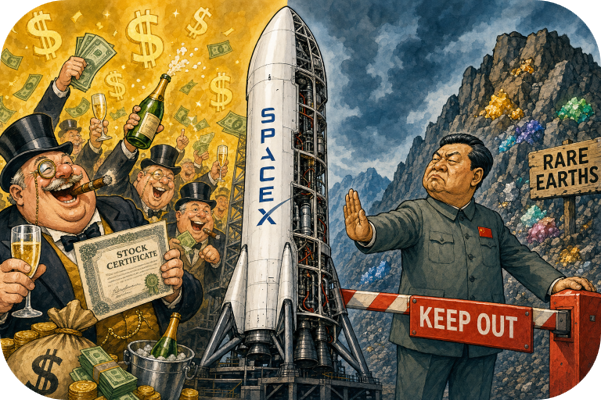
For now, new capital finds itself flowing into US assets which are relatively insulated from the crisis. In the coming weeks we will witness the IPO of SpaceX which will be followed in due course by Anthropic and OpenAI. One point of contention is that the rules for indices have been changed to fast-track the inclusion of these IPOs, making passive investors buyers at any price and providing a ready-made pump-and-dump scheme for investment bankers and venture capitalists.
If these large IPOs deter international investors while at the same time indirectly draining capital away from the rest of the US market, and if a US-Iran deal simultaneously de-risks rest-of-world assets, then US equities and the AI trade could temporarily lose momentum.
While emerging markets may once again be the favoured destination for capital in such circumstances, it is increasingly evident from multilateral policy manifestos, private institutional sector surveys and global supply chain tracking databases that G7 factory automation capital expenditures are accelerating. This could put a dent in the traditional emerging market manufacturing play, one that has benefitted from the stymied execution of US protectionist policy.
The big turning point in the ‘one-way traffic’ of tariff implementation came on 20th February 2026, when the US Supreme Court ruled that Trump’s use of the International Emergency Economic Powers Act to impose tariffs was unconstitutional.
This struck down the sweeping “reciprocal” tariffs imposed from April 2025 onwards, with refunds now being processed, and the US expected to repay an estimated USD166 billion.
In response, Trump invoked Section 122 of the Trade Act of 1974, imposing a replacement 10% universal baseline tariff on most global imports. This tool however is also under legal challenge, with a Federal Court of International Trade ruling against it on 7th May 2026, and by law it expires on 24th July 2026 unless Congress extends it. Congress has so far not acted.
There are however a number of other tariffs and trade deals still in place. These include:
Section 232, so called “National Security” tariffs. These survived the Supreme Court ruling in February and impose a 50% tariff on articles made entirely or almost entirely of steel, aluminium, or copper.
Section 232 also imposes a 25% tariff on cars and car parts (although compliant auto parts from Canada/Mexico are exempt).
There is also a 100% tariff on pharmaceuticals coming into effect on 31st July 2026 for large companies and 29th September for smaller companies (although many drugs are actually exempted).
There are also tariffs on various specific other items such as semiconductors, lumber and furniture etc.. which apply at various rates.
The legal authority for Section 232 tariffs is well-established and has been upheld in prior court battles (including during Trump’s first term). There is however a pending challenge to the way Section 232 steel/aluminium tariffs are being calculated. This is however a narrow administrative law point and is unlikely to unravel the tariffs entirely.
China was not part of the Section 122 universal tariff framework in the same way as other countries, with pre-existing Section 301 tariffs from Trump’s first term in office remaining in force.
Trump and President Xi met in Beijing two weeks ago and agreed to cut agricultural tariffs as part of a broader deal, with China committing to buy $17 billion in US agricultural goods annually. Some tariff reduction hints have also emerged from Congress.
A provisional US–EU trade deal was reached on 20th May 2026, and EU governments formally cleared it on 28th May. Under the deal the EU removes import duties on US industrial goods and the US caps tariffs on most EU goods at 15%. This agreement runs to the end of 2029.
Under the UK–US Economic Prosperity Deal (signed in May 2025), the 10% baseline tariff on UK goods remains in place. Aerospace goods and pharmaceuticals have a 0% tariff.
In addition, UK vehicle manufacturers have a quota allowing up to 100,000 vehicles to enter the US subject to a 10% tariff, which is a concession on the 25% car tariff. Steel and aluminium deals are still being negotiated.
With regards to Canada & Mexico, and under the long-standing trade agreement between the 3 countries, compliant goods are exempt from the 10% Section 122 tariff, but Trump’s trade representative has explicitly said tariffs will stay even if CUSMA is renewed at the July 2026 review. The two countries face ongoing duties on steel, aluminium, lumber, and other goods.
There has however been a big development this week with a new proposed tariff known as Section 301 Tariffs, the so called “Forced Labour” Tariffs. It appears that this is an attempt to replace the Section 122 Tariffs when they expire, given that Congress currently shows no desire to extend Section 122.
On 2nd June 2026, the US Trade Representative (a branch of the US executive) published findings from 60 simultaneous Section 301 investigations, accusing virtually every major US trading partner of failing to ban imports made with forced labour.
Under proposals made by USTR, tariffs will cover 99.4% of all US imports and come in two tiers:
- 10% for economies with some forced labour prohibition in place (or that pledged one via a trade deal). This includes the UK, EU, Canada, Mexico, Argentina, Bangladesh and Taiwan.
- 5% for the remaining 46 economies with no prohibition, including China, Japan, India, Australia, South Korea, Brazil and most of the rest of the world.
The legal basis for these tariffs is the same authority used for the longstanding China tariffs, which has survived all court challenges. This is widely seen as the administration’s most credible legal vehicle yet for a near-universal tariffs
The proposals are currently being consulted on, and any written comments are required by 6th July 2026, with a public hearing scheduled for 7th July 2026 – quite how comments submitted the day before will get a fair hearing is clearly going to be an issue.
There will then be a post-hearing rebuttal period but again it appears that the outcome has been pre-determined, given the drive to have these tariffs in place when the Section 122 tariffs expire on 24th July.
The overall picture therefore is that the Trump administration is actively constructing a Section 301-based replacement for the tariffs struck down by the Supreme Court, timed to kick in just as Section 122 expires, which will impose universal tariffs of 10% or 12.5%.
No doubt China will meet these developments with a flexing of its own muscles. Discreet satellite and supply-chain logistics data has indicated an unseasonably steep draw in industrial rare-earth metal inventories inside localized Asian trading hubs. This could indicate stockpiling by major hardware manufacturers in anticipation of tightening export policy.
This could include the extension of license requirements from Gallium and Germanium to other advanced minerals such as Dysprosium and Terbium, a ban on the export of extraction technology for magnet manufacturing and precursor materials, and the manipulation of mining and refining quotas to squeeze international resource markets.
It just so happens that SpaceX is heavily dependent on rare earth elements and critical minerals across all three of its primary business segments, so now may be a good time for the venture capitalists to find some exit liquidity…
Where are markets up to?
The rolling 12 month % cumulative returns in local currency from various indices is shown in the following chart:

Where are the portfolios up to?
The portfolio performance, net of fees, to close of business on Thursday is as follows: