weekly update newsletter 16.01.26
The whirlwind start to the year has not let up and, if anything has accelerated, with key issues surfacing in macroeconomics and geopolitics alike.
On the geopolitical front, Trump has again been very much in the limelight, backing up his action in Venezuela, with a thinly veiled threat to Mexico, a warning to Cuba that it is running out of time to come to heel, a threat to the leaders of Iran and a doubling down of his rhetoric to take Greenland by force if necessary.
In Venezuela itself, Trump is indicating that US oversight of the oil sector will potentially extend for years, though a planned second wave of US military attacks has been cancelled following increased cooperation and the release by the interim Venezuelan Government of former political prisoners. This mix of coercion and cooperation keeps the situation highly politicised but somewhat stabilised in the near term.
The widespread unrest in Iran has reached a fever pitch over the past few days, leading the Iranian Government to resort to a violent repression of the protestors, the execution of protestors and the imposition of nationwide internet restrictions and severe communication curbs.
Trump repeatedly warned Iran’s leaders that the U.S. would use force if they continued killing protesters, but he did not spell out precise military steps that would be taken. His core threat was that if Iran “violently kills peaceful protesters” or proceeds with hangings and executions, the United States would “come to their rescue,” was “locked and loaded and ready to go,” and would take “very strong” military action.
As the week wore on the immediate tension between the S and Iran dissipated a little with Trump claiming that, “We’ve been told that the killing in Iran is stopping — it’s stopped, it’s stopping, and there’s no plan for executions or an execution or executions” and that “we saved a lot of lives”.
In respect of Greenland, Trump’s justification for his provocation seems to come down to a claim that if the US doesn’t take Greenland, then Russia or China will and by owning it, the US will deter such actions.
Personally, I am contemplating nipping up to Jackson’s car dealership and stealing the very nice Bentley that they have on display. I won’t be doing it as a criminal act; I’ll be doing it to make sure that non-one else steals it…
Denmark has signalled a hard response by deploying an advance party of troops and by stating that its forces would immediately open fire in the event of an attack on Greenland.
There is a tacit backing of this stance from both Europe and NATO, the latter of which of course lives by the mantra that an attack on one member is an attack on all members. When they came up with that notion it is hard to imagine that they ever contemplated that it would be the US threatening to attack one of the members.
I was fortunate enough to attend a briefing arranged by one of the fund management houses that we deal with at which former US Secretary of State Condoleezza Rice and Bob Gates (former Secretary of Defence to Obama & Bush) were speaking.
What really struck me was the fact that both of them were adamant that what is happening now under Trump is not really that different from what normally happens in the US Government. The key difference is that Trump makes his policy announcements first and makes them as exaggerated as possible. That is then followed up by a very smart team of people work out what can actually be put in place, which is usually significantly less than the original policy announcement.
This differs to the conventional course, which is for the policy to be formulated first and then announced when it is finalised.
They also made the point that both Congress and the Supreme Court are now really starting to impact Trump’s use of Executive Orders and that we can expect to see a curtailment of this style of Government over the coming months.
Their stance on both policy making and the use of Executive Orders was significantly more relaxed than I had expected.
Separately, there is also a growing concern over the looming expiry of the last Russia–US nuclear arms control treaty, known as New START, without a clear successor,
The expiry on 5 February 2026 removes the last legally binding cap on US–Russian strategic nuclear arsenals and is widely viewed as a major driver of nuclear risk and potential arms racing.
New START (in force since 2011, extended once in 2021) limits each side to 1,550 deployed strategic warheads and 700 deployed delivery systems, plus intrusive verification and data‑exchange measures.
The treaty cannot be extended again under its own terms, and with Russia having suspended implementation of inspections and data exchanges since 2023, its practical constraints and transparency have already been badly weakened.
Once New START lapses, there will be no treaty‑based limits or on‑site verification between the world’s two largest nuclear powers for the first time in over 50 years of US–Soviet/Russian arms control.
Analysts warn that without constraints, both sides could upload hundreds of additional warheads onto existing missiles within months, fuelling worst‑case planning and increasing the risk of miscalculation or crisis escalation.
Trump has signalled a willingness to let New START “expire” without a replacement in place, framing this as leverage to seek a “better” or broader agreement later.
Russia has floated the idea of both sides voluntarily continuing to observe New START’s central numerical limits for at least a year after expiry to avoid an immediate arms race, but this would be politically, not legally, binding and so far lacks a clear US commitment.
Without such interim arrangements, it is feasible that the most likely trajectory is a gradual but accelerating arms competition, higher defence spending on strategic forces, and an impulse on other nations / regions such as China and Europe to accelerate their own nuclear arsenals.
Over the past week there has been a cluster of macroeconomic reports showing a resilient global economy.
The World Bank’s January 2026 Global Economic Prospects report projects global growth at about 2.6% in 2026, slightly slower than 2025 but still above earlier fears, and rising modestly in 2027. The report highlights that one in four developing economies remains poorer than in 2019 and warns that trade tensions and policy uncertainty are key downside risks.
A separate UN outlook and other commentary describe global growth as “subdued but resilient”, with trade and domestic demand expected to soften as the one‑off boost from pre‑tariff trade front‑loading fades.
US employment data show modest payroll gains and an unemployment rate near 4.4%, reinforcing the picture of a cooling but not recessionary labour market.
Meanwhile US inflation data shows a year-on-year headline inflation at 2.7% and month-on-month Core CPI at 0.2%, below the 0.3% expected. The expected inflationary impact from tariffs is showing remarkable shyness…
Similarly, the impact of tariffs on China’s Balance of Trade is missing in action, with Chinese exports expanding 6.6% year-on-year, well ahead of the 3.0% expected. Admittedly Chinese imports also grew strongly (5.7% year-on-year), but nonetheless, China’s trade surplus is now USD114bn and these numbers indicate that China has very effectively negotiated the tariffs and found other outlets for its production, most notably Europe and the rest of Asia.
UK GDP remains anaemic with the monthly growth for the 3m / 3m November figure coming in at just 0.1% and the month on month figure at 0.3%, giving a 1.4% growth figure year-on-year.
Trump also chose this week to ramp up the pressure on the Federal Reserve by having the Department for Justice launch a criminal investigation in to the Fed’s Chair, Jerome Powell, over his alleged criminal handling of the Fed’s building projects.
This was met with a very strong rebuttal from Powell whose public statement concluded with him saying, “The threat of criminal charges is a consequence of the Federal Reserve setting interest rates based on our best assessment of what will serve the public, rather than following the preferences of the President”
Powel was supported very strongly by a group of Global Central Bankers, including Andrew Bailey of the Bank of England and Ursula von der Leyen of the European Central Bank.
As a consequence of the backlash and the clear determination of Powell to fight the charges, Trump has sought to distance himself from the action, claiming he didn’t know anything about it. This saga promises more twist and turns before it is done.
Where are markets up to?
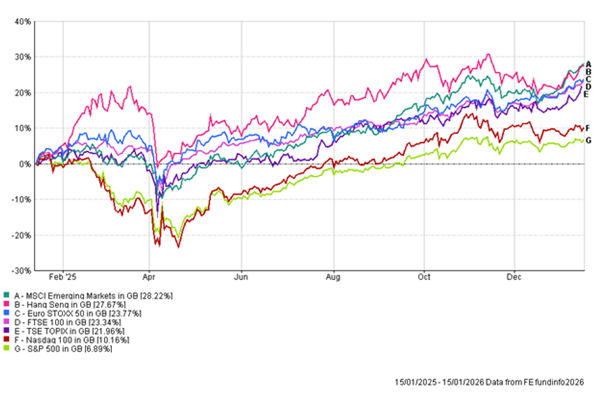
The rolling 12 month % cumulative returns in local currency from various indices is shown in the following chart:
 Where are the portfolios up to?
The portfolio performance, net of fees, to close of business on Thursday is as follows:

As ever, if you would like to discuss any aspect of your portfolio, please do not hesitate to contact us on service@blythefinancial.com.