Another strong week for global equities as President Trump announced great progress on a deal with Iran amid a freshly issued ultimatum to the IRGC. In addition, the UAE elected to leave OPEC which improves the supply-side dynamics for crude oil. Markets are becoming desensitised to geopolitical volatility and have been focusing on strong corporate results and the gradual monetisation of Artificial Intelligence.
Riding higher off the results from the mega-cap magnificent hyperscalers last week, numerous software stocks reported strong earnings and provided some examples of AI driving margin expansion.
That’s not to deny the overall picture for the sector was mixed; some companies are clearly exhibiting disruptive pressures while some are being forced to cut staff, like Cloudflare, which will reduce its global workforce by a fifth. This employment dynamic, however, is playing out more favourably for those companies which are growing revenue far faster than headcount.
That was always going to be the difficult balance for SAAS companies; on one hand they would be able to reduce costs through greater productivity, on the other AI-driven accessibility threatened pricing pressure. For now, the cost of compute is manageable, but as infrastructure expansion is increasingly constrained by energy and hardware bottlenecks, this additional cost becomes an additional pressure.
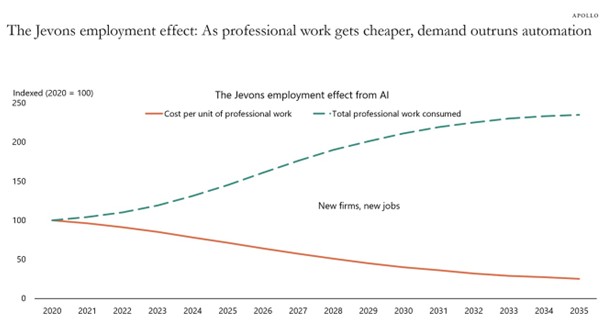
Overall employment data is yet to feel any meaningful impact of this productivity boom, with yet again resilient jobs market data in the US. This has had Torsten Slok, Chief Economist at Apollo Global Management, repeatedly point out the nature of Jevons’ paradox, which highlights that when technology makes a task more efficient, total consumption of that task can increase, as can employment in that industry.
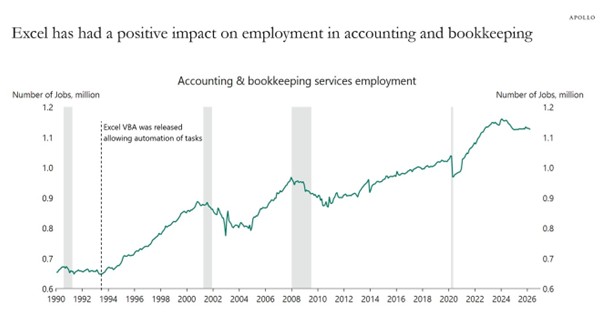
I take issue with the notion that this is a paradox, as indeed it only is so when viewing the economy through an incorrect lens, albeit one that has become entrenched in conventional wisdom. It is really no surprise to me that when we become more productive, we have the tendency to consume more, and if we focused our attention to productivity as the primary driving force of the economy, then this would be implicit. It is often asked, “what will humans do if AI takes their job?”, to which I ask, what is it we are working for all our lives for in the first place?
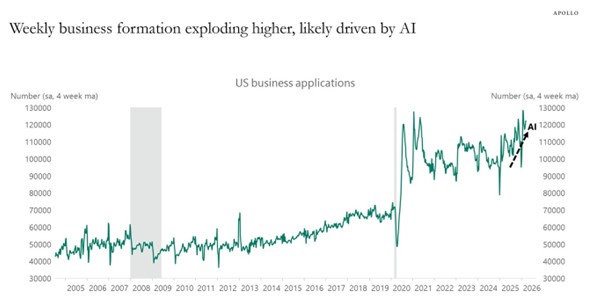
To bolster the optimism about the US economy and AI, business formation is booming:
Trump also threatened the EU with higher tariffs if the bloc failed to ratify its trade agreement with the US by Independence Day, July 4th, having already pledged to increase tariffs on cars and trucks imported from the EU to 25%.
But of course, the highlight of the week comes from UK local elections which took place yesterday with counting ongoing today. It was highly anticipated that Reform UK would achieve sweeping gains and pile pressure on the incumbent Prime Minister, and results so far indicate this to indeed be the case.
Yet, Keir Starmer has vowed not to step down and with an alternative leader yet to emerge Gilt markets have remained settled. Possibly this is the simple case of “buy the rumour, sell the fact” with much of the negativity already priced into bond markets. Still, much of this story is likely to develop over the weekend.
With the Green party also achieving exceptional gains, Starmer will face immense pressure from his backbenchers to stop the rot by increasing public spending or adopting more radical policies, inducing a lurch to the left. If not, and should the Labour party lose confidence, a replacement is likely to also represent a leftward shift, thus, Gilt yields will likely remain in no-man’s land for the foreseeable future.
Traditionally local elections represent the lagged effect of general election results, so it is interesting to contemplate their predictive impact for voting patterns at the next general election (due before August 2029). Much will depend on how voters perceive each party’s performance in running the councils in which they gain control once faced with the harsh and often mundane reality of tight budgets and already dissatisfied locals. Campaigning and winning support with eye-catching promises is one thing, but if Reform UK and the Greens struggle to govern at the local level, it could put people off voting for these parties in the next general election.
The one big take-away is that, in what has historically been a two-party system, one in which on election day voters may be willing to ditch their favoured party to support a frontrunner, Reform UK has now given itself credibility as a leading party to gain these types of vote. And it speaks volumes that they are, as right-wing party, the leading opposition to nationalist devolution and/or independence agendas in Scotland and Wales.
Where are markets up to?
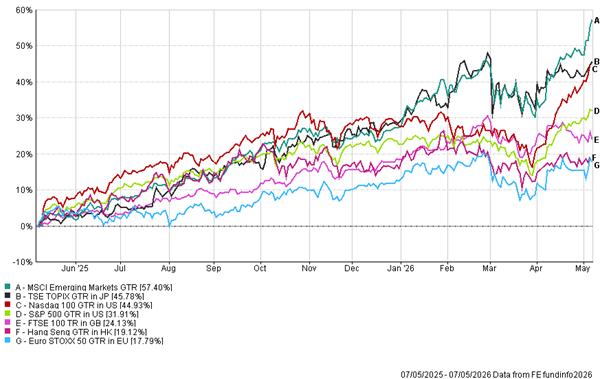
The rolling 12 month % cumulative returns in local currency from various indices is shown in the following chart:
Where are the portfolios up to?
The portfolio performance, net of fees, to close of business on Thursday is as follows:

As ever, if you would like to discuss any aspect of your portfolio, please do not hesitate to contact us on service@blythefinancial.com