Trump’s Bored of Peace
Over the weekend the US and Israel launched a joint operation targeting and killing Supreme Leader Ali Khamenei and dozens of top military commanders within the Islamic Revolutionary Guard Corps (IRGC). Through the week, air superiority has been established with near three quarters of Iran’s air defences and missile launching capabilities destroyed.
Iran’s response has been to launch drones and ballistic missiles at Israel and neighbouring Gulf Cooperation Council states which are considered complicit because they host US military bases.
The primary justification for engagement is that Iran was on the verge of a nuclear breakout after Iran refused to permanently end all uranium enrichment during talks in Geneva and claims that 85% enriched uranium had been found, which is just days away from producing weapons-grade levels.
While the Republican administration hopes to avoid the endless wars of the past to minimise the huge economic cost of extended military action, the IRGC’s vast scale makes this a far more significant engagement than the hit and run operation in Venezuela. Consequently, the strategy is a heavy-handed focus on total military degradation circumventing the need for a full-scale ground invasion or nation-building, with a preference for pruning leadership to let internal forces drive any political change.
The IRGC is a primary branch of the Iranian Armed Forces, founded shortly after the 1979 Islamic Revolution to protect the country’s Islamic primary system and prevent internal or external interference, unlike the regular military which is tasked with defending Iran’s borders. It is a massive state within a state, possessing its own land, air, and naval forces, as well as significant economic power.
The regime is widely characterised as the primary architect of Iran’s current humanitarian and economic distress, more so through a western lens, and the regime’s domestic legitimacy is considered to have reached a point of no return following the massacre of between 3,000 and 36,500 people during domestic protests in January.
The humanitarian crisis there can be quantified by a near 50% inflation rate, a 50% caloric deficit, and a 50% absolute poverty rate in a nation that should be one of the wealthiest on earth, given the scale of its natural resources.
The IRGC’s global network has grown from a collection of militias to a transnational criminal-military syndicate, allowing Tehran to project power thousands of miles from its borders while maintaining a degree of plausible deniability.
In January, the EU designated the IRGC as a terrorist organisation citing evidence of IRGC cells planning attacks on Jewish community centres in France and Germany. Argentina President Javier Milei has also cited renewed evidence of IRGC sleeper cells operating in the “tri-border area” of Argentina, Brazil, and Paraguay having also shown concern over the Bolivia-Iran defence pact signed in recent years. This week’s developments offer clarity as to the US diplomatic alignment with Argentina in recent months.
To fund these operations, the IRGC have built a parallel financial system that bypasses traditional banks. Chainalysis has reported that in late 2025, IRGC-linked addresses moved over $3 billion in cryptocurrency to facilitate oil sales and fund militia activities and currently control over 50% of the illicit crypto volume coming out of the Middle East.
US authorities also recently confirmed that a covert IRGC unit was responsible for a sophisticated murder-for-hire scheme targeting Donald Trump during the 2024-2025 period. Secretary of Defence, Pete Hegseth, announced this week that the leader of this unit was successfully eliminated in the recent strikes on Tehran.
The events of this week have appeared to also curtailed the efficacy of the “Axis of Resistance”, the Iran-aligned organisations in operation in the Middle East. Israel has responded to Hezbollah rocket barrages with massive force, conducting over 250 airstrikes in Lebanon, with the government making an historic attempt to ban Hezbollah’s military activities, by demanding they surrender weapons to the state to prevent Lebanon from being completely destroyed.
Hamas had already been hamstrung by the events in Gaza and the precision air strikes on its leaders in Doha, Qatar, in late 2025. They have explicitly stated they would not open a “support front” for Tehran. Iraqi Militias have been attacking US interests and are pressuring the Iraqi government which remains neutral but so far these insurrections have been limited but are increasing as we head into the weekend.
The Houthis in Yemen are one to watch. They have exercised caution given the risk of an operation against them directly and instead signalled a return to targeting commercial vessels in the Gulf of Aden and the Red Sea. Global shipping giants have already begun rerouting ships around the Cape of Good Hope again, fearing a total blockade.
The main area of concern from an economic and capital market perspective as a result of this conflict is the maritime logistics through the Straits of Hormuz, through which c. 20% of global oil supply passes.
Iran cannot stop the US Navy from moving through the Strait, but they can make it so dangerous and expensive that the world’s merchant fleet stays away. Major insurers have removed coverage for the Gulf and ships are not sailing. The US is in a race against time to destroy Iran’s coastal missile batteries before the global energy supply hits a breaking point. They are however being less restrained than in previous conflicts with orders to destroy any Iranian naval asset that leaves its berth. So far over 11 major Iranian warships have been sunk.
The single greatest challenge to achieving stability in the strait are the attack drones that can be launched from the back of a pickup truck. Without the need for a military base or fixed runway, a launch vehicle can be driven out of a hidden cave or a civilian garage, launch the drone in 60 seconds, and drive away before a US satellite or jet can target them. With a cost of $50k this creates a huge financial imbalance, the US Navy currently uses missiles to intercept them at a cost of $2-$4 million each time. Within the narrow channels of this waterway these drones only need to disrupt vessels to halt the flow of oil.
Clearly the main financial impact will be of crude oil prices which are moving higher reaching $90 per barrel. With crude oil one of the key balancing factors that has served to stem inflation, the knock-on impact is on the direction of interest rates which were falling to support economies but now that economic boon could dissipate. The situation presents a stagflationary impulse – downward pressure on economic growth and upward pressure on inflation.
Both typically defensive assets gold and US Treasuries have therefore not been highly effective defensive investments in this scenario, as higher than expected interest rates put downward pressure on them too.
The US dollar on the other hand has benefitted, with the US a significant energy producer, higher oil prices should provide a boost to their domestic economy. The opposite is true for countries which are notable importers of oil, particularly those who import oil that travels through the Straits of Hormuz:

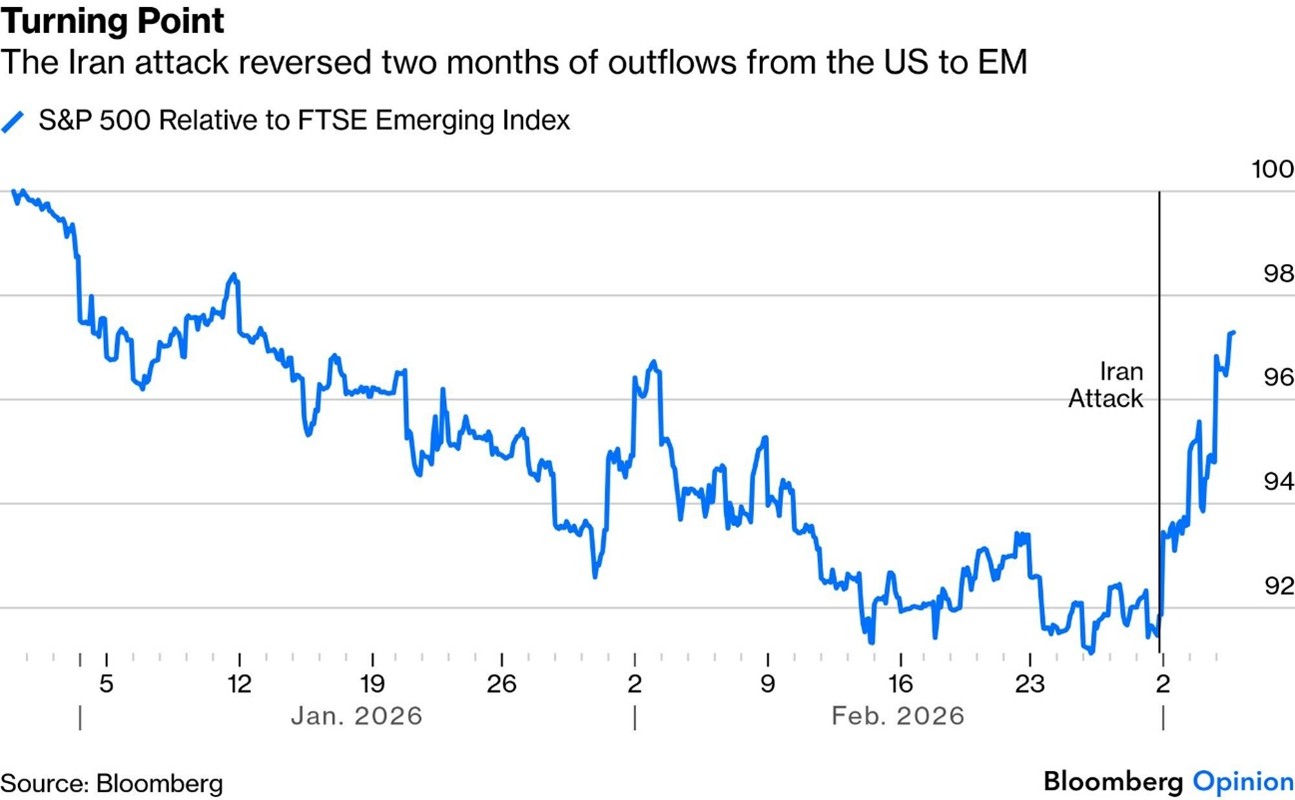
India, Japan and Korea, the latter two of which have been darling stock amrkets so far in 2026, have felt the brunt of the selloff with record volatility. The trend of the last 12 months has started to reverse and the US may be back in favour, at least for now:
Otherwise, equity markets have been relatively sanguine in response to these events. This is largely as a result of the data evident in the history of events like these. Yes, there is usually a risk-off response but typically markets are higher within twelve months’ time. With this data in hand many financial institutions have suggested the scenario may provide an opportunity to buy the dip, and maybe that’s no surprise given the economic circumstances outside of this event were looking rather expansionary.
President Trump has mid-terms later this year – he needs a deal, lower oil prices, and something he can sell as a win. Affordability is the one goal he is yet to deliver, and this will be the key issue. A higher oil price is the one thing they don’t want going into this election.
While China publicly condemns US strikes to maintain itself as a champion of sovereignty, it is economically desperate for the continuation of oil transit. As the world’s largest oil importer with a particular reliance on discounted Iranian crude for its industrial sector, China also lacks the energy independence of the US and views disruption to the Strait of Hormuz as a direct, existential threat to its own economic stability. Beijing has explicitly stated its desire for the Strait of Hormuz to remain open.
The relative calm in markets is also a circumstance of current oil supply-demand dynamics. The amount of oil Iran produces is not in excess to the existing supply glut and therefore the production of oil itself is not a major concern, as long as oil production sites outside Iran were to become targets of retaliation.
The lingering question remains one of longevity, just how long will this conflict last and how long will transit routes be blocked. A sustained disruption to shipping through the Strait of Hormuz could be far more severe supply shock, one several times larger than the historical episodes markets typically reference for comfort.
Where are markets up to?
The rolling 12 month % cumulative returns in local currency from various indices is shown in the following chart:

Where are the portfolios up to?
The portfolio performance, net of fees, to close of business on Thursday is as follows:
As ever, if you would like to discuss any aspect of your portfolio, please do not hesitate to contact us on service@blythefinancial.com