Multiple factors have come together and snowballed into a sharp downturn for AI related stocks in recent weeks culminating in huge volatility for individual stocks but, by comparison, relatively muted volatility at the index level. This excludes the South Korean market; its prospects resting on its largest two companies, which as AI memory chip producers are benefitting handsomely from US tech capital expenditure, thus one of the world’s largest stock markets has moved near 25% in both directions through the week.
What’s extraordinary is that for many investors this volatility has gone largely unnoticed, with value, quality and income indices, for example, remaining largely unchanged – as is also the case for our portfolios.
The slump’s downward trajectory was initiated when it emerged that the progressive enterprise deployment of cheaper open-weight models from Chinese AI developers was prompting corporate users to switch away from expensive proprietary US models to curb runaway spending.
Building on the sector’s woes, bond yields have been rising as inflation pressures from the fallout of the Iran war mount against a backdrop of fiscal excess while Federal Reserve Chair Kevin Warsh limits forward guidance thereby adding a margin of risk to prices despite the FOMC maintaining interest rates at current levels this week. There is also the simple demand dynamic of corporate debt issuance tied to AI infrastructure buildouts competing directly with sovereign debt for capital, and that is also putting upward pressure on yields.
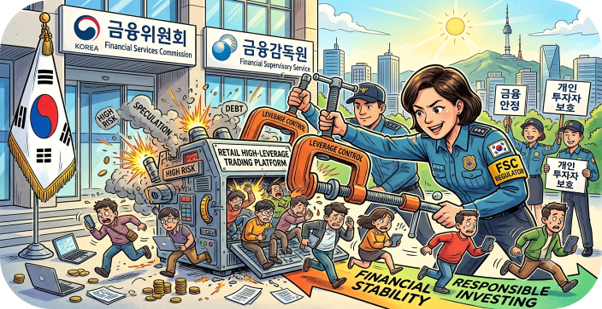
For the Korean memory chip giants, the May debuts of leveraged single-stock ETFs had helped propel the country’s stock exchange higher, but the tripling of margin requirements and a 20% of portfolio value upper limit on these types of investments, both of which were accelerated into effect this week, played a significant role in unwinding excess leverage.
The leverage unwind was not limited to Korea, with US prime brokers demanding more capital to de-risk AI-concentrated hedge fund exposures while aggressively issuing margin calls. The dearth in liquidity culminated in the near-implosion of former Open-AI researcher Leopold Aschenbrenner’s heavily leveraged, AI-focused hedge fund, which had grown from c. $250m just a couple of years ago to over $40bn at its peak. Ironically named ‘Situational Awareness’, the fund has managed to survive forced to liquidate its entire publicly listed portfolio to provide liquidity to protect its private investments from a forced fire sale.
Today represents the turnaround as markets regain positive momentum having passed a key risk on the calendar following the Bank of Japan’s overnight decision to hold interest rates steady. The Yen carry trade is another key provider of leverage and despite another significant bout of intervention from Japan’s Ministry of Finance, which has pushed the Dollar-Yen ratio back to 160 from over 163, there was no major hawkish rhetoric that would instigate an immediate and rapid unwind, although it may be too soon to explicitly rule out that this risk won’t emerge.

Are we in the eye of the storm or is the storm over?
A significant liquidity event that did not result in collateral damage across unexposed segments of the market as AI infrastructure capital expenditure continues to expand while the blended earnings growth for US companies tracking near 37% year-on-year, the highest in almost 5 years. This would suggest that this was just a liquidity-induced bout of volatility that is now over.
Exceptional results from Microsoft and Amazon confirm that the hyperscaler revenue story is intact and capex will continue to feed the hardware providers. Each subsequent earnings season will be accompanied by jitters over whether these tech companies will scale back capex but the economy has made it through this one unscathed.
China will continue to push towards converging with US technology and is now producing its own deep-ultraviolet (DUV) lithography machines, which are the high-tech machines used to produce AI chips. They are not yet able to produce the extreme-ultraviolet (EUV) machines, which are the cutting-edge innovation at the forefront of US technology, but this represents the first step along that path. As such, the end of this liquidity event does not eliminate China’s potential to compete and disrupt the value prospect of US technology companies.
The war in Iran also lingers as a threat to global economic growth.
Where are markets up to?
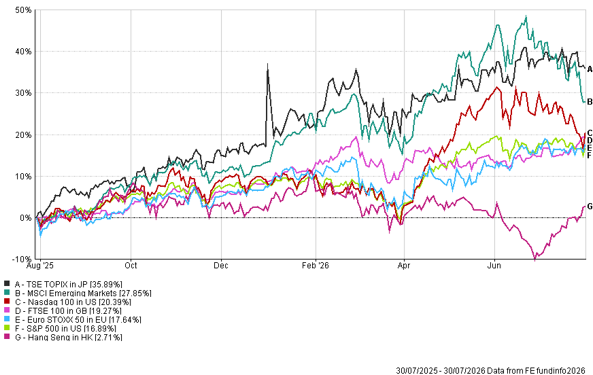
The rolling 12 month % cumulative returns in local currency from various indices is shown in the following chart:
Where are the portfolios up to?
The portfolio performance, net of fees, to close of business on Thursday is as follows:

As ever, if you would like to discuss any aspect of your portfolio, please do not hesitate to contact us on service@blythefinancial.com.