
The key market issue this week is the contrasting fortunes of 2 key technology stocks, Alphabet (owner of Google) and Microsoft, following the release of their latest trading data. The following table gives a snapshot of the key metrics of both:

Even though both companies reported strong revenue and vigorous demand for cloud computing, the market focused on whether AI expansion was strengthening or straining the underlying business.
Looking at Microsoft first, Azure growth and positive cash generation provided evidence that investment was translating into revenue, whilst leaving the company net cash positive after capital spending.
For Alphabet however, the combination of weaker-than-expected advertising revenue, lower monetisation in AI search and negative free cash flow suggested a harder balancing act.
This shows that the market is now more discerning about growth and how it is achieved and explains why Alphabet’s share price suffered a sharp repricing, whilst Microsoft’s share price largely held its ground.
The key macroeconomic issues this week have included strengthening US growth but against a backdrop of persistent and accelerating inflation.
US Q3 GDP grew at a 3.4% annualised rate, up from 2.2% in the second quarter and above the 3.2% consensus forecast. At the same time, September’s Personal Consumption Expenditures (an alternative measure of inflation figures) showed:
• Headline inflation of 3.6% year on year, up from 3.4% in August.
• Core inflation, excluding food and energy, of 3.1%, up from 3.0%.
• A monthly headline price increase of 0.5%.
The US Federal Reserve held its policy-rate range at 3.75%–4.00%. It upgraded its description of economic growth to a “strong pace”, whilst in acknowledgement of the above figures, noted that inflation remained elevated. The Chair, Kevin Warsh, was keen to stress that further tightening remained possible, depending on incoming data.
For markets, the important distinction is that unchanged rates did not mean that rate cuts were approaching. The combination of strong growth and persistent inflation left investors facing the prospect of elevated interest rates for longer.
Meanwhile the European Central Bank left its policy rate unchanged at 2.5%, but warned that rising oil and gas prices were increasing inflation risks. Christine Lagarde (who announced her resignation as ECB Chair from next April) said policymakers had discussed an immediate increase before deciding to await more data, whilst pointing towards a possible rate increase in December.
The ECB also highlighted that the latest increase in bond yields could reduce growth by around 1% and inflation by 0.9% across 2027–28.
UK Chancellor John Healey’s first Budget provided temporary support for households facing higher energy costs, financed partly through additional taxation. Measures included a £100 payment for 20 million households, an extension of temporary VAT relief on electricity, continued fuel-duty relief and a temporary increase in the bank surcharge to 6%.
The underlying economic picture remains weak with the Office for Budget Responsibility forecasting growth of 1.2% in 2026 and 1.0% in 2027 and inflation projected to peak at 3.8% in early 2027.
The immediate market response was relatively calm, with Gilts finishing Budget Day unchanged, whilst shares in banks rallied on the relief that additional levy being imposed on them was only 3%, somewhat lower than the possible 5% – 8% being bandied around before the Budget.
In geopolitics, Reuters reported that October had become the worst month for attacks on commercial shipping in the Strait of Hormuz and nearby waters since 2017. By 23rd October, the Washington Institute had recorded 28 confirmed and reported attacks during the month.
In Brazil, Lula da Silva defeated Flavio Bolsonaro by more than four million votes in the presidential runoff. Bolsonaro subsequently left for the United States and, in typical Trumpian style, declared himself Brazil’s rightful “leader”, alleging electoral fraud without providing evidence.
Brazil’s electoral authority, international observers and Bolsonaro’s own party did however recognise Lula’s victory, with several prominent conservative allies rejecting the fraud allegations.
Unsurprisingly Trump approved Bolsonaro’s arrival in the US and criticised the election.
Israel’s elections produced deadlock, leaving Benjamin Netanyahu in a caretaker role whilst coalition negotiations were expected to continue.
Echoing the Trumpian style again, Netanyahu alleged voter fraud without providing evidence. In response, election officials said allegations were being investigated but that the integrity of the election had not been “systematically compromised”. Final results confirmed that neither Netanyahu nor the opposition, led by Gadi Eisenkot, had won a majority in parliament, with the former winning 53 seats and the latter securing 48 seats.
The two Arab parties defied expectations to win a record 19 seats in the 120-seat Knesset following a surge in turnout among Arab voters. This positions them as potential kingmakers, with indications being that they are more likely to support Eisenkot.
Next week could be even more seismic as the US goes to the polls in the eagerly anticipated Mid-Term elections on Tuesday.
Whilst these elections do not include a vote for President, they are important in that they can change control of the 2 chambers of Congress, being the House of Representatives and the Senate.
In what could be huge blow to Trump, the latest evidence points to a Democratic victory in the House of Representatives and a more competitive — but still Democratic leaning – contest for the Senate.
Winning both chambers is the single most likely outcome, but Republicans retaining the Senate remains a substantial possibility.
The latest available odds from the leading spread betting bookmakers show:
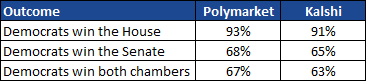
Meanwhile the latest polling data supports the market expectation of the Democrats taking control of the House of Representative, whilst in the Senate they have several routes to a majority, but the margins are more narrow.
Republicans currently hold the Senate majority with 53 v 47 seats. Democrats need a net gain of four seats to reach 51, because a 50–50 Senate would remain under Republican control through Vice-President JD Vance’s casting vote.
USA Today reported that Democrats have a 94% chance of winning the House of Representatives and a 75% chance of winning the Senate.
We should however be wary of polls, especially in US politics. CNN analysis illustrates the breadth of plausible outcomes, with one set of competitive-race assumptions producing anything from 49 to 55 Democratic Senate seats.
The key target states for the Democrats in the Senate battleground are Maine, Ohio, Alaska, Texas, Kansas and Iowa, whilst Republicans are targeting Michigan. North Carolina is also a vulnerable Republican seat, although the latest polling suggests it is less finely balanced than those other contests.
Interestingly, even though this vote does not elect a new President, both parties have put Trump at the heart of their campaigns, and so Trump’s personal approval ratings look like being significant factor in these elections.
Latest average polling data suggests that his net approval rating (simply, those that approve of him minus those that disapprove) is -20% to -22% nationally.
In the key Senate battleground states his approval ratings are poor:
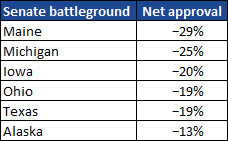
If however, we look at his approval ratings amongst “MAGA” supporters, we see a different picture, where his approval ratings remain exceptionally strong. The latest Economist/YouGov figures give Trump a net approval rating of +89% amongst self-identified MAGA supporters. The same poll also showed that 64% of MAGA supporters “strongly approve” of Trump.
MAGA supporters however should be distinguished from Republicans generally. Amongst the wider Republican cohort his approval ratings are lower with a CNBC poll finding an 82% approval rating and FOX News coming up with a 76% approval rating.
Trump’s immediate electoral weakness therefore is not a collapse of loyalty among his committed MAGA supporters but is the gap between that core and the voters beyond, which explains the huge emphasis being placed on mobilising Trump’s base and getting voters to turn out and vote Republican.
Whether that group of support is large enough — or will turn out strongly enough — to offset opposition elsewhere remains to be seen.
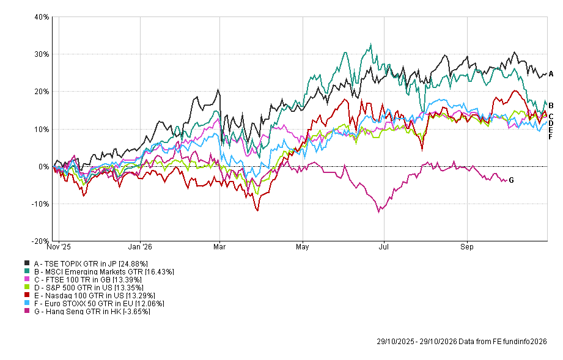
Where are markets up to?
The rolling 12 month % cumulative returns in local currency from various indices is shown in the following chart:
Where are the portfolios up to?
The portfolio performance, net of fees, to close of business on Thursday is as follows:

As ever, if you would like to discuss any aspect of your portfolio, please do not hesitate to contact us on service@blythefinancial.com