
It certainly feels like AI is the only game in town as equities continue to look through the energy crisis during a week in which the head of Britain’s intelligence, cyber and security agency warned that the West is facing a narrowing window to counter cyber threats from China (as a science and technology superpower with sophisticated, advanced capabilities across its military, cyber, and intelligence agencies) and Russia (which is intensifying hybrid warfare through relentless cyber-attacks, sabotage, and physical attacks on critical infrastructure and democracy).
Former CIA chief David Petraeus highlights the growing danger of drone swarms and repeated the warning that western militaries are ill equipped to deal with them. Reports today of a Russian drone hitting NATO state Romania do little to ease any of these concerns. For Russia, this hit may represent tit-for-tat retaliation to Ukraine’s ability to strike deep within its own territory, something we illustrated in the 15th May update, and Moscow has even gone as far as passing law to allow its central bank, its largest bank, and state-linked cash collection agencies to down drones – albeit this may simply be an attempt to pass defence costs away from the Kremlin.
America’s explosive rush to develop AI infrastructure may ultimately be judged by history as astute, rather than a gluttony of excess driven by hype.
President Trump’s tact continues to grate in this environment of rapidly evolving military technology, as he threatened to bomb the long-standing neutral Middle Eastern nation of Oman if “they don’t behave just like everybody else,” after it emerged they were in discussions with Iran over a post-war arrangement to jointly manage shipping through the Strait of Hormuz which included a maritime service fee.
The supply-side risks of the energy crisis continue to coil like a spring, and it is in agriculture that the biggest consequence may emerge. Natural gas prices spiked this week as Hormuz choked Asian-bound LNG flows, and we are starting to see the secondary effects as industrial ammonia and nitrogen fertiliser plants start to shut down across Eastern Europe.
A shortage of fertiliser mixed with extreme spring weather has agricultural economists formally warning European and UK farming networks that they are sleepwalking into a structural food crisis. Internationally, a super El-Nino could send ocean temperatures 2-3 degrees higher, disrupting Asian monsoon systems and causing torrential rains in the Americas. These risks compound.
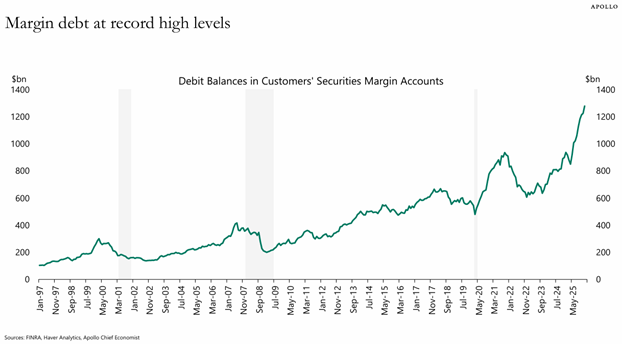
For as long as global economic growth remains unimpaired, investors will treat these circumstances as opportunities instead of risks as expressed in the record high levels of margin leverage utilised to feed the momentum. It is increasingly interpreted that any economic shock will likely be inflationary or met with inflationary policy, thus the combination of secular growth stories (to dampen the risks presented by stagflation) and risk-assets (to protect capital against runaway fiat-currency devaluation) make for the most attractive investments. With AI driving the entirety of US economic growth it increasingly appears to be the only game in town.

Torsten Slok, Apollo Global Management Chief Economist, highlights the infiltration of AI in both equity and fixed income investments and notes that the focus for diversification and investment risk mitigation is less about equities versus bonds and increasingly about AI vs Non-AI.
The opportunities in AI have been broad but the boom for memory chip producers has been exceptional, producing three new trillion-dollar companies, with gross margins likely at peak but production expansion continuing and demand strong. At the start of the year, the supply deficit was expected to persist through 2026 but ease in 2027. Now the market is expected to remain tight for much longer, driving another year of exceptional year returns for these stocks.
The other key area of growth which has garnered much less attention is in the field of optics, specifically silicon photonics, which seeks to transfer data using light at a microscopic level. Then there are the materials required for all these high value manufacturing processes. A joint European-US defence industrial review highlights that expanding military equipment production lines are running into direct bottlenecks for critical minerals and rare earth elements. These AI beneficiaries trade at high valuations which represent the massive market growth potential and will trade on expectations and sentiment until the rubber meets the road.
While the innovators power ahead to provide solutions to the world’s growing financial and demographic problems, with zero evidence so far of job losses from this transformational productivity, the UK grapples with its own employment issues.
The Milburn Report into the number of people under age 25 who are Not in Employment, Education and Training (“NEETs”) garnered a lot of attention in the UK media this week.
The Labour Government-commissioned report finds that there are over 1m such NEETs and is emphatic that this is a “whole system failure”, not a generation unwilling to work. It found that 84% of NEET young people want a job.
The main issues identified by the Report as to why they can’t work are cited as follows:
Mental and Physical Health – the single biggest driver of the recent rise. The proportion of NEETs citing a work-limiting health condition has risen 70% in a decade. Mental health conditions have nearly doubled among disabled NEETs. Crucially, once a young person falls into health-related inactivity, 80% are still NEET two years later.
A Failing Education Pipeline – children not school-ready at ages 4–5 are nearly three times as likely to be NEET at 16–17. Schools are measured on exam results, not on employment outcomes.
Benefits System Traps – only around 1 in 5 NEET young people in England receive meaningful employment support from the welfare system. The benefits structure rewards declaring incapacity rather than supporting capability and participation, creating a perverse incentive to stay outside the labour market.
Shrinking Entry-Level Routes – the number of entry-level jobs has fallen 66% between 2007 and 2022 according to the review. More than 10% of UK jobs are classified as “insecure” (variable hours, low pay, limited rights) which deters rather than attracts young people. The labour market simply is not absorbing even well-qualified young people where 30% of NEETs have good GCSEs, 21% have A-level equivalents, and 15% have a degree.
Geographic Mismatch – vacancies are concentrated in wealthier areas, far from where NEET clusters tend to be, and public transport links to access them are often poor.
A Broken Transition Point at Age 18 – at 18, the NEET rate nearly triples. Statutory participation duties end, local authorities stop tracking young people, and no alternative support system picks up the responsibility.
Without intervention, the Milburn Review projects the figure could reach 1.25 million by 2031, costing the country an estimated £125 billion per year, more than the entire annual education budget.
Keir Starmer, the UK Prime Minister, described the findings as “sobering” and indeed taken in isolation the findings are sobering.
What we need to consider however is whether or not the report presents all of the information or whether it has been selective in its approach.
The first concern is that the report author, Alan Milburn, is by nature a left-leaning politician and was a member of the Labour Government ousted in 2010.
His “system failure” diagnosis of course protects the current Labour Government from direct criticism.
Milburn was commissioned by Labour’s own Work and Pensions Secretary, Pat McFadden. The “whole system failure” of education, health, and welfare conveniently attributes the problem to institutional structures that have accumulated over decades under multiple governments, rather than specifically to Labour’s recent policies. This is politically convenient for the party that commissioned the report.
The report however actively downplays Employer National Insurance and Minimum Wage policy directions implemented by the Labour Government. It also completely ignores significant changes to industrial and employment laws and regulations on employee rights.
The report states that “there is no clear evidence” that the rise in employer National Insurance Contributions played a major role, and that minimum wage increases were not the “root cause.”
Yet Milburn himself is on record as saying he would urge the government to reconsider both, stating “every employer I engage with expresses the same sentiment.” He can’t really have it both ways.
The Federation of Small Businesses has explicitly stated that rising employment costs are “a significant factor” and that ministers “cannot overlook” this. Rachel Reeves’ £25 billion NIC increase is a recent, measurable policy choice that the report actively deflects blame from.
This “84% Want to Work” statistic is repeatedly used to dismiss what Milburn calls the “cruel caricature” of a lazy generation. The problem with the statistic, though, is that it comes from a self-reported survey commissioned for the review itself, which carries obvious response bias.
People are likely to say they want work when asked directly, regardless of the complexity of their actual behaviour and choices. The figure is not independently verified and is used to pre-emptively shut down any supply-side argument about work ethic, benefits attractiveness, or cultural attitudes, which are legitimate areas of debate.
On the attraction of benefits, Milburn makes the striking finding that the government spends 25 times more on benefits for young people than on employment support.
Surely a sensible response to that would be to reduce benefit generosity to improve work incentives. Milburn’s framing however is the opposite — spend more on employment support rather than reduce benefits. The data point is used not to question whether benefit levels are too high, but to argue for more state intervention and spending.
The report also briefly dismisses immigration as a driver of the crisis, on the basis that NEET rates have been high for a long time. But the specific question of whether recent high net migration has compressed the entry-level job market (particularly in sectors like hospitality and construction where young people traditionally get their first jobs) is not seriously interrogated. That is a notable omission given the political salience of the issue.
Finally, the historical baseline is selectively chosen, with the report comparing today’s NEET rate to pre-pandemic 2019 (10.7%) to show deterioration.
If you look at the data however, the NEET rate barely fell below 10% for 25 years even during periods of economic strength, meaning this is partly a chronic structural problem that predates any particular government.
The sharp rise since 2021, which coincides specifically with the post-pandemic welfare expansion and the embedding of remote/flexible working norms, is treated as a long-run system failure rather than as a recent policy-driven shift.
To be balanced though, the long-term decline in entry-level jobs (down 66% since 2007), the geographic mismatch in vacancies, and the genuine rise in mental health conditions are real, independently verified trends that are not politically manufactured.
The NEET crisis does have deep structural roots. But the interpretation of why those roots exist, and what should be done, is where Milburn’s political instincts — state investment, system reform, employer obligations — clearly shape the conclusions.
Shadow Work and Pensions Secretary Helen Whately’s response put it plainly:
“[Labour’s] jobs tax, capped apprenticeship funding, and keeping young people dependent on welfare have made it tougher for them to secure their first job.”
That is not an unreasonable counter-reading of the same dataset.
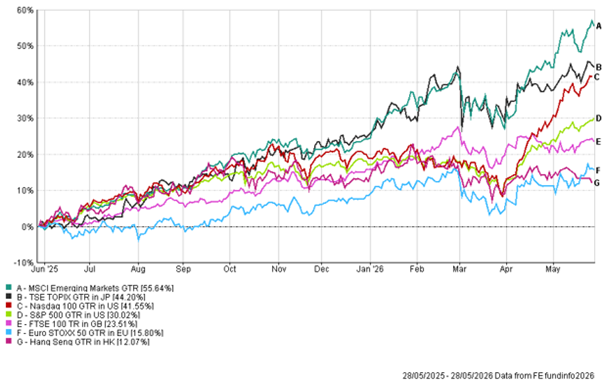
Where are markets up to?
The rolling 12 month % cumulative returns in local currency from various indices is shown in the following chart:
Where are the portfolios up to?
The portfolio performance, net of fees, to close of business on Thursday is as follows:

As ever, if you would like to discuss any aspect of your portfolio, please do not hesitate to contact us on service@blythefinancial.com.