In a week in which President Trump, quite seriously, said that his ultimate intervention in the bond markets could come from the US military, and he signed, yet another, Executive Order renaming Lake Ontario to Lake America in retaliation for the Canadians walking away from his Trade Deal, you could be forgiven for thinking that we are living in some kind of parallel universe to one we normally occupy.
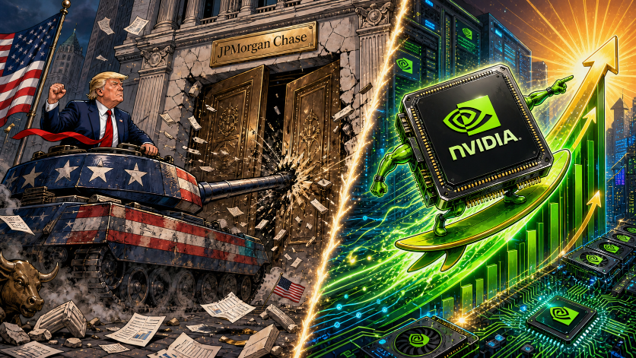
Whilst we have spent probably more time than we should thinking about how the military could intervene in the bond markets (carpet bombing the yield curve? Tanks smashing down the doors of JP Morgan on Wall Street?), what is now underlined more than ever is that the markets have taken to completely ignoring Trump’s outbursts and have carried on regardless.
The long-dated bond yields that we discussed in last week’s update have calmed a little this week, but not because of Treasury Secretary Bessent’s interventions. No, good old fundamentals have been the architect of that particular move, with Qatar and Iran, working independently of the US, to start moving traffic through the Straits of Hormuz.
This sentiment was bolstered by rumours of discussions restarting in respect of reaching a longer lasting settlement in the region and including both the US and Iran.
As a result, the price of oil declined, inflation expectations followed suit and as a consequence the yield on longer dated bonds retreated. That shows that the power of the market is far stronger than even the mighty US Treasury.
These moves do not address the fundamental problem of US debt -to-GDP ratio and the absolute size of the amount of US debt in circulation, but it does show that economic forces are inextricably linked to market performance.
Equities have rallied, also in part due to same news flow, but also in reaction to the waning of (some) scepticism about just how strong the AI boom is and just how circular the financing of the industry is.
The $5tn tech giant and standard bearer for the industry, Nvidia, published its quarterly results on Wednesday evening and the numbers were truly staggering:
- Revenue for the quarter $96.2bn
- Projected revenue for the current quarter $108bn
- Projected revenue increase for 2027 70%
In respect of the “circular financing” discussion, Nvidia was at pains to point out that about 25% of their revenue is derived from the clients for whom they have provided funding. They also made the argument that the circular fund is not a problem and in fact is expanding their industry at a pace that couldn’t be achieved by relying solely on traditional financing routes.
We question whether circular funding is actually circular funding anyway. The concept of vendor financing is as old as the hills and sits quite comfortably alongside other financing mechanisms – the Trade Debtors line on any balance sheet is exactly the same thing. Admittedly though this so-called circular financing is on a scale and term much larger than traditional vendor financing.
We do however think that at its current scale the circular financing is not a problem – if these companies were subsidiaries of Nvidia, would anybody really care if the parent company financed them in this way?
Also, provided those companies benefitting from the funding are growing their balances sheets and generating revenue and profit (or at least have a clear line of sight to profit) then it doesn’t appear necessarily problematic.
Turning back to the US bond market, what has become apparent is that the US Treasury (via Treasury Secretary Scott Bessent) and the US Federal Reserve (via its Chair, Kevin Warsh) are now effectively at loggerheads.
The tension around this matter has been intensified by Stanley Druckenmiller (a Wall Street Grandee and legendary hedge fund manager, and a mentor of both Warsh and Bessent) wading into the argument noting that the market sets the level of the long term yields, is the “most important price in the world” and is “the only fiscal disciplinarian the US has left”, thereby inferring that the US has abandoned all other fiscal discipline.
All eyes are therefore on Kevin Warsh’s set piece speech today at the Jackson Hole Symposium of Central Bankers where market observers (us included) will be keen to see if he makes any comments regarding bringing the Fed in line with Treasury or whether the battle between the two will intensify. Also, we will be looking for comments and clues about where the Fed now sees it’s role and the future path of US rates and the size of the Fed’s balance sheet.
Underpinning most of the themes examined in this week’s update, is a growing feeling that the looming Mid Term Elections in the US in November are driving an increasingly desperate agenda for POTUS and the leading acolytes in the Trump Administration.
There is increasing speculation that Trump may lose control of one or both chambers of Congress, which will in effect mean that he becomes a “lame duck” President for the remainder of his Presidency. It is also conceivable that in the event he loses control of both the Senate and the House, he will be faced with impeachment proceedings for the third time.
It is probably fair to say that we can expect more moves aimed at bolstering Trump’s popularity with his core support in the coming weeks and, in the event that he does lose significant ground in the Mid Term Elections, we will see a series of “fireworks” over the legitimacy of that result.
Where are markets up to?
The rolling 12 month % cumulative returns in local currency from various indices is shown in the following chart: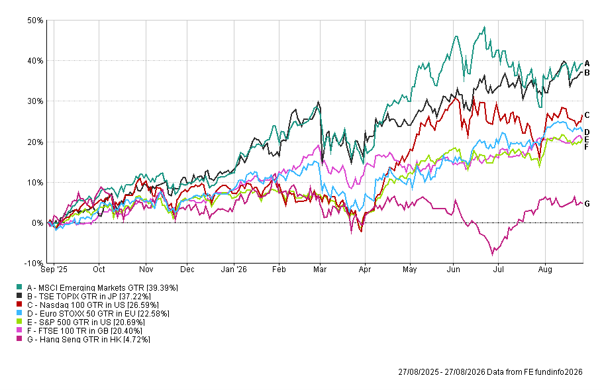
Where are the portfolios up to?
The portfolio performance, net of fees, to close of business on Thursday is as follows:

As ever, if you would like to discuss any aspect of your portfolio, please do not hesitate to contact us on service@blythefinancial.com