Economic developments continue to be dictated by the back-and-forth negotiations over transit through the Strait of Hormuz. Reports of a diplomatic exit ramp that emerged on Monday suggested Tehran might suspend nuclear advancements in exchange for relief from the US blockade, and President Trump indefinitely extended the ceasefire, but this optimism remains tempered by the apparent lack of physical progress in the Strait.
A trickle of traffic made it through over the weekend, but the IRGC has continued to demand transit fees (now in bitcoin to bypass banking sanctions) and since seized or fired on container ships under the accusation that they were operating without authorisation. The US continues to apply economic pressure by seizing Iranian vessels carrying oil, and President Trump has issued a shoot-and-destroy order against any new Iranian mine deployment.
The standoff persists. The consequence is a gradual grinding higher of both crude oil prices and bond yields as inflation remains a key concern. There are, however, limited concerns of a protracted hit to the global economy with equity markets paying far more attention to corporate earnings and the persistence of AI capex.
The technology sector remains bifurcated with a marginal recovery in software insufficient to reverse newly ingrained sector scepticism while, in contrast, there was a clear renewed optimism towards the physical backbone of AI as hardware and chip giants continue to thrive and spending plans continued to build. This is most poignantly illustrated by Meta’s plans to cut 10% of its workforce, not as an outright cost-cutting measure but instead a deliberate redirection of capital towards tech infrastructure.

Intel reached an all-time-high following news of a major US government grant for its Ohio ‘Silicon Heartland’ facility, potential contracts with Amazon and Alphabet, and its partnership with Elon Musk’s Terafab. The high-bandwidth-memory bottleneck remains a key driver of momentum, set for a tight market throughout 2026. It is in helping to address this that AMD is improving its GPUs’ market position having added more capacity than Nvidia to its top end models. The company is also maturing in its software proposition, which potentially removes the friction of switching from Nvidia to AMD for major hyper-scalers.
Companies specialising in AI chip cooling are also back to the races with record order books as the pre-Iran war momentum trade is revived, helped by ample leverage from quant and momentum traders. It is perhaps unsurprising that corporate results would be optimistic, given the effects of the energy crisis have barely reached the real economy, and maybe we won’t look back – after all the world can’t sit idly by as a single country constrains such a critical trade route.
Unfortunately for economies that are reliant on LNG, a protracted structural tightness will likely erase the anticipated 2027 supply glut because the time to restore the damaged specialised refrigeration turbines at Qatar’s Ras Laffan is now worse than previously expected – up to five years – owing to shared supply chains with AI infrastructure. Energy fortress nations like the US, France, the Scandinavian states, Australia and Canada are relatively well insulated from the negative effects.
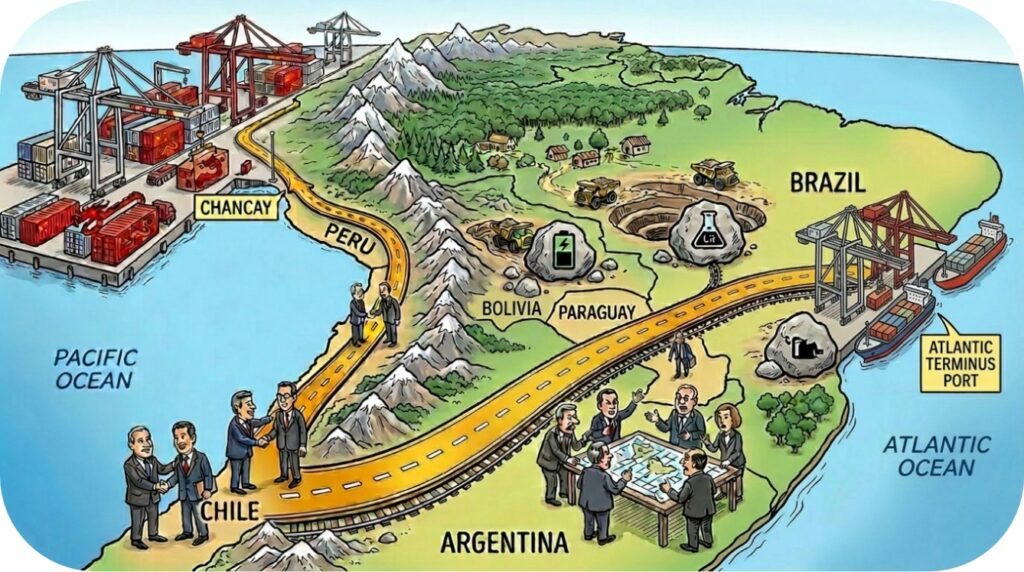
While the world is distracted by events in the Middle-East, China continues to solidify its Latin American pivot. Following the successful opening of Peru’s Chancay megaport, Chinese state-owned giants have secured new contracts for high-speed freight locomotives designed for the Bioceanic Corridor – A massive railway project connecting Brazil’s Atlantic ports to the Pacific as a direct challenge to the Panama Canal’s regional dominance.
Crucially, eleven satellite ground stations have been integrated into the infrastructure to ensure that the throughput remains tied to Beijing, not Washington. While US lawmakers scramble to incentivise port buybacks to regain control over Lat-Am logistics, the momentum currently resides with China’s development and offtake strategy, which is successfully locking in critical mineral access.
Chancay, as the first deep-water port on the Pacific coast that is capable of handling the world’s largest container ships, has also raised alarms over its dual-use capability, potentially allowing Chinese naval vessels to dock under the guise of commercial repairs.
The other security issue which has been on the radar this week is the leak of Anthropic’s exceptionally powerful Mythos AI model to unauthorised users. This has rapidly developed into an immediate crisis, as global regulators now fear that the model’s ability to identify decades-old ‘zero-day’ vulnerabilities could be used to exploit the financial system.
US Treasury Secretary Scott Bessent and sitting Fed Chair Jerome Powell convened an urgent, closed-door meeting with Wall Street CEOs and legacy patching cycles have been declared a systemic risk. European regulators are auditing banks on their software visibility depth and may require financial institutions to hold extra operational risk capital if they cannot efficiently patch these vulnerabilities.
Where are markets up to?
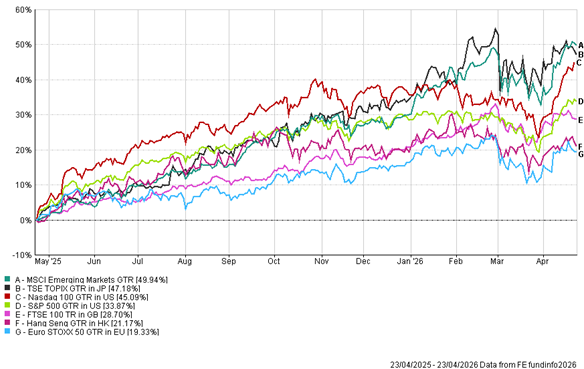
The rolling 12 month % cumulative returns in local currency from various indices is shown in the following chart:
Where are the portfolios up to?
The portfolio performance, net of fees, to close of business on Wednesday is as follows:

As ever, if you would like to discuss any aspect of your portfolio, please do not hesitate to contact us on service@blythefinancial.com.