Stronger than expected UK employment and inflation data opens the door to a dovish interest rate hike in November which spurred a rebound in pound sterling this week. It was merely a silver lining ahead of the Autumn Budget next week, the anticipation of which has trashed consumer confidence, posting the steepest monthly drop since the onset of the pandemic, and before that Brexit.
Rising energy prices aren’t helping matters with resumed strikes on energy processing facilities in Saudi Arabia re-introducing risk premiums into Middle Eastern oil supply lines. Oil prices have climbed as a result, despite the efforts of President Trump to ease markets with an executive order to waive Russian sanctions that were due to kick in this month.
Trump also formally designated US petroleum production, refining, and pipeline infrastructure as essential to national defence under the Cold War era Defence Production Act which unlocks direct federal subsidies, loans, and expedited permitting to fast-track domestic refinery upgrades, pipeline expansion, and fuel storage.
The deteriorating energy story helped intertwine negative news into a bearish shift in momentum in technology stocks which follows a revaluation of AI-related debt last week and a strong six-month run for semiconductors.
The flop first day of trading for Elice, a South Korean datacentre company, in which the stock price fell 32% despite its listing being almost 400 times oversubscribed, catalysed a broader sell-off in Korean markets. This level of volatility is becoming commonplace for Korea, which has experienced four ‘Black Tuesday’ crashes this year alone, but this time was unique in that it spurred equally volatile trading in other Asian stock markets, including Japan and Taiwan.
We have noted in previous weeks that the winter presents a risk for these economies as they rely heavily on natural gas in their energy mix while possessing limited storage capacity. Heightened energy disruption risks therefore present a good reason to reduce exposure.
But that’s only half the story – Investors are increasingly worried that actual monetisation and revenue growth are not keeping pace with the tens of billions of dollars being poured into AI infrastructure. With big tech earnings imminent, a certain amount of derisking is sensible, given often sky-high expectations.
The other risk which rapidly approaches is next week’s Bank of Japan interest rate decision which if accompanied by very hawkish commentary could spur a brief unwind in the Yen carry trade, and a repatriation of Japanese capital from US Treasuries, albeit market pricing has already shifted to factor that latter risk, and the broadly increasing competition for capital, over recent months. We don’t expect Japan is able to take this path at this time; thus it is more likely just a date in the calendar to move beyond.
Under the hood, there has been significant sector rotation as technology has sold off, with Healthcare, Consumer Staples and Utilities performing well. Treasuries also proved their risk diversifying worth. With momentum stalling, the bears have reared their ugly head, but markets appear to be settling into the weekend, and investors are left trying to determine whether this is the beginning of something sinister or a mere commonplace blip.
Nvidia CEO Jensen Huang reminded investors that Neocloud demand is ‘off the charts,’ imploring investors to focus on the strong underlying fundamentals of the technology.
However, Torsten Slok, Apollo’s Chief Economist, highlights some potential system fragility in that 80% of the top 1% of AI spenders are venture capital backed.
He also emphasises the record business formation as a result of AI and indicates that monetary policy is not restrictive, which in combination with loose fiscal policy merits a positive outlook for risk assets.
So, we’re not throwing the baby out with the bathwater just yet – and, incidentally, that Korean Neocloud stock is trading back above its IPO price as we head into the weekend.
China is another economy which has been surprising to the upside with strong GDP growth and industrial production data this week alongside resilient unemployment figures.
In contrast, France is facing a severe fiscal and political crisis that has pushed its government bonds, known as OATs, to a 24-year high. The government is struggling to pass a tough austerity budget meant to cut billions in spending and lower the national deficit as debt to GDP looks set to breach 120%.
Mass demonstrations broke out over the weekend with over half a million people taking to the streets across major French cities to protest soaring fuel prices, inflation, housing costs, and underfunded public services like schools.
Violent fringe groups and opportunistic rioters looted and ransacked thousands of businesses causing hundreds of millions of euros in damages, hardly aiding efforts to balance the books.
President Macron and his wife were snapped attending a Celine Dion concert on the eve of planned protests, an image that has drawn parallels to King Louis XVI and Marie Antoinette on the eve of the French Revolution.

Where are markets up to?
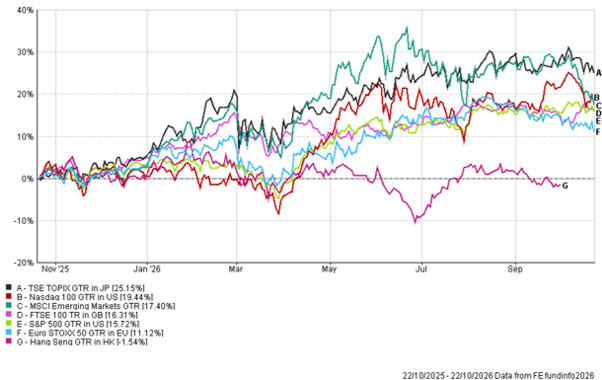
The rolling 12 month % cumulative returns in local currency from various indices is shown in the following chart:
Where are the portfolios up to?
The portfolio performance, net of fees, to close of business on Thursday is as follows:

As ever, if you would like to discuss any aspect of your portfolio, please do not hesitate to contact us on sservice@blythefinancial.com.