The US has an extremely impressive economy, but it is currently backed by an equally extreme fiscal circumstance; the country has issued a massive amount of debt, with the outstanding now standing at $40 trillion. Its debt-to-GDP ratio is 125% and that is a figure which is growing at a tremendous rate owing to a large, persistent budget deficit.
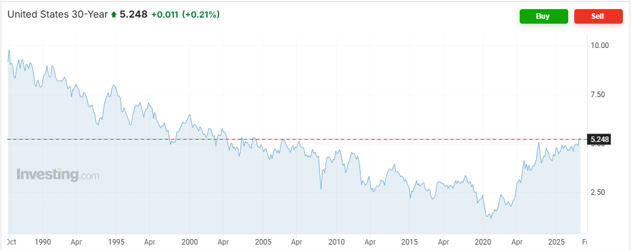
With debt levels so high, fiscal concerns now dominate bond markets and overshadow the Federal Reserve’s power to control inflation and steer the economy and, with inflation levels in question, long dated bond yields have hit highs not seen for 20 years:
Against that backdrop Scott Bessent, US Treasury Secretary, has stepped in, instead of the Fed, to buyback longer dated bonds in an attempt to stop yields from rising further.
That at least is the theory but as the following chart of the yield on the 30 year Treasury Bond shows, the move, for now at least, can only claim a partial success:
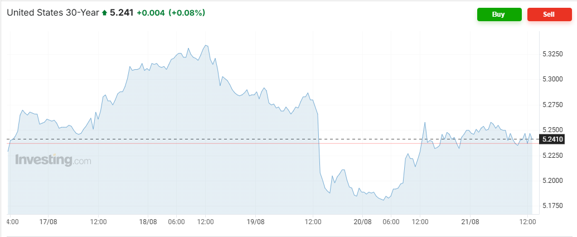
The steep fall in the yield around midday US time on 19th August is the immediate response to Bessent’s move, which then reversed almost 2/3rds of the way back up as the market evaluated the move.
The market verdict is that the move is largely just signalling, an attempt to limit the volatility of these assets, but the action further increases the amount of shorter dated debt in issuance. A heavy reliance on short-dated debt issuance is risky because it leaves the economy open to the risk that even a brief inflationary shock puts a temporary but huge interest burden on the government.
The move by Bessent has been dubbed as “a band aid on a bullet hole” given that the purchases amount to just $4 billion, a tiny fraction of the $40 trillion outstanding. Bessent’s reassurances that the US borrowing is now at a peak and that growth in the economy will see the debt to GDP ratio significantly reduce, have received a lukewarm reception given the lack of any policy announcements to back up that stance.
Ignoring the political spin though we do see that it is possible (probable?) that the US can find its way out of this current predicament, in part through the programme commenced by Bessent.
The US cannot go bust; the financial system is built on the premise that governments cannot default on debt issued in the country’s own currency. This is what gives everyone the confidence to use pieces of paper for the trade of goods and services. It is also what creates the phenomenon of inflation.
The ‘out’ for the government is that their central bank can increase the amount of money in the system. If everything else stays the same, more money means it has less value – this is inflation. This is less concerning in a vacuum, but when that domestic money can be exchanged for foreign money, it puts immense downward pressure on the value of the dollar.
If investors expect a weaker dollar, they also demand extra compensation for lending, thus borrowing costs can drift higher, further increasing the interest rate burden and squeezing the economy in a self-reinforcing inflationary feedback spiral.
The mechanism by which debt is inflated away is called financial repression, whereby the interest rates on government debt are below the inflation rate and thus lenders lose money in “real” terms while the debt pile equivalently shrinks “real” terms even if not in nominal terms.
For now, “real” US interest rates are positive, and that offers a tactical window for investors holding bonds that mature in just a few years’ time, allowing them to capture decent yields today but without losing too much to any additional inflation stoked down the line.
Owning bonds that mature decades away represents the risk of being locked in through a period in which financial repression is in force.
The Treasury takes the other side of that trade, if there are plenty of long dated bonds in circulation, the scale by which it can reduce its debt burden through financial repression is increased.
This however belies a problem of late. The US has increasingly relied on issuing shorter-dated debt. While this gives the Fed greater mechanical control over its debt interest payments, because it sets the interest rates which are borne by shorter dated debt, it must also repeatedly refinance that debt year-in-year-out. That means finding buyers or printing more money.
Lower interest rates, while beneficial by reducing the deficit, are a key input to the value of the currency. If an investor can earn a higher interest rate elsewhere, that other currency becomes more attractive thus appreciates relative to the dollar – i.e. the dollar weakens. Thus, we are back to the inflationary spiral (the cost of imported goods in dollar terms moves higher) which puts more pressure on the currency.
With limited long-dated debt reducing the potential for financial repression, it is self-evident that printing money won’t solve any real economy problems.
There are only two other ways to start bringing down government debt levels and they are:
i) reducing the deficit, by increasing taxes or cutting government expenditure (austerity); or,
ii) growing the economy, either outright or by improving productivity.
(Note that austerity and taxes can be counterproductive. Austerity is also a political death sentence.)
Fortunately, this comes at a time when technology has offered huge potential for productivity gains and thus the US has engaged in a mammoth “Hail Mary”.
By continuing to pump enormous amounts of liquidity and fiscal support into strategic sectors (like domestic AI infrastructure, semiconductor manufacturing, and industrial reshoring), the government hopes to artificially engineer a massive structural supply-side boom and leap in productivity.
This however also creates the potential for an extreme Boom-Bust scenario, brought to you by the masters of the Boom-Bust cycle.
Recently, it has been all boom but a bust could also be beneficial to the US government in the long-term. It would provide the opportunity for the Fed to reduce interest rates allowing the Treasury to cheaply refinance into long-dated debt and then begin the process of inflating the debt away through financial repression. It’s a win-win for the maverick policy makers stateside, although the social costs of a bust bring a whole raft of other issues.
For now, this is the boom, and the doomsayers should be cautious of calling this a bubble too soon, there is still plenty of liquidity to be thrown at this Hail Mary and there is plenty of runway. There is also the possibility they do manage to grow themselves out of this situation instead – AI is an incredible tool and is developing at incredible speed.
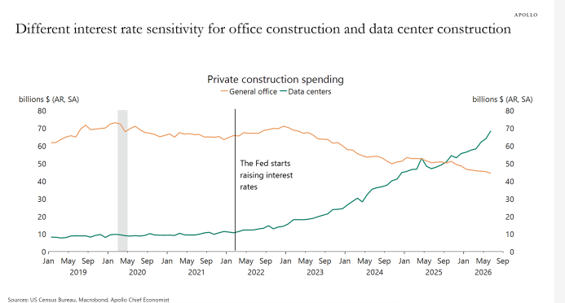
Indeed, there is a growing body of evidence that suggests that, even if we do end up with higher long term interest rates, the AI and data centre boom is largely immune to all of this and, coupled with the One Big Beautiful Bill, growth is inevitable. The following chart from Torsten Slok at Appollo asset Management illustrates:
So, there you have it, that’s why long dated bond yields have risen, and the dollar is on a knife edge, and that’s why gold (and dare I say Bitcoin) has replaced fixed income for many investors. We do however struggle to replace a defined absolute return asset that benefits from structurally driven returns, with a highly speculative lump of yellow metal or a Ponzi Scheme.
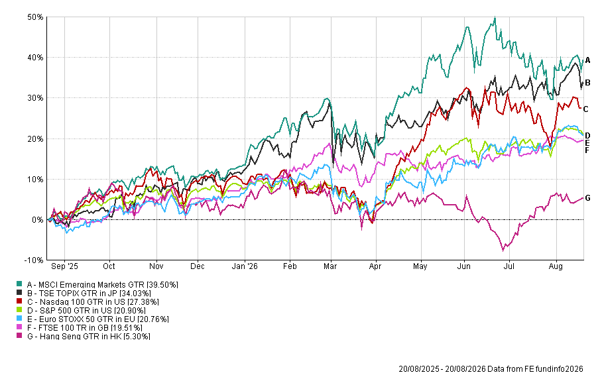
Where are markets up to?
The rolling 12 month % cumulative returns in local currency from various indices is shown in the following chart:
Where are the portfolios up to?
The portfolio performance, net of fees, to close of business on Thursday is as follows:

As ever, if you would like to discuss any aspect of your portfolio, please do not hesitate to contact us on service@blythefinancial.com.