Israel launched a massive strike on Iran’s South Pars gas field and the neighbouring Asaluyeh processing hub this week, reportedly damaging a fifth of Iran’s gas capacity and triggering an Iranian retaliatory strike on Qatar’s Ras Laffan LNG facilities, sending European gas prices 35% higher.
There’s always some nuance in these numbers as they reflect the immediate price change, which makes for a powerful headline, but does not necessarily reflect the price one can pay today for gas tomorrow. There’s also nuance as to who ultimately pays these prices. Take Japan, for example, the country sources two fifths of its liquefied natural gas from Australia, largely under stable, long-term contracts which limit the impact of short-term price volatility.
That’s not to say there is no risk if the situation extends and there seem few material developments to indicate the contrary at this time. However, as retaliation persists, it is increasingly likely that other nations will get drawn into the conflict. Saudi Crown Prince Mohammed bin Salman is quoted, “We have shown immense patience for the sake of regional stability, but we will not stay unresponsive forever.”
For now, higher gas prices mean a higher cost of fertilisers which threatens food inflation once again, at a time when consumers will already be baulking at the higher cost of energy.
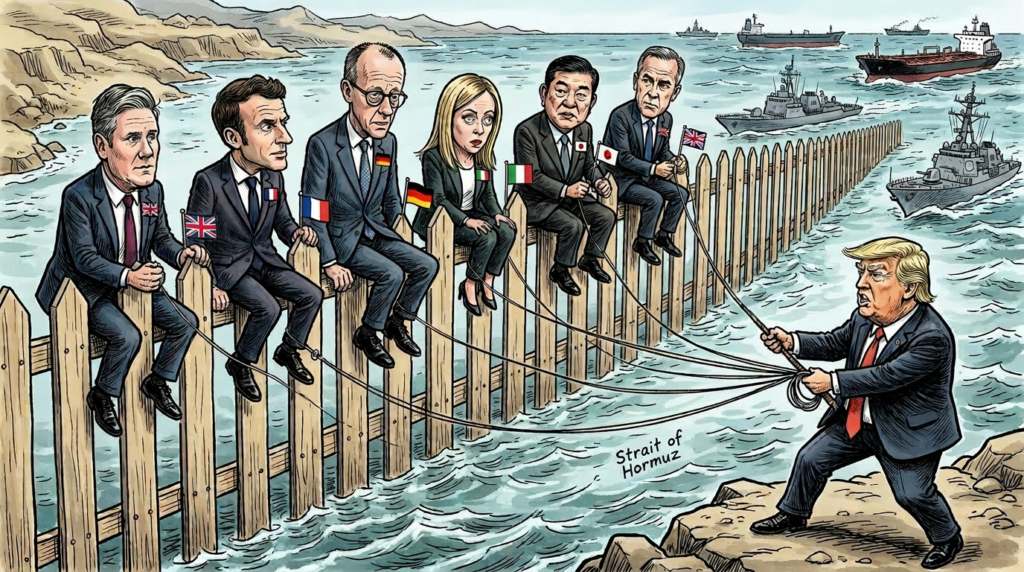
President Trump spent much of the week trying to engage US allies to assist him in keeping the Strait of Hormuz open, at first to no avail with reports of France and Italy in back-channel talks with Iran to allow safe passage of their ships. That may simply be a prerequisite for alternative action and Iran has remained steadfast, with dispensation only for those who “do not facilitate American aggressors.”
As we alluded to last week, it is only a matter of time until net energy importers must take some action if the Strait remains closed, and by the end of the week a unified statement from UK, France, Germany, Italy, Canada, Japan, and the Netherlands labelled Iran’s actions as a de facto closure of the Strait – a critical legal distinction that allows allies to justify naval intervention under international law without technically declaring war.
There were plenty of central bank interest rate decisions this week, and maybe not surprisingly most stayed unchanged as events in the Middle East develop. Federal Reserve Chair Jerome Powell struck a hawkish tone but made some allusions to the potentially temporary nature of some price impacts, without using the word “transitory” for which he has been heavily criticised for incorrectly approaching the inflation environment in 2021.
The general consensus for some gentle monetary easing this year has had to be tempered and short-term interest rates have rapidly adjusted higher. However, the Fed’s recognition of the disinflationary power of AI will serve to anchor interest rates for now. The Bank of England remains very dovish despite inflation risks while the ECB, having run through its cutting cycle more quickly, may be closer to hiking again.
The situation still points to a higher US dollar, but we still haven’t seen as much appreciation in the currency as one might have expected, a good indication that markets maybe still believe this energy shock will be overcome in good time. It’s certainly nice to be looking out the window at sunshine as the northern hemisphere heads into spring, hopefully curtailing the consumer impact of higher gas prices.
The Swiss on the other hand are experiencing a very strong currency which is one of few safe havens in a world where investors are looking for alternatives to the dollar and the yen. The Swiss National Bank broke its recent silence to hint at possible currency intervention to limit the currency’s impact on the economy, but would risk being labelled a “currency manipulator” by the US in doing so.
Gold and precious metals took a nosedive on Thursday, with many of the recent tailwinds temporarily in reverse, particularly the outlook for the dollar, it appears that some of the high levels of leverage in markets of late was unwound.
It’s an unusual move in some ways because the impact of this energy shock is widely expected to be an increased stagflation risk – put simply: higher inflation, lower economic growth. Gold is typically an effective defensive asset under such circumstances, and instead we’re seeing it fall in value.
We have noted in recent write ups, including our end of year commentary and our 30th January weekly update that gold at these high prices becomes more speculative and the demand-supply dynamics around copper may make the brown metal a more attractive structural hedge (or store of value) despite its historically cyclical nature – cyclical meaning its performance relies on the prospects for the economy. This has been evident on the day, falling by a far lesser margin.
It’s a fickle situation for some of these metals because their extraction is very energy intensive, and become more so as ore grades diminish, but most of the world’s future energy scarcity solutions require these materials, the extraction of which is hampered by a lack of energy. An inflationary feedback loop to some degree.
Credit spreads have increased, which is typical when risks increase, but yields have also been under pressure from tech sector disruption from AI and concerns coming from private credit markets. I have held back from commenting on some of the headlines coming out of this space because it very much remains opaque, as it always has been, and that’s why we wouldn’t invest in it.
However, we have noted it as a potential systemic risk, and we have seen numerous funds gating redemptions of late. This alone does not in itself point to a crisis, but Morgan Stanley suggested in a report this week that default rates could climb to 8% if software companies struggle. Defaults in 2025 were 2.1%.
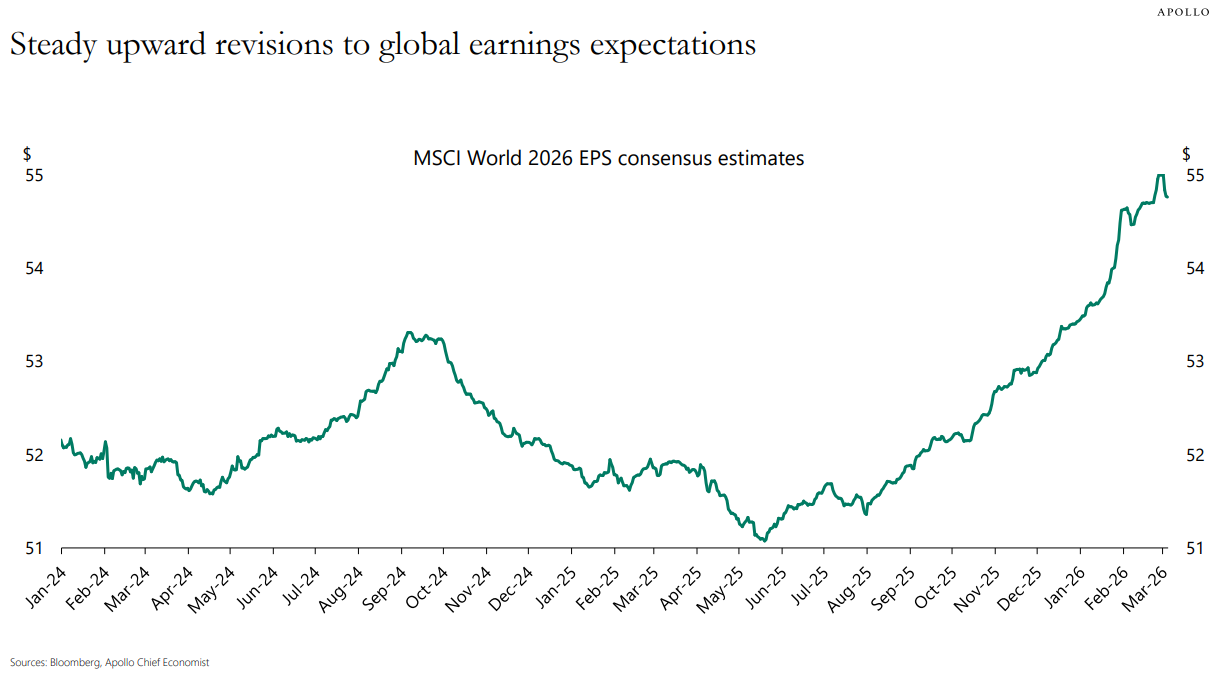
Amidst all this it was a surprise to see a sizable bounce in equities on Wednesday, but they capitulated thereafter, reflecting a market that remains in no man’s land. Maybe this was in response to little concern over corporate earnings which have yet to be dialled back significantly, unlike last year following Liberation Day:
Memory chip maker Micron Technology reported this week, and its CEO revealed that the company is only meeting two thirds of the demand from its largest customers. Memory chips are one of a few bottlenecks in the AI datacentre build-out and producers will be using a huge portion of their current revenue to build new factories. These require expensive, high-end machinery that wasn’t necessary for legacy memory chip production, while also requiring far more space compared to GPU chip production facilities.
With an increasing number of constraints including energy, which is now in a crisis of its own, could AI infrastructure capex slow in 2027? That would signal a downward shift in margins for the “picks and shovel” producers like Nvidia, which this week may have helped navigate that risk by joining the agentic AI space by releasing of a suite of tools designed to make autonomous AI agents. This includes open-source project OpenClaw which has been very popular in China. And they say big companies are bloated and slow moving…
Where are markets up to?
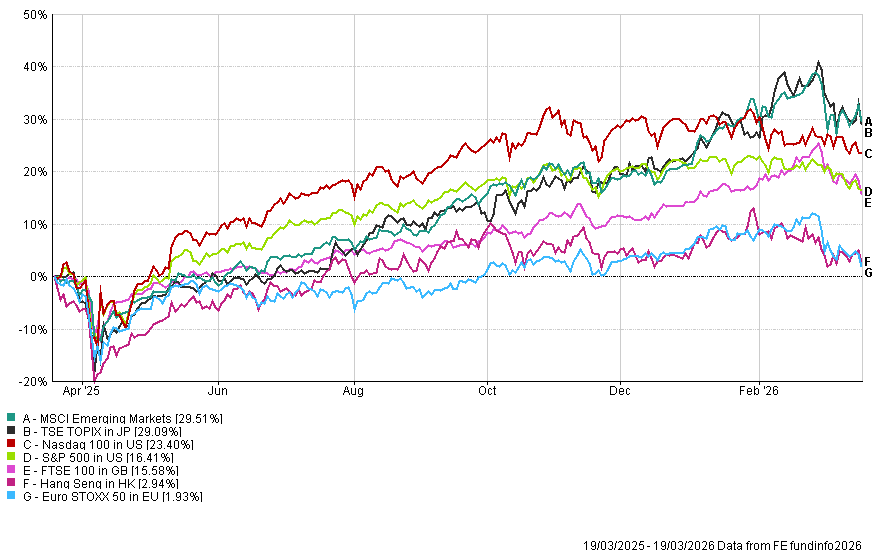
The rolling 12 month % cumulative returns in local currency from various indices is shown in the following chart:
Where are the portfolios up to?
The portfolio performance, net of fees, to close of business on Thursday is as follows:

As ever, if you would like to discuss any aspect of your portfolio, please do not hesitate to contact us on service@blythefinancial.com