More Torque on Inflation, Strait Talking from Iran and Stark Warning from Trump
Recent news media has been dominated by the unravelling of the Epstein files and the gradual momentum building toward actually holding someone accountable for an identifiable crime. The Andrew formerly known as Prince was arrested under suspicion of misconduct in public office on Thursday so it may just finally be an opportunity for the UK to show the US how it’s done, for a change.
On the economic front there is less to get excited about as weak UK wage data and downward inflation momentum strengthened the case for an interest rate cut at the next MPC meeting and this dampened the outlook for sterling. The Chancellor did have something to smile about though, a January budget surplus of £40.9bn was an unexpected boost, driven by an increase in self-assessed tax receipts.
The post-deadline month is always a good data point for the budget though and, unfortunately, higher receipts could indicate that a wealthy cohort is cashing out, maybe ahead of rumoured spring budget tax hikes but possibly as a continuation of the exodus.
Stateside the FOMC minutes suggested that the members are in no rush to cut interest rates which helped the dollar and saw short-term Treasury yields edge higher. There has been a discussion this week about the dichotomy of AI productivity gains and capital intensity which may conflict with each other as to their consequential impact on interest rates.
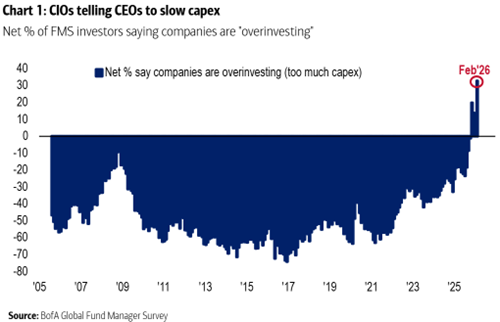
I think what’s missed in some of the rhetoric around massive AI capex and the debt debate more broadly is that corporate debt is not at concerning levels after a steady post-pandemic deleveraging period. Households are not in bad shape either. Yet, investors are more concerned than ever by the spending plans of major firms:
It is really government debt that is too high. So, while all yields may be driven higher by the baseline yields of ‘lowest risk’ government bonds they are also held down by tighter spreads, which keep corporate yields relatively low. This makes sense under these circumstances, as long as faith in the currency is not lost.
In reality, the direction of interest rates has little to do with corporate debt capital requirements and everything to do with the productivity gains associated with them, which impacts inflation and employment, the dual mandate under which the Federal Reserve manages monetary policy.
I think these discussions on interest rates are slowly evolving to allude to the fact that a debt-fuelled investment boom in highly productive assets will lead not to an across-the-board push or pull force on inflation but instead a torque, a twist, where many goods and services will become cheaper but the debt-fuelled additional demand on other goods pushes prices higher.
Commodity markets are already beginning to reflect this perspective, but it may long continue.
The biggest risk to confidence in corporate debt levels comes from private credit markets, which may reveal a scenario that’s not so rosy, but their opacity means we won’t understand the detail until something is already unfolding. Blue Owl Capital has now permanently restricted withdrawals from one of its retail-focused debt funds, spurring concern that this is the beginning of something bigger.
Counter to these concerns is the expectation that the US economy is beginning to roar again with strong industrial production and manufacturing data this week serving to promote this view. After a relatively defensive rotation for capital markets so far in 2026, consensus is growing that cyclicals could be the most attractive part of the market for the rest of the year. These are companies that are more reactive to the boom-and-bust cycles of the economy.
All the while, geopolitical tension builds in the Middle East again as the US increases its presence in the region with a growing likelihood of further strikes on Iran. President Trump issued a stark warning from the inaugural meeting of his Board of Peace: If a meaningful nuclear deal is not reached within 10 days, “bad things” will happen.
Earlier in the week, Iran temporarily closed sections of the Strait of Hormuz, through which 20% of global oil production is transported. They declared that they are in complete command of the waterway and that they are ready to restrict access immediately if ordered to do so.
Crude oil has reacted, with prices moving higher, but not aggressively so, and otherwise the markets have been rather sanguine. The media has been much quieter on the matter compared to recent history, so maybe they are too busy focusing on those high-society files.
What adds a little bit more risk to the current scenario is the three Silicon Valley engineers charged with stealing Google trade secrets and sending data to Iran. This adds a layer of malicious intent -something which I’m sure will be getting President Trump’s back up – and national security may, this time round, be a reasonable justification for action.
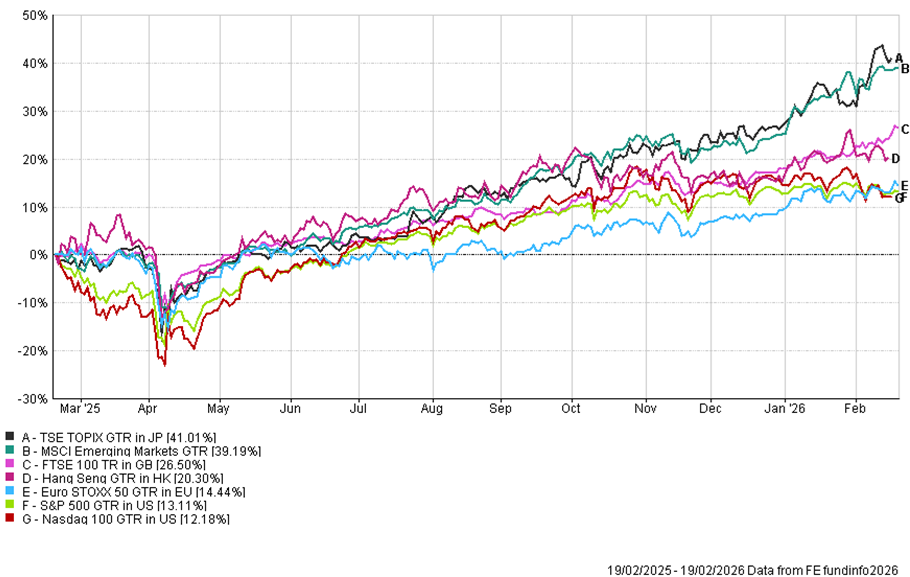
Where are markets up to?
The rolling 12 month % cumulative returns in local currency from various indices is shown in the following chart:
Where are the portfolios up to?
The portfolio performance, net of fees, to close of business on Thursday is as follows:

As ever, if you would like to discuss any aspect of your portfolio, please do not hesitate to contact us on service@blythefinancial.com.