Equity markets have been impressively resilient through a significant batch of volatility in fixed income markets which is ultimately resulting in tighter monetary conditions. This week the US Federal Reserve raised interest rates as expected, but the unanimous decision combined with a dot plot of higher projections, a stronger than expected economy, and comments around discipline and the “removal of some accommodation” have indicated a pivot into a rate-hiking cycle.
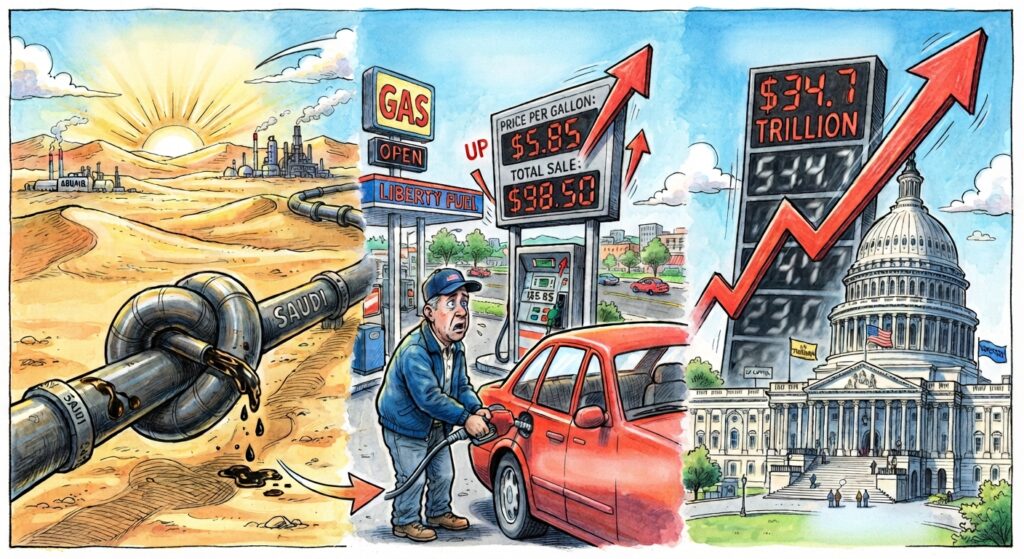
With the removal of forward guidance, it was our view that the deviation of expectations would subsequently be greater on average and thus during times of upward inflation pressure bond yields could be inclined to move more sharply. This has so far been the case with crude oil prices spiking this week after Saudi Arabia’s East-West pipeline closed because a pump station was hit by drone attack.
This pipeline has been picking up significant slack while the Strait of Hormuz is blockaded, allowing oil to be instead transported over land to the Red Sea for onward transit to Europe. The very importance of this pipeline for Europe begs the question; why was it not sufficiently defended from drone attack, but that’s a discussion for another day.
Escalation in the Red Sea provides further oil transit risks with the Houthis having taken the port of Mocha last week and exercising greater control over the Bab al-Mandab strait – the narrow southern entrance to the Red Sea that connects Europe and Asia. The East-West pipeline helps a large volume of oil avoid that route.
A cursory search for how long it may take for the station to be up and running would have given you weeks, possibly months, but it has fortunately since been reported that operations may resume in a matter of days, thus oil prices have peaked and are gently settling lower.
There may be reason to believe that this is indeed just a batch of higher bond volatility which could prove temporary should there be a more positive outlook for inflation, most likely driven by positive developments in the Middle East. In those circumstances could bond yields briefly fall further than expected too?
The counter perspective is that this is indeed a more structural policy pivot, a view that is currently widely promoted, some even likening Fed Chair Kevin Warsh to Paul Volcker, both having absolute focus on providing price stability while electing not to give forward guidance. Volcker was Fed Chair from 1979-1987 and in the first years of his tenure oversaw the most aggressive interest rate-hiking cycle in the modern history of the Federal Reserve following the 70s oil crisis.
The big winner in all this is the dollar which has gained on higher interest rates indicating that yields are not solely moving higher owing to rising fiscal concerns. The Bank of England, in contrast, elected to keep rates unchanged owing to weaker wage data thus the pound weakened.
We expect the yen will begin to weaken against the dollar again after the Bank of Japan duly delivered the expected interest rate hike but did so with dissenters and insufficient hawkishness to get the bond vigilantes back in action or the carry traders on edge. Investors should be glad to see the back of this event as it threatened a reversal of the carry trade which provides a large pool of leverage which ultimately supports equity markets.
The Bank of Japan, however, has been known to provide a one meeting buffer between policy guidance and policy action so we may instead see some jitters at the next meeting which falls just before Halloween.
As for equities, there should be renewed optimism that they took this week’s central bank meetings in their stride, as well as overcoming a capex spending scare after prominent AI executives called for AI frontier labs to deliberately slow the rate of capability advancement to allow time for risk management and safety frameworks to catch up.
US equities have exhibited good performance over the past year, and valuations have also improved over that time so there is plenty of scope for continued momentum, and concerns of overinflated valuations owing to AI overspend or inflating earnings owing to circular financing can be put on hold as a result: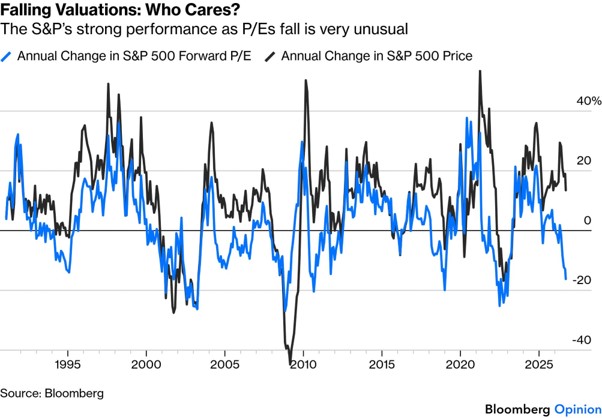
Naturally, President Trump publicly dismissed any safety concerns of artificial intelligence. With the Iran war rumbling on and interest rates ratcheting higher – which means higher petrol prices and mortgage rates for everyday Americans – a slowdown in the AI theme may have been the final nail in the coffin for a Republican mid-term election campaign that has barely got off the ground.
Across the Atlantic the EU welcomed Canada as its first ever associate member, aiming to forge a deep strategic alliance encompassing critical minerals, energy security, and defence capabilities. As to what it means to be an associate member, well that is still to be determined.
Where are markets up to?
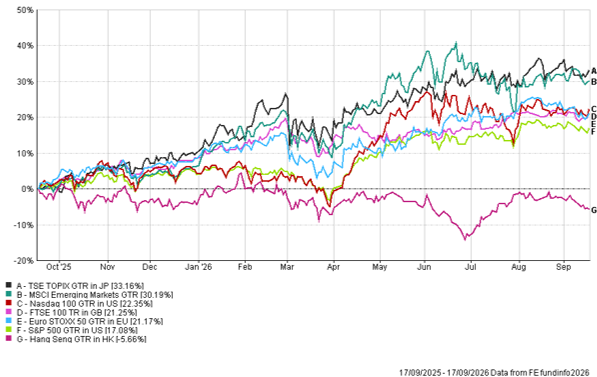
The rolling 12 month % cumulative returns in local currency from various indices is shown in the following chart:
Where are the portfolios up to?
The portfolio performance, net of fees, to close of business on Thursday is as follows:

As ever, if you would like to discuss any aspect of your portfolio, please do not hesitate to contact us on service@blythefinancial.com.