The green transition powers on and is translating into a European economy that’s more resilient to oil and gas shocks. For now, the continent avoids a stagflation shock, or at least it does while the sun is shining. Investors continue to absorb the reality that the global economy is less oil intense and therefore the fears associated with historical shocks of this nature are overblown.
Yet the risk associated with the lack of oil transit still lingers and with each week passing there is upward pressure on energy prices, and an increasing risk that economic growth will be eventually hit by shortages.
While these concerns remain, so does the expectation that the Federal Reserve will maintain higher rates to tame inflation, and that could provide another headwind to both economic growth and asset values. Thus, equity markets are experiencing some profit taking.
There are also concerns over the future path of the hyperscaler giant’s capital expenditure plans as bond spreads for these companies widen a little further. Illustrated by the following graph, the astonishing transfer of capital of last few years has resulted in booming financial results for AI hardware but more questionable balance sheets for big tech. There are two methods by which this reverses – faster AI monetisation or a scaling back of capex.
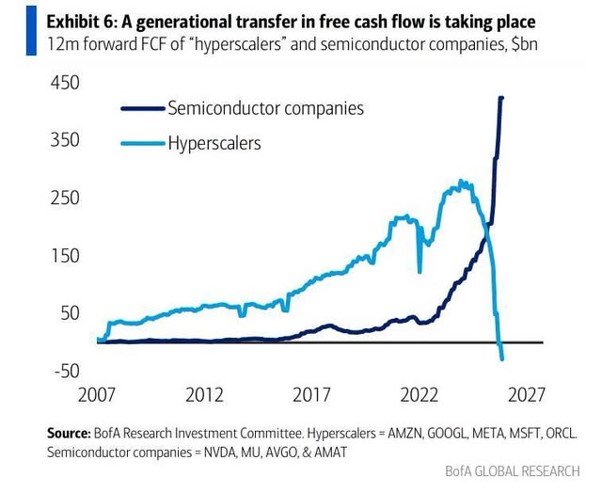
Data ahead of corporate earnings reveals big tech is on track for an unprecedented $800 billion in AI capex for 2026, rising to $1.2 trillion in 2027 – will there be any surprises?
Recent upward revisions to earnings set a very high bar while assets appear to be propped up by record trading leverage (see FINRA margins) and high capital flows to capture the AI boom:

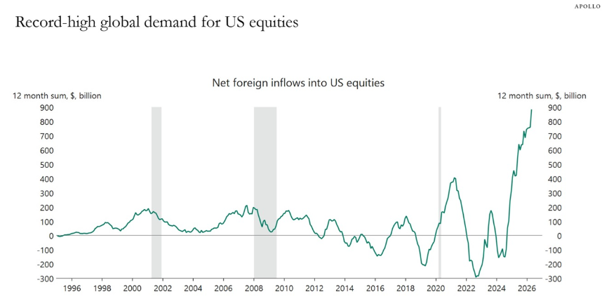
These capital flows into the US, which are also being propped up by the energy crisis, appear to be supporting the dollar which otherwise has been carrying negative sentiment owing to American fiscal excess. It highlights that the safe-haven status of the dollar may very well be heavily tied to the AI trade.
With volatility sitting in a relative lull, semiconductors have been at the forefront of profit taking as investors are redeploying capital into lagging, cyclical, or defensive sectors in anticipation of a resilient broader economy.
These circumstances have had the greatest impact in the Korean equity market, which is again exhibiting extreme volatility; something we have highlighted numerous times of late but once again the level of volatility has increased with a “Black Monday” plunge compounded on Thursday when the Bank of Korea unexpectedly raised interest rates.
The story of economic resilience could wane as winter approaches or if Iran-backed actors expand naval blockades to Bab el-Mandeb Strait.
Then there is the ominously approaching Bank of Japan interest rate decision at the end of this month. While FINRA margins are high, leverage is also being utilised in the form of the Yen carry trade, where US investors borrow in a weakening and low-yielding Yen to buy other financial assets. A brief but sharp unwind in 2024 temporarily roiled markets but has since been a relatively settled issue.
If the Bank of Japan was to shock markets with a more aggressive monetary policy stance, the resulting sharp unwind in leverage would have a powerful impact on asset prices.
However, Japan’s Ministry of Finance has been restrained regarding currency interventions, thus far relying more on rhetoric than action. Such intervention is most likely to take the form of selling US Treasuries to buy the Yen. As the largest foreign holder of US debt, it would make sense to gradually reduce those reserve assets while the dollar is relatively strong before making a policy change that would rapidly strengthen their own currency, resulting in losses on those assets in Yen terms. This graph illustrates that there is probably further to go:

We therefore don’t expect there to be any surprises from the BoJ, come the end of July, and chart a course of gradual policy normalisation but investors will probably be comforted by reaching August unscathed.
In the UK, the pound is responding well to the news that Ed Miliband isn’t the top candidate for Chancellor, instead Shabana Mahmood, a strict centrist who should maintain a fiscally conservative grip on the public finances, is the frontrunner with Yvette Cooper an alternative.
The incoming Prime Minister’s plans are starting to come to light, with a crackdown on the annual £400bn of spending on private government procurement contracts, aggressive devolution, and an expanding state footprint in housing, transport, energy, and water utilities.
While his predecessors aimed to “go for growth” with little strategic vision of how that may be achieved, beyond relying on an ever-shrinking private sector, Burnham’s introspective focus will put him in the neat position where he’ll be able to just make the numbers up.
Where are markets up to?
The rolling 12 month % cumulative returns in local currency from various indices is shown in the following chart:

Where are the portfolios up to?
The portfolio performance, net of fees, to close of business on Thursday is as follows:

As ever, if you would like to discuss any aspect of your portfolio, please do not hesitate to contact us on service@blythefinancial.com.