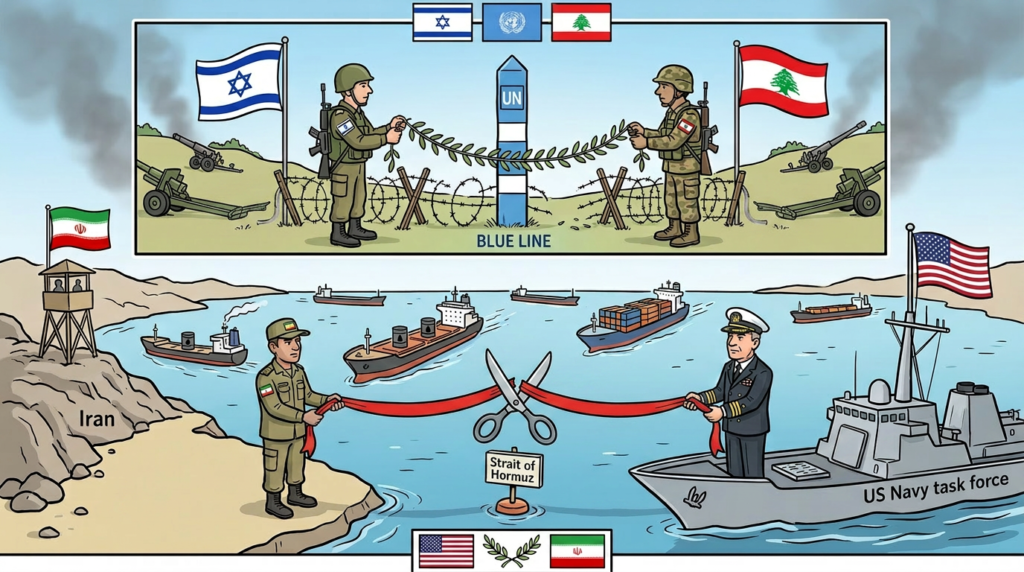
The US has resorted to fighting fire with fire this week, countering Iran’s blockade of the Strait of Hormuz with a blockade of its own. Incredibly, capital markets have been buoyant and look to be pricing as if the conflict is over, at a time when the last oil tankers to traverse the strait before the outbreak of war are reaching their destination refineries.
To some extent this makes sense; the US-led blockade signals a shift in US strategy away from warfare to economic countermeasures and comes after threats to Iranian energy infrastructure. With that infrastructure looking increasingly likely to remain intact, the excess global supply of crude oil should also remain intact, once the transit issues are resolved.
We argued in our quarterly commentary that the most likely solution is increasingly one of combined international pressure and this full blockade forces China, who receive the largest portion of oil that traverses the strait, to react. Reports this week suggest that this is indeed the case as ceasefire talks continue culminating in an agreement from Iran that the waterway will be opened as long as the ceasefire between Israel and Lebanon holds – which has been agreed only for the next ten days.
For now, that will mean the resumption in the momentum of assets which had been performing well ahead of war. There has also been a notable rebound in the AI trade this week, best illustrated by an exceptional surge in digital real estate leasing which has been well reflected in stock prices:
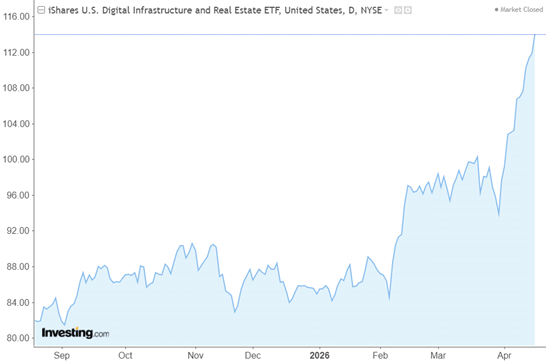
The ramp up in these deals could point to a market which is becoming increasingly constrained by power infrastructure, grid interconnection and critical electrical components, even if there is no indication of a slowdown based on conversations with industry stakeholders. Half of US data centres planned for 2026 have been delayed or cancelled.
Any indication of a forced slowdown in infrastructure capex could stifle the momentum and margin growth of the ‘picks and shovels’ stocks that have so far benefitted most from AI spend. The following chart highlights a slowdown in the lagging data, but it is believed that delayed data will feed through into improving numbers in later quarters:

What’s most stark is the regional dispersion with the US taking a clear lead on AI investment. There is huge dispersion in views as to whether or not the Iran war has been beneficial to the US and the extent to which it will be detrimental to Asian nations including China. With both an anti-US narrative and an artificial intelligence narrative now prevailing, which assets will prove to be best performers from here?
Regardless, the impact of AI appears to be ever present – Anecdotally seeing the rapid improvement through our regular use of it, as a significant disruptor to the software and cybersecurity sectors, and now as a tool to form new businesses:

Still, that’s not to discount some of the obvious hype: Sustainable footwear brand Allbirds is abandoning its shoe business to pivot entirely to AI compute infrastructure. After selling its brand assets for $39 million, the firm’s pivot has achieved a massive 400% rise in the company’s valuation.
Open AI also paid an undisclosed low-hundreds of millions for the Technology Business Programming Network a few weeks ago to secure a direct-to-audience communication channel for shaping the AI narrative and more closely controlling its own public relations.
US corporate debt issuance has so far had a bumper year, 15.6% ahead last year, which will continue to reinforce this cycle’s momentum.
In Hungary, after 16 years of dominance, Viktor Orbán and his conservative Fidesz party were defeated by the newly formed, more central Tisza Party. The two-thirds constitutional supermajority will give new prime minister, Péter Magyar, the power to undo many of the constitutional changes introduced during his predecessor’s tenure, which has been criticised for its corruption, scandals, and crumbling healthcare system.
If the country can reassert EU democratic standards, billions of euros in EU recovery funds which had been frozen due to rule-of-law disputes could be released, triggering a surge in public sector investment.
While President Trump’s complete and total endorsement of Orbán and a last-minute campaign visit from Vice President JD Vance was intended to boost the Republican ally, it may have instead underscored the toxicity of the MAGA brand to moderate voters frustrated by the apparent kleptocracy.
President Trump has resorted to throwing verbal punches with the Pope after promoting himself a Christlike figure in a picture posted by his social media account, which was later deleted. There’s a lot of work to do between now and the mid-term elections, with dour current approval ratings – I wouldn’t discount a surprise though!
Where are markets up to?
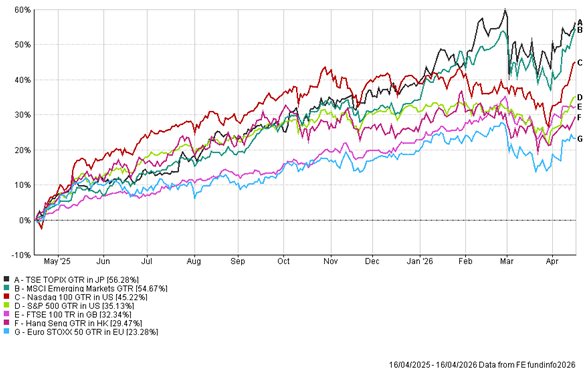
The rolling 12 month % cumulative returns in local currency from various indices is shown in the following chart:
Where are the portfolios up to?
The portfolio performance, net of fees, to close of business on Wednesday is as follows:

As ever, if you would like to discuss any aspect of your portfolio, please do not hesitate to contact us on service@blythefinancial.com.