
Weaker US jobs data last Friday and cooling inflation this week helped temper expectations that the Federal Reserve will be significantly raising interest rates, but the yield achieved on 30-year Treasury issuance this week was still the highest it has been in a quarter century.
With Federal Reserve Chair Kevin Warsh giving little away, not only in terms of the potential direction of travel but also with regard to general policy framework, yields have been heading higher as market sentiment is extending the short-term perspective. That is to say, the market appears to be taking Warsh’s views on current circumstances as forward guidance, even though he has explicitly ended this type of forecasting. The fact that Fed policy could change ‘on a dime’ may be a factor in why yields have headed higher too – to price out some of that risk.
However, there is also a strong consensus building that US long-dated yields should be higher than they are currently, and this perspective is driven by a ‘crowding out’ effect. The current scenario can be explained simply as follows: The competition for capital in both public and private markets is pushing bond yields higher.
With a high US budget deficit continuing to add to an already high level of total government debt, currently sitting at around 123% debt-to-GDP, there are already concerns over fiscal sustainability which alone puts upward pressure on borrowing costs. Add to that the huge amount of private sector investment related to AI and you have a huge desire for capital across the economy.
Typically, the crowding out effect would result in a fall in private sector spending as borrowing costs increase. This time, borrowing is surging on both sides because the AI trend is a unique opportunity for private sector investment, one that will not likely relent owing to a marginal increase in financing costs. Thus, as the competition for capital continues, long-term borrowers should expect higher borrowing costs, and this higher term-premium is what is expected by many macroeconomic analysts.
This is important for the bond market and cautious investors who would typically utilise long dated bonds to provide the capital protection in their portfolios, but it is also important for equities. A jump in yields could hamper future returns, doing so with greater magnitude for companies exhibiting higher growth.
As for whether AI companies are spending too much, there is an apparent backlog in cloud revenue for companies transitioning their data into the cloud ahead of utilising AI tools and agents and this appears to be sufficient to justify current Capex levels. While the free-cash-flow metric turning negative has been rolled out as an indicator of excess, operating cashflow is growing consistently and strongly.
Interestingly, the broader benefits of AI may be coming sooner than we might expect, with Neura CEO David Reger speaking to Bloomberg, as part of their ‘Inside Europe’s AI & Robotics Boom’ feature, suggesting that humanoid robots may begin to take on labour-based tasks within a couple of years. AI may be coming for blue-collar jobs too.
Illustrating this forecast, he explains that it is now far quicker to teach a robot to do some complex actions than it is to train a human. It has become apparent that the humanoid robotics market is expanding with an estimated 60,000 units to be sold this year and China currently claiming 97% of the market.
We must take individual claims from insiders with a pinch of salt as they will be well versed in stoking excitement to raise capital to fund their research and development, but 70% of these robots will find themselves in industry for pilot and early commercial phase deployment so this represents the shift towards real-world deployment.
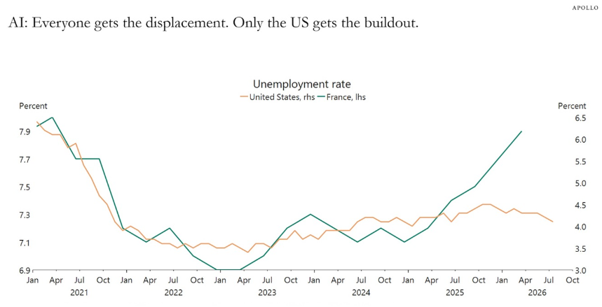
Apollo’s Chief Economist Torsten Slok highlights the issue for lagging Europe, which isn’t yet benefitting from the AI business startups which are providing resilience to US labour markets:
In the UK, despite AI driving 50% of GDP growth we’re less interested in robots and focusing more attention to bins from outer space as the Clacton by-election results are in. Impressively, Count Binface achieved 27% of the vote from which any serious contenders had withdrawn. Farage will use this victory to represent his democratic right to be in parliament despite an ongoing investigation into pre-election financial support he received in 2024, which will now resume – dare I say that despite defeating the space-candidate, he still faces a probe.
While the US and Iran have yet to come to an agreement, crude oil prices have remained surprisingly low but the emerging risk for Europe/UK may be in gas prices with storage levels at the lower end of the spectrum for this time of year as we edge closer to winter.
And finally, there was a flurry of Taiwan-related headlines this week as the country began its annual military exercises, combat-simulated war games and emergency drills to prepare the country for a Chinese incursion or blockade.
While this would typically be a matter of course, Israeli cybersecurity firm Dream has uncovered evidence showing that a swarm of suspected Chinese AI agents targeted Taiwanese government IT supply chain vendors, government email systems, the nuclear safety agency, the Ministry of Justice, and several energy companies compromising 85 government accounts, mapping 21 connected government systems, and exfiltrating more than 2,500 documents and sensitive personnel records.
Determining whether this is a precursor to escalation is difficult: Any escalation would be expected to have cyberattacks as a precursor, but not all cyberattacks are a precursor to escalation. The consensus view is that China would not likely invade Taiwan, instead opting to blockade and disrupt supply-chains and with the US reportedly low on missiles and distracted in the Strait of Hormuz, the apparent window of opportunity to do so would be now.
This could be a key focus in the coming weeks, but with China seemingly accelerating its technology and manufacturing capabilities, it may simply not need to engage with Taiwan to improve its competitive position against the US, which is busy whittling away extra resource on its own wars.
Where are markets up to?
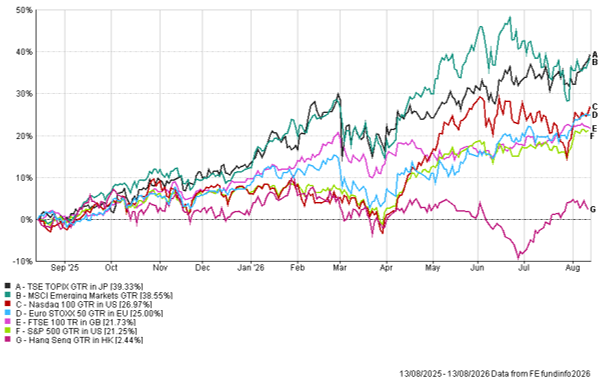
The rolling 12 month % cumulative returns in local currency from various indices is shown in the following chart:
Where are the portfolios up to?
The portfolio performance, net of fees, to close of business on Thursday is as follows:

As ever, if you would like to discuss any aspect of your portfolio, please do not hesitate to contact us on service@blythefinancial.com.