The focus remains solely on the events in Iran with little else of note happening elsewhere this week and the most material change is simply that seven more days have passed. Last week we noted that, “The US is in a race against time to destroy Iran’s coastal missile batteries before the global energy supply hits a breaking point.”
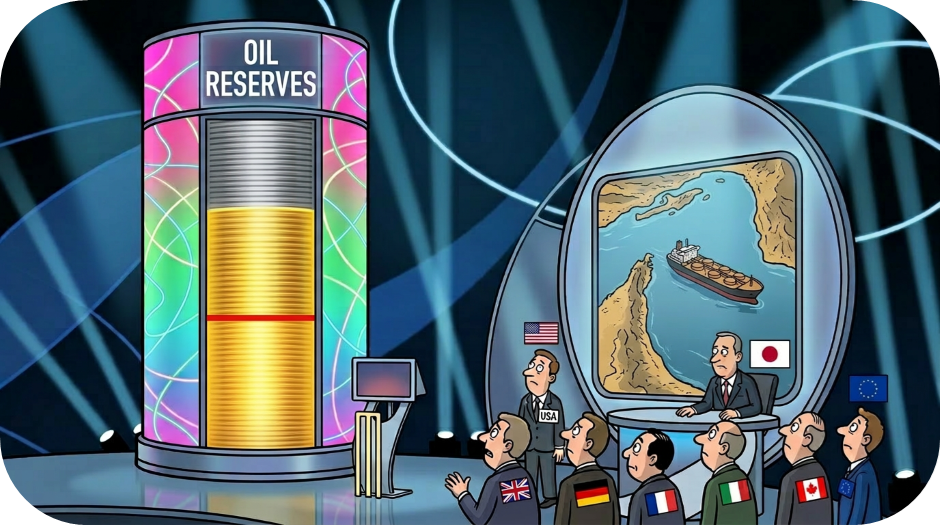
The 32 member countries of the International Energy Agency agreed this week to release 400 million barrels of crude oil held in strategic emergency reserves which represents a third of total emergency reserves and over a fifth of their entire inventory. This will backstop the oil that isn’t flowing through the Strait of Hormuz for between 20 and 50 days – most likely skewed to the lower end of that range.
That buys time, as does President Trump’s grant of a 30-day sanction waiver for Russian oil already at sea. The problem is, if it needs to happen again come April, these nations will need to seriously consider their options for fear of the entire strategic oil reserve depleting. There is a red line before that happens which requires a military response.
In the week crude oil has been volatile, initially spiking before a sharp reversal in reaction to Trump’s comments that the war would end soon. There was little reaction to the release of strategic reserves and prices have crept higher since with Brent now at around $100.
Other asset markets have so far been relatively calm, with the “stay-the-course”, “do nothing” mantra largely prevailing backed by the view that geopolitical shocks are often short-lived and markets end up higher on the other side. I suppose if everybody takes this view, it could provide an opportunity to de-risk, and assets are fading into the weekend.
There have been few areas in which investors have been able to protect capital, with bond yields grinding higher as inflation expectations increase, and gold failing to hold up after a stellar run in recent years. The main issue for gold is that the US dollar appears to be the main hedge against this type of shock with the US a net energy exporter, unlike other major economies. With the dollar back in favour, gold loses its shine for the world’s deepest capital market.
The scenario serves to reverse many investment trends of the past 15 months, but this has so far unfolded with a level of resistance. As the impasse extends, that momentum will accelerate, but when we begin to see some form of resolution it may provide instead an opportunity to rotate into the prior consensus.
Iran’s new Supreme Leader, Mojtaba Khamenei, son of the previous Supreme Leader, has initially vowed to continue with resistance. Several commercial vessels have been struck in the straits and western military bases in the region have been attacked. US strikes on Iran have continued. There are today reports that Khamenei was already seriously injured during strikes on the 28th of February, so his true influence is unknown.
As for dissecting the route to a diplomatic solution; this is simply impossible right now. Anyone in a position of power in Tehran must walk the tightrope, appeasing remnants of the old regime while ushering the country towards some form of new democratic leadership. That could result in an initial show of defiance that moderates in due course or indeed the situation may head in the other direction.
A new democratic regime is the expectation from the US, and suggestions of a no-kill list support the theory that an undercurrent of intelligence has built the foundation for change, but we are simply not privy to such information.
There appears to be a coordinated push by Iranian opposition leaders abroad to position themselves as a bridge to a new government. The National Council of Resistance of Iran formally announced a provisional government led by Maryam Rajavi last week with a stated intention to manage a six-month transition period leading to free elections. Reza Pahlavi, the son of the former Shah, has also been extremely visible, asserting that millions inside Iran are calling for his return as a steward of transition.
Where are markets up to?
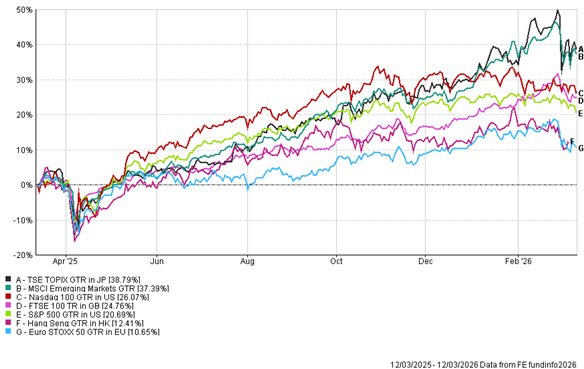
The rolling 12 month % cumulative returns in local currency from various indices is shown in the following chart:
Where are the portfolios up to?
The portfolio performance, net of fees, to close of business on Thursday is as follows:

As ever, if you would like to discuss any aspect of your portfolio, please do not hesitate to contact us on service@blythefinancial.com.