Europe’s largest multinational information technology services and consulting company, Capgemini, has seen its share price fall 30% over the last month in response to sluggish European revenue growth and recent derating of stocks that may be disrupted by AI.
In today’s update, CEO Aiman Ezzat announced a strategic pivot to focus fully on AI with a €700m restructuring to achieve it. What planet have they been living on for the last two years? OK, I am being slightly sensational; the company has steadily been exploring AI for over twelve months, but I highlight this as indicative of the uninspiring pace of adoption from technology incumbents, despite the rapid pace of technological change.
It is this general trend which has driven analysts to reassess the future prospects of many companies, and it’s not solely in the technology sector; it’s anywhere AI could be seen as a potential disruptor. Investors are marking down the future value of these companies as their future becomes more uncertain.
This is a problem of time. With many of these companies with substantial growth expectations, their value is largely derived from the medium-to-long-term outlook. There is little concern over the impact of AI on these companies this year or maybe the next, but beyond that there is a lot less certainty.
On the other hand, their losses should be someone else’s gain. If this is to be the Mega-cap tech companies that have the infrastructure that supports this disruption then they should be benefitting handsomely from this change in perspective, but that is not yet the case.
Again, this is a problem of time. With huge capital expenditure, much of which is to be derived from debt – note this week’s issuance of a 100-year bond from Google (which really shouldn’t draw comparisons with Motorola in 1997) – can these hyperscalers monetise their investments quickly enough to make a successful return if the bulk of the value of these investments occur in the earlier years, as they do with high tech processor chips?
So, we are in a rut where the effects of AI are becoming clearer as this incredibly powerful technological force appears to be rather hastily coming to fruition and yet, corporate valuations are being held back. It would be better for it to turn up now or much later, rather than soon.
There has not been a flood out of risk assets as a result, however, the key trend has instead been a rotation out of anything to which AI poses a risk into anything more solid, more physical, more real. Small caps have also benefited over the larger-cap incumbents.
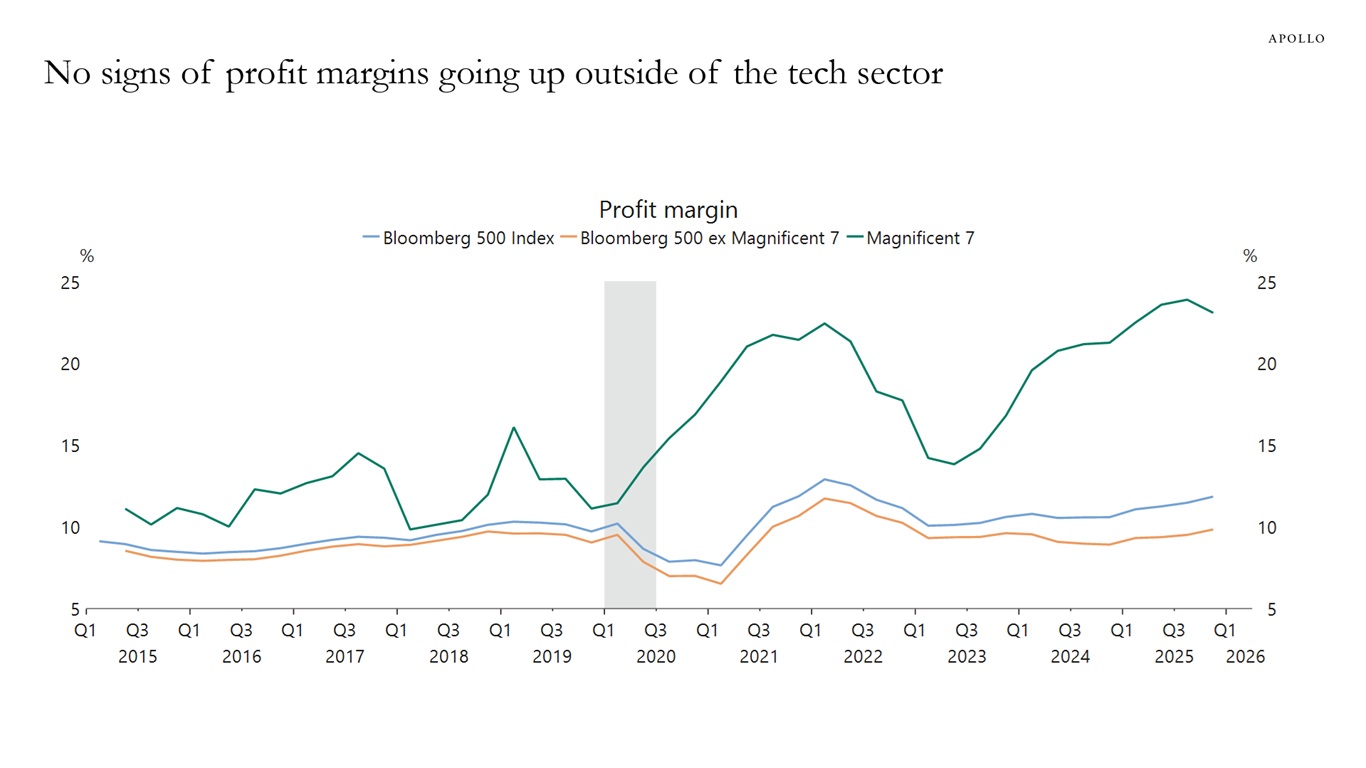
Torsten Slok of Apollo Global Management has been firing up the data furnace this week, providing some insight which would merit pause for thought. There have yet to be signs of AI boosting profit margins for companies outside the tech sector:
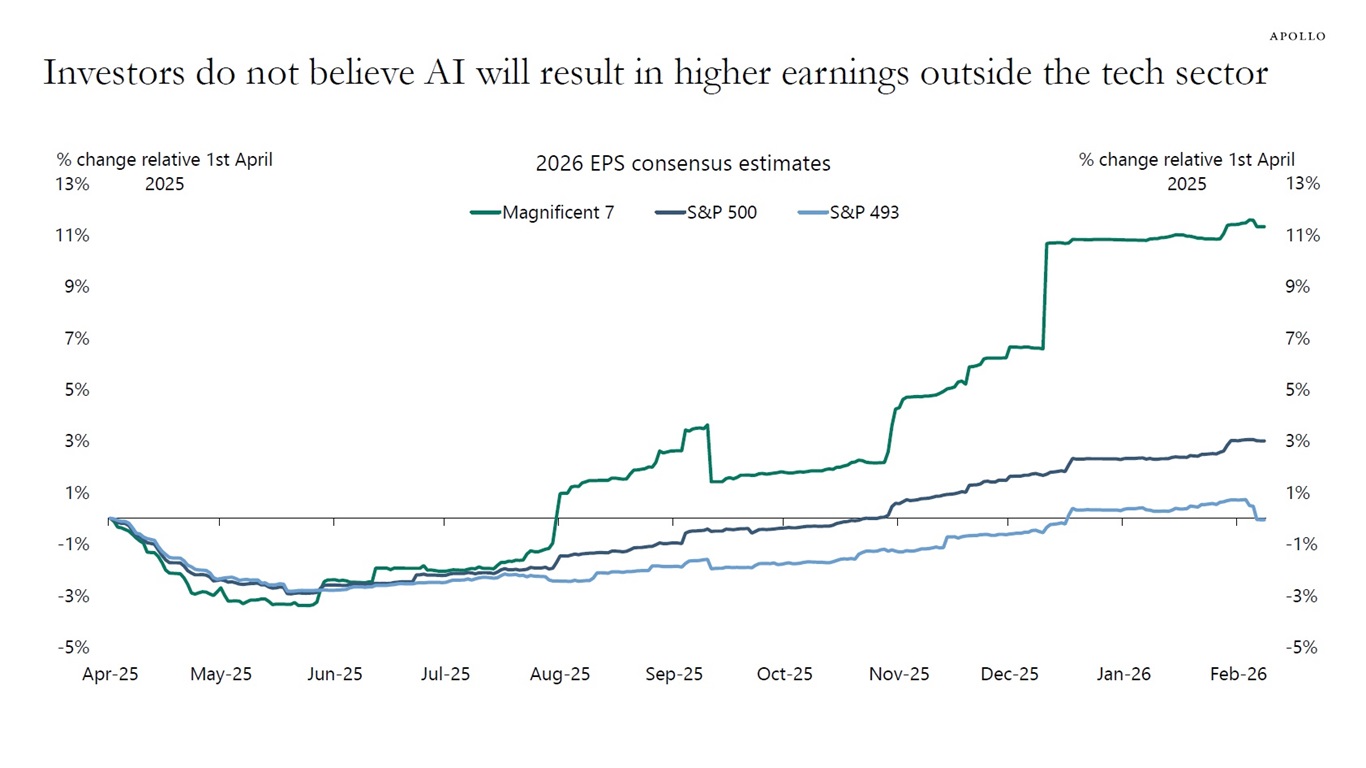
 And, despite recent market moves, there is also yet to be signs that such a change is reflected in investor expectations:
He also underlines the point that AI disruption is unlikely to derail the US economy for reasons threefold: Much of the financing for datacentres has already been committed for 2026, there is strong support for reshoring production facilities for semiconductors, pharmaceuticals and defence, and expansionary fiscal policy will, according to the CBO, lift GDP growth this year by 0.9%.
It is therefore very difficult to be negative on the US economic outlook. It is a sentiment punctuated by one sector at the core of the AI trend that hasn’t been fazed by these developments and that’s semiconductors, a sector which has had an excellent set of corporate results and very good stock price performances year to date. Semiconductors are typically a very good indicator of underlying economic momentum.
Add to this the conclusion that incoming Federal Reserve Chair Kevin Warsh will reduce the scale of the Fed’s balance sheet to justify reducing interest rates, which is more probable after resilient employment data this week, and it’s possible we will be looking at a roaring economy as the year progresses.
Sentiment towards the Japanese economy is in similar territory after the election landslide victory promotes expansionary fiscal policy. Japanese stocks have been on a tear and have not been held back by the currency as one may have expected. The Yen weakened initially but has strengthened after approaching intervention territory. It looks like there is a more orderly large-scale yen carry trade unwind going on and that has stalled any short-term weakness, while also de-risking the systemic issue which rattled markets in August 2024.
One systemic issue which may be in a riskier place in 2026 is private credit with UBS warning that 35% of the $1.7 trillion US private credit market is exposed to AI-sensitive sectors. They predict that in an “aggressive disruption” scenario, private credit default rates could surge to 13%.
S&P Global also recently noted that 20% of entities in software/IT services currently have credit scores in the CCC (distressed junk) range, making them highly vulnerable to refinancing failure. This credit risk and the time-based valuation issues described above are a very good reason to promote lower interest rates to avoid a potential crisis while in the middle of a technological arms race with China.
This arms race could be stifled by competition for critical resources, so the US has rapidly ramped up Project Vault into its operational phase. It will utilise almost $12bn to build a strategic reserve of copper, lithium and rare earths, 60 minerals in total, to buffer industry during supply shocks.
Original Equipment Manufacturers, like Boeing, will effectively pay a subscription fee for allocated quantities that can be drawn under certain circumstances, on the promise that they replenish them when the supply shock has subsided. They must also commit to using domestic allied-refined material in some instances and the US government will commit to buying at specified price floors to block Chinese mineral dumping.
In doing so it becomes a buyer of last resort and thereby reduces the investment risk in new domestic or allied mining or refining projects.
In the UK, Starmer appears to have avoided a crisis in confidence and Gilt yields are steadily recovering. That didn’t stop another bout of weak economic data.
Where are markets up to?
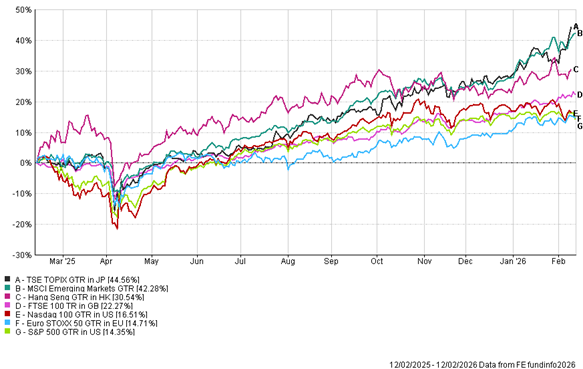
The rolling 12 month % cumulative returns in local currency from various indices is shown in the following chart:
Where are the portfolios up to?
The portfolio performance, net of fees, to close of business on Thursday is as follows:

As ever, if you would like to discuss any aspect of your portfolio, please do not hesitate to contact us on service@blythefinancial.com.