Markets have been under pressure this week with concerns about inflation and the situation in the Middle East interlinking to provide a backdrop of uncertainty over the possibility of interest rate rises, which in turn damage the future profitability of the corporate world (and in particular the Mag -7 and AI Titans).
The root cause of the inflationary backdrop of course is the Middle East Crisis and the blockade of the Strait of Hormuz, which places a huge strain on the global supply of oil.
The mood in markets darkened over the week with the Middle East ceasefire seemingly under pressure of collapse with tit-for-tat strikes by Iran -v- US and Iran -v- Israel.
That mood however lightened significantly through the course of yesterday (Thursday) as focus turned to developments surrounding a proposed US / Iran Memorandum of Understanding.
Trump told reporters that the US and Iran have reached what he called a “great settlement of the war with Iran,” describing it as subject only to final documentation.
He went on to say that they expect to have a signing “over the next few days, probably have a signing, maybe in Europe,” and repeatedly pointed to this weekend as the likely timing. He also added that Vice President JD Vance will attend the planned deal signing in Europe, and that Vance could sign the agreement on behalf of the United States.
Trump further stated that “the strait will officially open as soon as we sign, which could be soon, very soon, maybe over the weekend in Europe”.
On social media, Trump has claimed the agreement has approval from “the highest level” of Iranian leadership and from key regional states including Israel, Saudi Arabia, Qatar and the UAE.
Optimism however was in much shorter supply following comments from Iran’s Foreign Ministry saying that the draft text remains under review, whilst the Iranian Republican Guard affiliated news agency, Fars, dismissed speculation about an imminent signing and that final negotiations would concentrate on nuclear material and economic issues only, leaving Iran’s missile programme firmly off the agenda.
In addition, Iranian state television reported that transit through the Strait of Hormuz had been suspended (again) until further notice.
Nonetheless, we have seen something of a relief rally filter through markets on Thursday, with the US tech heavy index the Nasdaq 100 rallying 3.29% on Thursday, and into Friday – at the time of writing European markets are up between 1% – 1.5%.
Just how concrete the “great deal” is, remains to be seen but for now markets seem prepared to accept it at face value.
Meanwhile the European Central Bank raised its benchmark interest rate by 0.25% yesterday, taking the main policy rate to 2.25%, the first such increase since 2023 and reflects the perceived impact of the energy shock from the Middle East crisis on inflation.
In reality though, the move is as much about signalling the ECB’s position as it is about the marginal change in the cost of money.
Markets had largely priced in the rate rise, and so the ECB has effectively validated expectations. Given that Eurozone growth has been weak and inflation recently accelerated, the decision suggests the ECB is prioritising inflation control and credibility over near-term growth concerns.
The immediate impact is likely to see some upward pressure on short end euro rates and support for the euro, although much of this has probably already been “baked in” by the expectation of the rate rise.
The UK GDP numbers were released this morning showing that the month-on-month rate for April came in at -0.1%, in line with consensus expectations. The year-on-year number for April came in at +1.2%, below consensus expectations for +1.3%.
These weak numbers serve to reinforce the sense that underlying momentum is barely alive. Manufacturing remains under pressure, services are only just positive, and the overall level of activity is barely above its pre pandemic trend.
The on-going weak activity has increased expectations towards gradual Base Rate reductions, but the Bank of England finds itself in a dilemma.
On one hand, inflation is still above target, and the Monetary Policy Committee has been wary of declaring victory too early, especially with renewed energy price pressure from the Middle East conflict.
On the other, flat or falling output, softer labour market indicators and fragile business confidence increase the risk that maintaining restrictive rates for too long does unnecessary damage.
The ECB’s decision yesterday to hike gives the Bank of England some cover not to appear excessively dovish relative to peers, but this latest GDP number reinforces expectations for one or more cuts over the next few meetings of the Monetary Policy Committee.

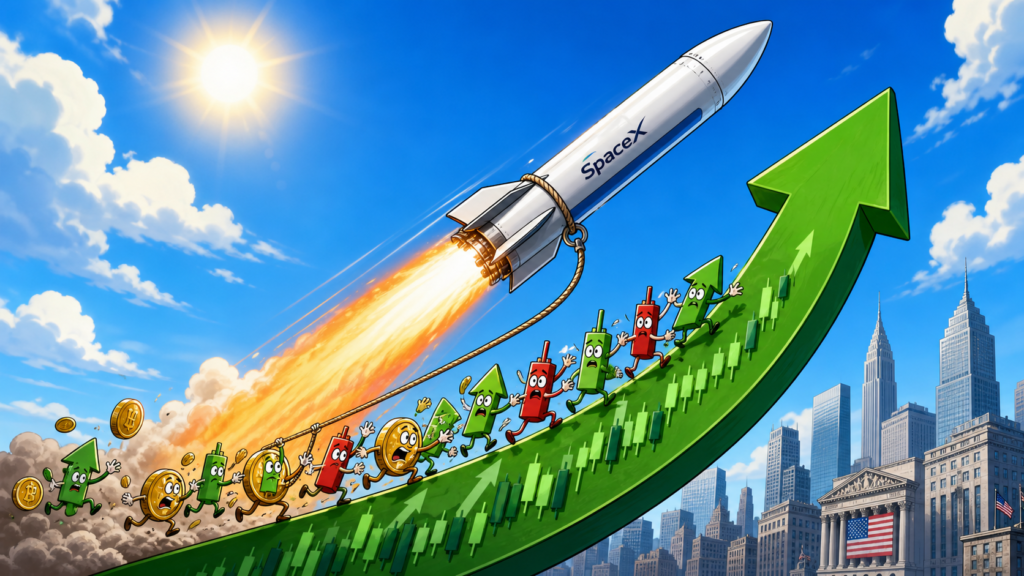
As we type SpaceX stock begins its trading and price discovery on the US stock market. The company has raised a staggering $75bn in equity capital, which is the 3rd largest event of this nature in history, surpassed by only Apple’s $110bn stock buyback plan in 2024 (for which it used its own cash), and Google’s recent $85bn equity raise (which will be executed over an extended period).
To achieve this feat the company has been valued at over $1.77 trillion, accelerating it to the ranks of the top 10 global companies by valuation, aided by the premium investors are willing to pay for a good story and one Elon Musk.
Some will be eager to engage for a get-rich-slow scheme, sold on the company’s long-term prospects and its potential to surpass the imagination of institutionalised analysts and their valuation models.
For others the situation represents a substantial short-term trading opportunity. Over the next month, plenty of index tracking funds will be forced to purchase SpaceX shares owing to their inclusion rules which have been recently changed to accelerate the introduction of newly listed assets. This provides a forced, price-insensitive buyer.
The maths is simple: as long as the valuation of SpaceX remains high enough for inclusion there is a defined amount that will be bought by these funds, assuming assets under management are static. There are an unknown number of long-term holders versus short-term traders who own the stock. As long as these funds are buying more than those trying to make a quick buck are selling, the price will stay lofty, but if there are too many short-term traders the price could quickly subside. Most of this interplay will actually happen in 5-15 days’ time.
There are few reasons to sell immediately unless the price moves higher, so we expect it is likely to do so, supported by a reportedly massive oversubscription from both institutional and retail investors.
Longer-term, however, the current valuation assumes flawless execution of highly speculative, long-horizon projects like lunar bases and the colonisation of Mars, and an addressable global broadband market for Starlink that is ten times larger than some analysts would caution.
Our own surface-level assessment is that the company must now embark on reducing the cost of space launches by as much as 90%, in an environment in which energy and materials are increasingly scarce. This may be harder to achieve than it would have been in a vacuum, so to speak.
Where are markets up to?
The rolling 12 month % cumulative returns in local currency from various indices is shown in the following chart:

Where are the portfolios up to?
The portfolio performance, net of fees, to close of business on Thursday is as follows:

As ever, if you would like to discuss any aspect of your portfolio, please do not hesitate to contact us on service@blythefinancial.com.