The US-Iran ceasefire broke down this week after Iran attacked three commercial tankers transiting the Strait of Hormuz, as it seeks yet again to assert unilateral control over the waterway. President Trump reacted in the way we have come to expect, with verbal diatribe and heavy retaliatory airstrikes that hit dozens of targets across five Iranian provinces, focusing on strategic targets including air defences, radar sites, coastal missile installations, small boats, military-use bridges and railroads.
Simultaneously, the US revoked the sanctions waiver that had allowed Iran to sell oil under the June signed Memorandum of Understanding (MoU).
The response from capital markets was an immediate but moderate upward revaluation of crude oil prices to factor in the rising risk of supply disruptions. Bond yields also trended higher to factor in the increasing probability of higher inflation, but risk-assets have otherwise and once again been relatively sanguine.
The escalation completely upended the agenda at the NATO summit, which originally intended to project alliance unity, celebrate increased European defence spending and secure an aid package for Ukraine. Instead, Trump openly slammed European allies at the summit for failing to directly join the US and Israel in the military campaign against the Islamic Revolutionary Guard.
However, the alliance’s members are gradually being pulled into the conflict even if they firmly resist merging their naval forces into a US-led command structure. NATO allies have explicitly condemned Iran’s behaviour, backed a joint declaration demanding freedom of navigation in the Strait of Hormuz, and spent sideline meetings planning a distinct, multinational maritime security initiative led by the UK and France to protect shipping lanes independently from the US.
While we were pleased to see a resolution could be achieved directly between the US and Iran with the MoU and ceasefire being reached in June, we had anticipated that “the only solution is one of combined international pressure, despite the emerging fragmentation of historical allegiances” – as per our first quarter commentary. What is happening now is probably just the next step towards a final resolution, rather than a step backwards.
What happens to Iranian stockpiles of enriched Uranium, however, becomes less clear.
There are plenty of time hurdles here: the longer this drags on, the greater potential there is for internal pressure on the Iranian regime, the greater the risk of slowing global growth, the greater the risk to Trump’s midterm election campaign, the greater the cost to governments using debt to fund their deficits, but also the longer capital remains attracted to US assets and the US dollar.
The Republican’s attempt to cut government spending reached a conclusion this week with the quasi-agency DOGE (Department of Government Efficiency) reaching its hard self-termination deadline. It claims to have achieved $215 billion in cumulative government spending cuts.
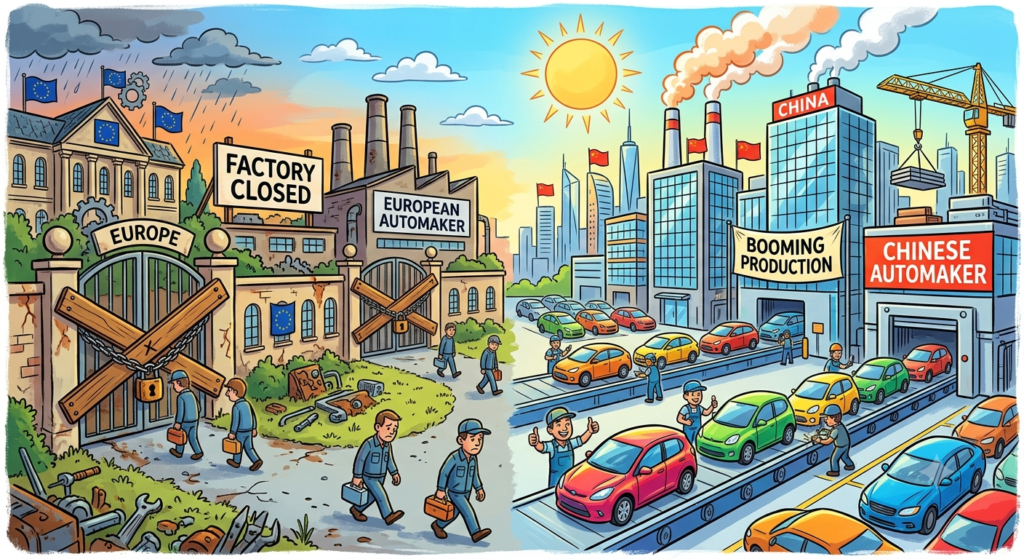
The automotive crisis continued to squeeze Europe’s industrial backbone as a wave of major tier-one automakers and suppliers slashed their full-year 2026 outlooks. Margins on Chinese sales are declining, domestic sales are slowing and the industry has been left begging the EU to delay environmental regulations on downstream parts as emissions tracing becomes too costly.
Volkwagen’s CEO, Oliver Blume, delivered the blunt assessment in the company’s ‘future plan’ – its legacy business model of manufacturing cars in high-cost European plants for global export is no longer viable. He will half VW’s models, quarter vehicle configurations, significantly downsize production and begin divesting assets. The proposed overhaul seeks to cut over 100,000 jobs by 2030 and close four major plants.
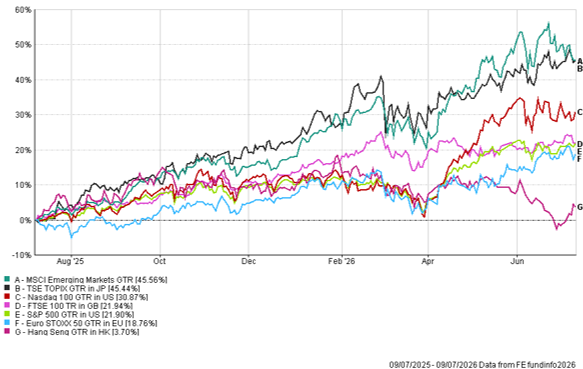
Where are markets up to?
The rolling 12 month % cumulative returns in local currency from various indices is shown in the following chart:
Where are the portfolios up to?
The portfolio performance, net of fees, to close of business on Thursday is as follows:

As ever, if you would like to discuss any aspect of your portfolio, please do not hesitate to contact us on service@blythefinancial.com.