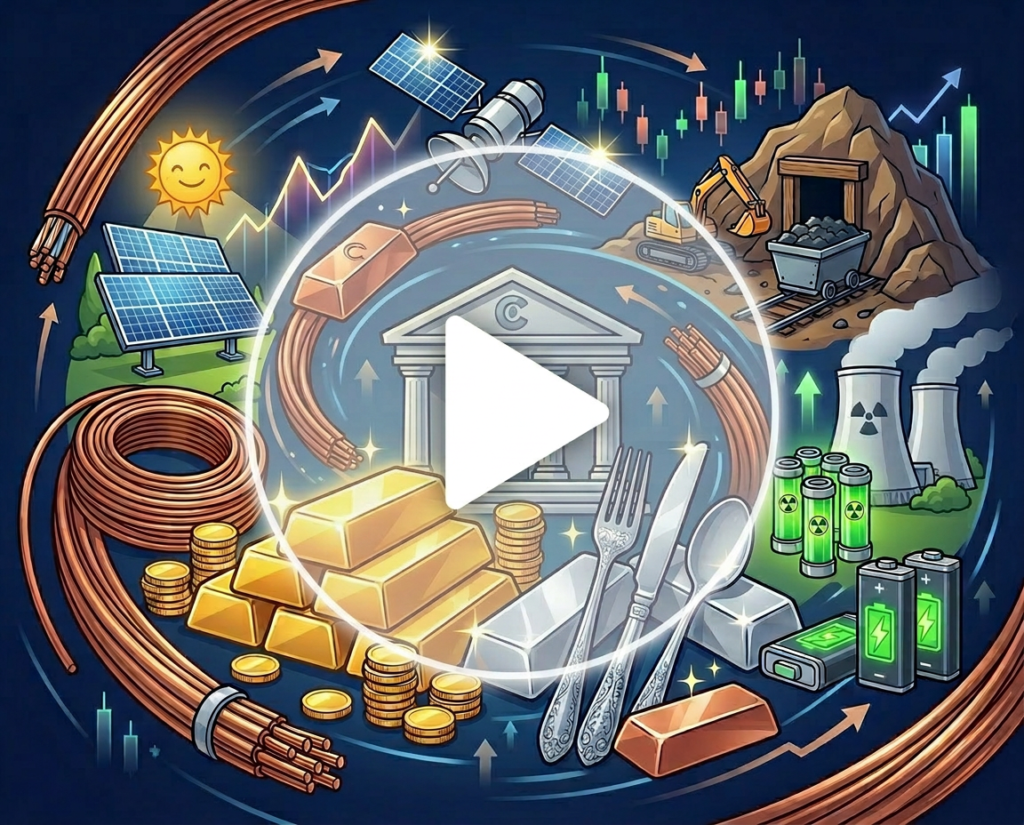
Here is a link to a video we posted earlier in the year but is still very much relevant:
Resource Scarcity; How Investors Should Be Thinking About…
Full Transcript – Edited for clarity and readability
So, Chris, what’s one thing investors should be thinking about right now?
Well, we touched on this last year a couple of times and covered it extensively in the year-end commentary. Then this year there’s been quite a lot of volatility, so everybody’s talking about it now really, and this is resource scarcity, particularly in select metals and then a few other areas as well.
Gold, Interest Rates and Geopolitics
I’ll start with gold. It’s got a lot of tailwinds at the moment. There’s a lot of good reasons to get behind the momentum in gold.
The main reason, and a lot of the other reasons filter back to this, is currency debasement. People are starting to lose faith in government’s abilities to maintain the value of currency, and that largely comes down to one primary factor which is just a huge amount of debt in the developed world, globally, but really in the developed world. In the last 5 years or so, the developed world has marched on in terms of how much debt it has relative to emerging markets and other parts of the world.
Number two on the list really is interest rate cuts. Donald Trump, now president, is putting a lot of pressure on the Federal Reserve and Federal Reserve independence has come into question to some degree, but generally this year was the year where we expected to see essentially a forced and excess amount of interest rate cuts. What that means is when you’re going to earn less money on your cash, particularly when you’re worried about inflation, gold becomes more and more attractive because there’s less of an opportunity cost of the interest you would have earned otherwise.
Heightened geopolitical issues are a big problem as well. When people are worried about what’s going on in the world, gold’s very, very attractive. Why? Well, at the end of the day, if you’re defensive, you might want to hold more cash or more defensive fixed-income type assets. If you’re worried about geopolitical issues, which cash do you hold? Whose cash do you hold? gold is the ultimate cross-border asset really in that sense, in a defensive manner. So, that’s another tailwind for gold.
The Anti-Dollar Narrative and Central Banks
On top of that, specifically with all those factors we’ve already just talked about, President Trump and essentially all the trade issues and policy we’ve been seeing, there’s now very much an anti-US dollar narrative. That’s primarily been driven by… essentially over a long period of time there’s been a huge amount of capital flows into the US. That’s as a result of the interactions within global trade, because the US is such a big importer of goods, and there’s also been huge demand for dollar assets and dollar equities because the economy has done so well. As other countries sell goods into America, they receive dollars and then they have to do something with those dollars, so they tend to buy dollar assets. Now that’s been going on for a very long time.
Take the UK as an example, a huge amount of domestic investments or pension funds – what I mean by domestic investments is portfolios that are held domestically – actually invest globally and a lot of that ends up in the US. Now we’ve reached a point where we’re really questioning whether that needs to turn around.
As part of that narrative and that potential change in momentum what we’ve also seen is a lot of central banks around the world are now looking to buy gold instead of US dollars as a reserve asset, and that’s just reduced the demand for dollars slightly and equally increased the demand for gold. I suppose the question around central banks buying more and more gold – and there is a little bit of question as to how much, you know, they’re not buying crazy amounts of gold – but the beautiful thing about a central bank buying gold is what price do they pay? Frankly, they pay whatever the market price is.
The Intrinsic Value of Gold…
This is one of the problems with gold all round: much of the market for gold is really made up of price takers. There is some industrial use, and we’ll talk about that a little bit more as we go on, but a lot of the market for gold is kind of people trying to work out where gold’s going to go. It’s very speculative. Ultimately that just means that when you have a lot of good tailwind stories behind gold, well, there’s a good chance that momentum carries forward to some degree. But actually, what is that anchor? What is the absolute value of gold? That is a bit more difficult to determine.
Inflation or Stagflation
I haven’t mentioned inflation too much. We’ve had a period of huge inflation, ok a few years ago now and it kind of hasn’t carried on, but it has been a bit sticky, and that’s got people worried. People are still very worried about inflation, and that again leads into gold being more attractive than maybe fixed-income assets where your interest that you earn will get eaten up in real terms by inflation. The other useful thing about gold is it’s a good asset to have theoretically in a stagflation environment, which is an environment where you have inflation, but you don’t necessarily have the economic growth to go along with it. It’s a bit of an economic paradox, stagflation.
Typically, it’s something that happens when there’s a supply shock of some sort. Well, we’re talking about resource scarcity here, and you know that it is very much a concern. On top of that, at the moment, we clearly think that AI could be the way out of this high-debt scenario. One way to get out of it is to grow your way out; the other way is inflation diminishes the value of fixed income.
As a Hedge for AI ?
Everybody is quite invested in AI at this point. It’s taken over quite a large part of the market, so everybody’s got quite a lot of exposure to AI. If you want to hedge that risk, which is kind of your key exposure in equities these days, if AI doesn’t work out, it’s probably going to be a problem for fixed income. We might have this high debt situation persist, and so gold is potentially quite a good hedge to your AI risk, and so maybe that’s been driving it to some extent as well.
Bank Regulation Policy & Paper Traded Commodities
And then the final piece on gold, I did say there is a lot, and there is, is there’s been some rule changes as well. So the Basel III, what’s known as Basel III endgame, named so because Basel III has been going on for some time – it’s quite complicated, it’s about how banks hold assets on their balance sheets in response to other liabilities they may have.
Ultimately there’s been some rule changes that came into effect in Europe a few years ago that have now come into effect in the US, and they essentially have made it so that physical gold is more cost-efficient and less costly to hold for banks than paper gold. What’s paper gold? Well, if I made an agreement with you, for example, if we just had an agreement about somebody earning on the gold price, maybe I’m a miner and I want to lock in a gold price, maybe you’re a jeweller and you want to lock in a gold price, and we come to some agreement, maybe we don’t actually have the physical gold to back that agreement. That would be essentially a paper deal; it’s called paper gold.
That happens quite a lot, and most of the time it’s quite reasonable. But what tends to happen in a lot of these commodity markets now is the amount of paper deals going on in the background is of a significant size, such that they almost start to control the market themselves more than the physical. I think it’s about 100 times the amount of paper gold than there is physical gold traded in the world. So, when that starts to interact with real prices, it starts to become a bit of a problem, and there is a bit of concern around that.
What these Basel rules will probably do, because the paper gold becomes more costly to hold for financial institutions, is there’s maybe a short-term drive to some of these financial institutions buying gold to back up those paper positions or just to reduce paper positions in their entirety. It is difficult to determine exactly how much of an effect that’s having, but again, if you put that story in with all the other pieces to this puzzle, it adds possibly another tailwind there.
Silver is Precious but has More Industrial Demand Relative to Supply
There’s a potential overflow into silver from all this as well, just because silver is in a similar situation on those Basel III rules, and it’s seen as a little bit more high beta (beta is how much an asset reacts relative to its peers). Potentially, if you can’t get your hands on physical gold, well, maybe you go for physical silver as well.
So, moving on to silver – that was a nice little segue to silver – it’s very similar to gold because it is also considered a currency debasement asset, or to protect against currency debasement.
Now, I would be a little bit cautious of that view because it’s actually not held as a reserve asset by central banks. But where it’s different is that it does have much more industrial use. So, gold maybe, you know, it’s a very small amount that’s used industrially. There’s ample gold in the world for its current industrial use. Silver, maybe five years ago or so, maybe half of it was used industrially, and now solar, electric vehicles, AI, all these modern technologies are now using it more and more. The big growth area has really been solar, and now silver industrial use is very, very high for how much is actually mined each year.
The way to think about metals, there is an elemental substitution. Yes, you can actually replace silver with maybe copper; you can replace copper with maybe aluminium. But you know, silver’s got the best conductivity. When you get to aluminium, you kind of need a big chunk of aluminium to get the same amount of conductivity as say copper, but it’s very light, so actually it does work in some places on electric vehicles for example. So, think of those in that hierarchy. Gold is actually less conductive than silver and copper, but it does have other properties which I’ll get on to shortly.
Silver Deficit or Squeeze
The thing about silver is it’s widely promoted in the media that it’s in a deficit, which means there’s more demand than there is supply from mines. I question this slightly. The numbers I’ve looked at – and you never quite know if you’re getting perfectly accurate numbers and whether they’re fully up to date as you want them to be – but I get the impression that it’s actually not in a deficit when you take away its use in jewellery and for bullion investment. It’s not actually in a deficit if we decide to say, “Look, anybody who wants silver as an investment or for jewellery just can’t have it right now, we need it for other things.” It doesn’t quite work like that, but equally there is what appears to be sufficient silver to provide industrial demand right now.
I estimate that maybe you improve the amounts you can extract because it’s a byproduct from other mining, we can potentially extract more than we are. There’s maybe more potential recyclability that we can achieve. Plus, if you took all the silver that’s already been extracted for investment and possibly sitting as cutlery in people’s homes, who knows, I think we probably could cover the deficit for about 30 years. If you’re being really prudent, maybe it’s only 15. So, I think we have got enough silver for quite some time. But the problem is obviously these investors are now using this to kind of hold on to the silver to artificially push up the price, and so I see the silver market really as much more of a squeeze than necessarily an actual shortage.
Doesn’t mean you can’t make money in a squeeze, but it’s volatile, you’ve got to be a bit careful, maybe it’s not the safest place, got to pick your timing, things like that. I’m not too concerned about silver, but we’ve obviously have had a huge amount of volatility earlier this year, I don’t know if everyone has seen it, we’ve a massive push up in gold and silver prices then a big crash. What happened there?
Well in the run up we had a price differential between western markets; how they were pricing silver, Asian markets; how they were pricing silver. In Asia, you have to have the physical commodity or at least in the silver markets you do to back up your trading, and so the narrative at the time was that potentially that was indicating that there was a real shortage of the physical stuff and western marketers, because they were paper driven, were just not reflecting this.
The narrative kind of changed, and what’s true we might still find out, but the view that followed was actually that what it reflected was that there was a lot of speculation that was happening.
In the end, the Chicago Metals Exchange upped the margin requirements on trading, which meant that if you were using leverage to buy these commodities, particularly silver, then suddenly you had to put a bit more money in to back up what you were doing, and that deflated the market. That’s what caused the pullback.
It’s widely reported that it was the appointment of Kevin Warsh (as Federal Reserve Chair Nominee). Maybe that was a catalyst; I think that was kind of a nice little thing that potentially helped to disguise the fact that they’d raised the margins. But if the silver price did come back because of margin requirements on leverage, then it did indicate that actually there was a lot of leverage being used to squeeze this market, so in my mind it was a fair thing to do; tone back the risk a little bit as the price had risen so much already.
Solar and Space
Just on solar panels, because they are such an important part of this whole scenario, there’s quite a lot of technological development in this area. They’ve already started in some companies in China to replace silver with copper in some solar panels. They may not be as efficient, so price will guide that to some degree because as long as silver – it’s only about 20% of the production of a solar panel – so if it starts to double the price of a solar panel copper becomes more attractive but at 20% of the cost it’s workable, so maybe the silver price can move around from where it is and go higher. But that will kill that structural deficit argument to some degree because if you can produce solar panels with copper instead of silver, that changes that narrative massively.
Gold has a place as well. The big problem with solar panels is you need batteries because you don’t have sun all the time, so you need some form of energy storage, probably batteries. One solution to that is putting solar panels in space. It’s something Elon Musk is looking to do. He’s already talking about doing it within 3 years. He’s never really achieved anything he says he’ll do in 3 years, but in space, the main issue is corrosion.
That is why gold is a central bank reserve asset, because it can be stored and doesn’t corrode and that’s the history of gold throughout time. In space, gold becomes a necessary metal to be used in those kind of networks. It’s relatively new technology, so it’s difficult to know what the outcome will be, but if they manage to achieve a level of efficiency, i.e. very fine films of gold around the copper and silver used for connectors, then they won’t actually need a huge amount of gold and there’s no concern of a deficit. If they have to use much more solid gold and maybe if you’re sending stuff into space you will, then gold maybe could be something that, you know, that we require a lot of it in due course, but that’s really a very long-term story, I think.
Gold can be used on the front of solar panels as well, but it would only be used in microscopic amounts. So, for the actual front of the solar panel, the array, it there’s plenty of gold out there.
Relative Cost of Precious Metals
And just at this point, it’s always worth mentioning, you know, the relative cost of gold, silver to copper. Gold is very, very expensive relative to probably how we’d use it industrially. Silver is pretty expensive compared to copper. Copper is still very, very cheap.
Copper: A Better Investment?
Copper is slightly different from both those because it’s not really considered a currency debasement trade. We don’t store it in bullion for investments. Without those buffers, what you’ve got is a straightforward supply-demand deficit, and we do have that deficit right now.
There’s been an issue with a mine that produced about or used to produce about 1% of global production that tipped the world into a deficit slightly earlier than we expected last year.
But, copper is in high demand. Ore grades have been reducing as they do for all mining because we mine the best ore first. It just looks like it’s going to be in a deficit for a very, very long time, assuming we don’t have a change in AI momentum or our electrification scenario, we don’t have a change in renewable production, and even with nuclear production we still need copper to transfer energy. Because of all those factors, I think it’s a really good safe haven place to be. Maybe next time there’s a market crash that could be a really good store of value. If you’re looking to protect against inflation, it’s a pretty good store of value.
Historically it’s a very cyclical good, which means when the economy busts it does do poorly and that’s largely because it’s demanded in things like construction and construction is a very, very economy driven industry, so there is that and I think that’s what has kept people away from it, but if we look at the recent crash in gold and silver, copper wasn’t hit quite as hard. It looks like a long-term play.
But there is one risk to that view, apart from potentially the technological change and the general trends we’re already very much aware of, and that is potentially we then may see some capabilities to actually beam energy instead. And so if we start beaming energy – which is if we have solar panels in space, that’s one of the ways that we would have to get energy back down from solar panels in space – if we manage to achieve that technology, that puts a big dent in that copper supply deficit scenario as well. But I think that one’s slightly longer term and more speculative of a technology at the moment. So, still pretty bullish on copper.
Uranium and Nuclear Power
So, another material that will be important that’s maybe slightly outside the scope of metals: uranium. Clearly nuclear power is becoming a big thing. It’s back in favour. We’ve got a huge amount of energy needs from all our technological development’s going on. It’s in a structural deficit; that’s what’s reported. It’s a little unclear as to whether we could actually mine more from the deposits we already have and that are being mined.
So, with copper, I’m pretty convinced that we’ve got a pretty medium-term / long-term structural deficit as it stands. With uranium, potentially we’re not in as bad a position as maybe is made out. But, you know, that still provides a pretty good foundation for a bullish story in uranium. I think the other bullish story is kind of an economic argument made that ultimately you sink so much capital expense into nuclear power plants that the relative cost of uranium, for how much you’ve sunk your capital, is relatively small. And so there’s scope really for uranium to increase in price without really having a great impact on the operations of nuclear power plants.
So, taking that as a kind of clever argument to invest in it, it does make some sense, and you know, we can see the trend in uranium. It’s a bit of a difficult area because it’s quite an opaque market. We talk about spot prices in uranium, but a lot of the actual transactions in uranium don’t happen in a spot market. So I think it kind of rides on sentiment a little bit. Maybe, how accurate is that uranium price? Not so sure. So timing in and getting in at the right time, I think, is important. But again, if you’re in it for the long term, you know, less concerns over timing.
Lithium and PGMs
Lithium’s interesting. Again, another metal that is expected to be in great demand. My slight concern with lithium is all the technology we talked about on solar and everything else. Yes, we need storage from solar, but if we’re going to get it from space, then there’s no intermittency issues. So, that’s possibly a risk down the line. The other thing is the Chinese are now ploughing on with sodium battery technology, which for a lot of; I mean, it maybe hasn’t quite got the energy density that we need, but actually could potentially do a lot of what we require for energy storage and to some extent in kind of shorter-distance EVs, electric vehicles that is. So just, I’m a bit wary of lithium from that perspective.
Platinum group metals, another area of interest, again have that kind of currency debasement factor to them but also being used industrially. Not going to go into that right now in much detail because we really don’t have the time.
In Summary
But overall, that’s kind of what we’re looking at. We really like copper. We think the story is fundamentally going to hold up very well. It’s cheap by weight relative to silver and gold. And that really, I think, backs it up over a long period of time.
Gold ultimately is a bit speculative: The foundation of it is it’s bought by central banks, okay, that’s not likely to change, but it feels quite a speculative asset.
Silver, it’s been a bit of a squeeze. Lots of good kind of deficit story behind it, but equally potential substitution risks. It’s reasonably abundant, but actually I am hearing that at the moment some of the exchanges are struggling to have silver on hand for delivery, and potentially some of these industrial users are using the exchanges to get physical silver. So that’s the risky one. Who knows? But we would just stick with copper over that.
So, there you go. That covers it. And I think that’s… I hope that gave you enough information.