If I were a data-driven, signal-based, news-flow-focused, algorithmic trading strategy, sentiment indicators would have been flashing red this week, with few positive headlines to balance the negative. The tech sell-off has gathered momentum as a result.
Capital market discussion has centred on two dominant issues; US employment data and whether we are in the midst of an AI bubble.
The bubble rhetoric has been reinforced by big-name investor activity and engagement. Peter Thiel, prominent venture capitalist and co-founder of PayPal, has sold his hedge fund’s entire stake in Nvidia. This follows a similar move by SoftBank last week, although both maintain large positions in other AI exposed companies, and both are typically bullish on speculative tech.
These could therefore be very company specific moves, with Thiel taking the view that Nvidia’s competitive position will be eroded by its peers. That outcome has yet to emerge, however, with Nvidia reporting last quarter’s earnings with above expected revenues and profits. Revenues have grown a mere 62% over the last twelve months, have grown tenfold over three years, and profits are now larger than its largest rival’s sales.
This news initially looked to have halted the downward trend in risk assets as markets opened well in the green on Thursday, but optimism faded quickly.
Michael Burry, of “Big Short” fame (he made his billions betting against sub-prime mortgage debt ahead of the 2008 global financial crisis), has questioned the way in which large AI companies are accounting for their capital expenditure, hinting at financial engineering.
The problem here is twofold. Firstly, capital expenditure for datacentres is expensed as depreciation over the years ahead. That means when the money is spent it doesn’t hit the financial statements immediately in full so, as we move forward, earnings growth could begin to suffer as more and more historic capex hits the profit and loss account.
To compound this issue, the useful life for AI chips is deemed to be 3-5 years, but there are mixed reports on the accuracy of this approach with intensely run high end chips expected to last only two years and other chips still working in datacentres 8 years after production, leaving a wide array of potential outcomes for these companies.
To add to the cautious outlook for tech, Amazon was added to list of mega-cap tech names raising debt to fuel further investment in AI datacentres and the European Commission probes into Amazon Web Services and Microsoft Azure as gatekeepers of cloud services, which could leave them open to tighter regulation.
Cloudflare also had an outage which halted many consumer-facing websites and apps that rely on them; it’s estimated that the company covers 20% of websites globally. The silver lining here was that it was not a result of a malicious attack.
The long-delayed US labour market report finally emerged with a headline nonfarm payrolls rise ahead of expectation but weaker numbers in the weeds. The two major labour market surveys continue to diverge with the economy adding more jobs while the unemployment rate continues to rise as a result of an increasing participation rate. Full-time employment is falling, showing some deterioration in employment quality.
These were September figures, and we won’t be privy to October’s owing to the government shutdown, so we go into the final Federal Reserve interest-rate decision in December with no further employment data. The data is suggestive of a cooling economy enough and strengthens expectations for further interest rate cuts in 2026. US economic bellwether Home Depot’s disappointing sales growth and weak guidance also pointed to an ailing consumer.
The final piece of bad news this week was in private credit as Blue Owl had to cancel plans to merge two of its funds into a single investment trust structure. The problem with doing so was that investors in the smaller structure would suddenly be exposed to the investment trust’s 20% discount, and that spurred a series of redemptions, some of which were blocked by the company. This looks to be more folly than fiasco.
It doesn’t end there, either, cryptocurrencies have had another dismal week, with bitcoin falling over ten percent and now in negative territory for the year. To what extent this is having an impact on other asset prices is difficult to determine. These moves could be a result of the deleveraging of technology investments either causing or in response to asset prices falling. One thing is for certain, though, over a trillion dollars of value has been wiped from cryptocurrencies in recent weeks, and that “monetary stimulus” or “wealth-effect” is not to be ignored.
While the sell-off appears broad-based, there are signs of sector rotation with defensive & value segments of the market holding up, notably healthcare, utilities and consumer staples, but also industrials and cyclical-value stocks. This suggests that this is indeed a pull-back due to excess momentum and high valuations with nothing more sinister yet to emerge.
On the positive side, a 28-point Russia-Ukraine peace plan was proposed this week with the US administration heavily involved, although unlikely to advance quickly without major revisions and broader European support. As it stands, the plan aligns more closely with Russia’s longstanding strategic goals than with what most Western governments or Ukrainian officials consider acceptable, but we can expect more reasonable prices for oil in the meantime.
And not everyone is pulling back on AI, Berkshire Hathaway revealed a large new stake in Google, albeit the company has mounds of cash and this is now the post-Warren-Buffett era.
So, we enter the Black Friday weekend on a downer, but this is usually the time of year we see new consumption records being set, so roll on Christmas!
Where are markets up to?
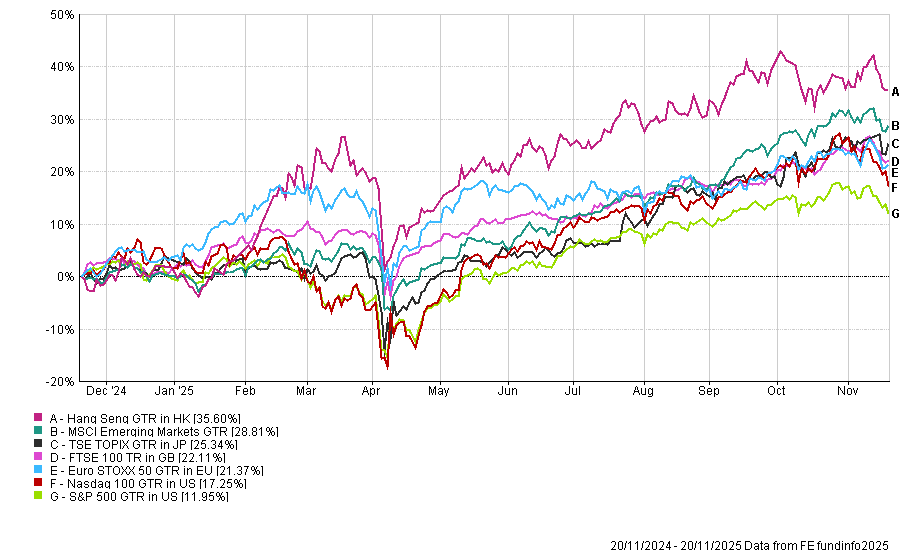
The rolling 12 month % cumulative returns in local currency from various indices is shown in the following chart:
Where are the portfolios up to?
The portfolio performance, net of fees, to close of business on Thursday is as follows:

As ever, if you would like to discuss any aspect of your portfolio, please do not hesitate to contact us on service@blythefinancial.com.