There were few major revelations from Federal Reserve Chair Jerome Powell’s final speech of 2025. The FOMC cut interest rates by 0.25% with three dissenters; two for no cut and Stephen Miran, who is firmly aligned with President Trump, targeting a double increment cut. This represents significantly higher dispersion than has been the case in the past five years and is more a reflection of Political interference than fragmentation in how economic data is being interpreted. The Fed will remain data dependent while Powell sees out his term.
There were no real signs of hawkish sentiment which was pegged as an outside risk for 2026, but Powell was also keen to reign in the idea that the central bank would be embarking on a significant easing cycle. The dot-plot indicates a single cut in 2026, below the market’s expectation for two.
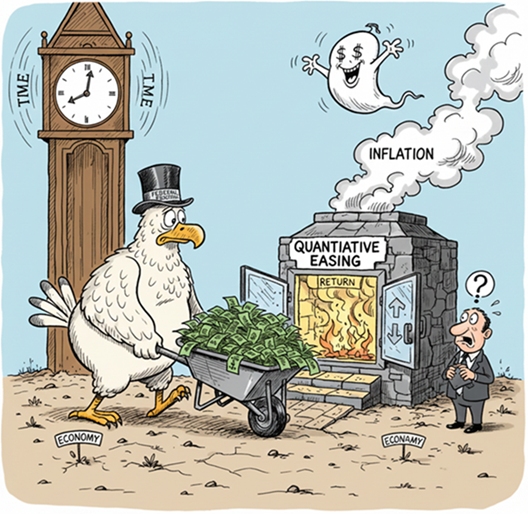
While that alone was enough to get asset markets more optimistic about 2026, the Fed also upgraded its economic growth forecast by 0.5% and will resume asset purchases, starting with $40bn inside the first month. As much as this has been described as a “technical” measure conducted as “reserve management purchases” targeting only short-term Treasuries to resolve a “plumbing issue”, it cannot be denied that this is simply a return to quantitative easing (QE).
This will provide liquidity, boost confidence and act as a boon for risk assets but will not in its current form have the same impact on longer dated yields as post-global-financial-crisis QE did and, thus, may not favour growthier equities to the same magnitude.
It’s no surprise therefore to see a bit of sector rotation, with equities broadly responding well but the technology sector exhibiting some weakness. Oracle was also partly to blame after raising its capital expenditure forecast by over 40%, which wasn’t welcomed by investors and appeared to have a knock-on impact on other hyperscalers.
Not everyone is as pessimistic. Disney will invest $1bn into Open-AI with additional warrants opening the door to subsequent share purchases as the company becomes a major enterprise customer of the AI platform. In return Disney will provide limited, structured access to its vast intellectual property – maybe it is a Mickey Mouse technology after all.

Advances in Nvidia’s chip-tracking technology could be the reason the US government is now allowing the company to sell its H200 chip into China, but it could also be the cool 25% of the sales revenue the government will receive as a result. As a reminder, this approach is effectively a US tax on Chinese consumption. The H200 is Nvidia’s second-most powerful chip generation; the successor to the H100 and immediate predecessor to the current flagship Blackwell line. Nvidia’s stock, however, barely reacted to these developments.
While US-China relations eased, China-EU tensions could resurface after EU watchdogs embarked on their second unannounced “dawn raid” under their new Foreign Subsidies Regulations. This time it was the more recognisable online retail giant, Temu, on the receiving end, suspected of distortive Chinese state subsidies which would give it an unfair competitive edge. Hopefully you all got your Christmas shopping finished early this year!
But the EU must look west as well as east: A leaked draft of the US National Security Strategy lays out an explicit strategy for reorienting transatlantic relations by improving US ties with Austria, Italy, Hungary and Poland with the stated aim of pulling them away from the European Union. In the document the republican administration believes Europe as facing “civilizational erasure” due to mass immigration and politically correct leadership from Brussels. Looks like British cynicism has finally made it across the Atlantic.
…and of course this has since been coined the “Make Europe Great Again” strategy which gives the far more satisfying acronym: MEGA.
Where are markets up to?
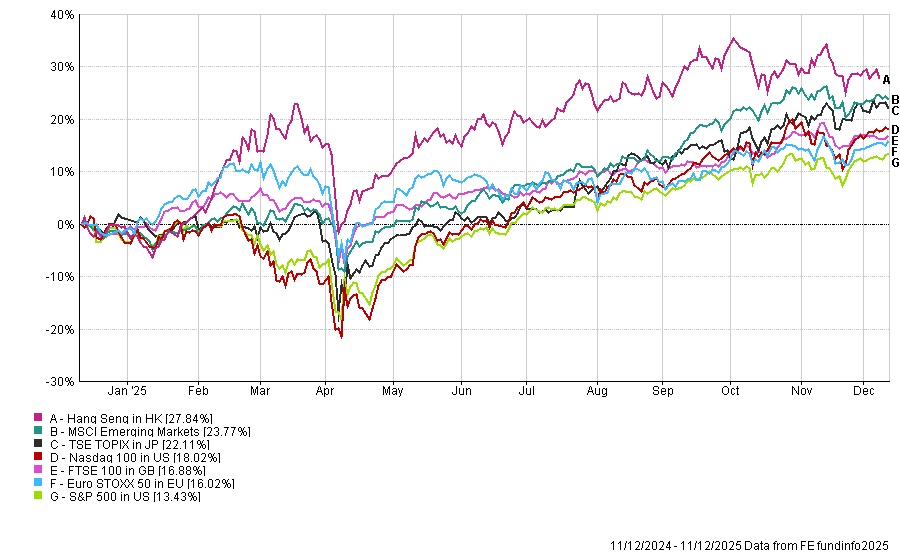
The rolling 12 month % cumulative returns in local currency from various indices is shown in the following chart:
 Where are the portfolios up to?
We apologise, it appears that our data provider is suffering a technical issue, so our usual performance update is not available. We will defer this data to next week’s update.
As ever, if you would like to discuss any aspect of your portfolio, please do not hesitate to contact us on service@blythefinancial.com.