As the World Cup rolls on, the US achieved a solid 2-0 against Bosnia & Herzegovina but it was 4-1 against President Trump as the Supreme Court handed down some major rulings.
They struck down his day-one executive order that attempted to end birthright citizenship for children born in the US to undocumented or temporary immigrant parents and flatly declined to hear his appeal to overturn the $5m civil jury verdict finding him liable for sexually abusing and defaming writer E. Jean Carroll.
Ahead of the midterms, Trump had hoped to restrict mail-in voting, which he views as deeply corrupt, but the court reinforced that states may continue to count mail-in ballots that are postmarked before election day, even if they arrive after.
His big victory dismantled a 90-year-old legal precedent, SCOTUS ruling that a president has the constitutional authority to fire leaders of independent federal agencies “at will” (i.e. without reason). However, the Federal Reserve was specifically safeguarded from these powers, and Trump was blocked from firing Federal Reserve Governor Lisa Cook.
Last week’s update proved to be a premonition, with poor US payroll data feeding into interest rate expectations such that the ‘higher-for-longer’ hawkish narrative reversed, and the dollar fell. Jobless claims also dipped, so the labour data on the whole did not spark concern over the economy but a weak Atlanta Fed’s ‘GDP Now’ figure of 1.2% vs 2.5% expected did take the shine off US assets.
There is nuance in the data that feeds into the GDP Now, which is a fast moving, more forward-looking indicator of economic growth. It was entirely owing to scaled-up imports, which could be in part owing to stockpiling ahead of anticipated policy changes following the midterm elections – a sign that President Trump will be back to his antics come November, perhaps.
The other cause could have been the acceleration of retailer peak season – pulling autumn and holiday shipping volumes forward into June to lock in transit prices before they climbed higher, and of course the World Cup could be a factor in that regard. Regardless, it is likely that these effects are more about timing and will come out in the wash once those orders can be turned into sales.
In the Eurozone, falling oil prices have begun to feed into the inflation data which was better than expected and provided a boost for European risk assets, while in China industrial production showed growth at a steady rate, undeterred by any energy crisis.
Japan’s Ministry of Finance appears (as it doesn’t formally disclose) to have once again engaged in some currency intervention with the exchange rate having passed through 162 versus the US dollar. As noted in our update from two weeks ago, the previous marker of 160 was likely to be adjusted with the dollar strengthening on hawkish Fed comments rather than explicit Yen weakening.
Evidently this intervention has been moderate with the Yen only slipping back to 160 and now motioning back closer towards 162, volatility that is far more muted than during recent attempts at intervention. With the dollar falling again, maybe we will see another attempt to protect the currency, and it has been common to do so during US public holidays when there is thinner liquidity to get the most bang for one’s buck – roll on Monday…
Where are markets up to?
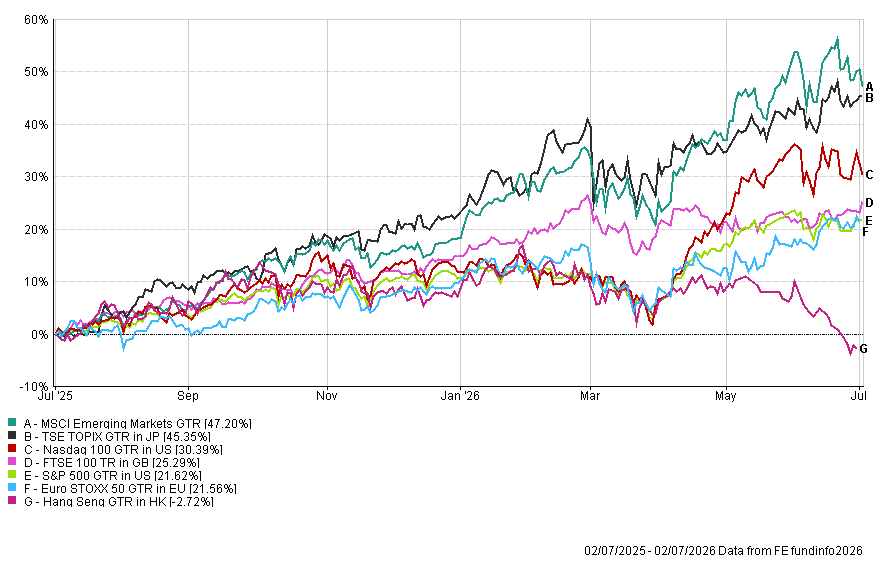
The rolling 12 month % cumulative returns in local currency from various indices is shown in the following chart:
Where are the portfolios up to?
The portfolio performance, net of fees, to close of business on Thursday is as follows:

As ever, if you would like to discuss any aspect of your portfolio, please do not hesitate to contact us on service@blythefinancial.com.