An impressive showing at the World Cup by the England Football Team on Wednesday illustrates what can be achieved with the right leader at the helm – Next up: UK Prime Minister. The Makerfield by-election results are in, and it was an astounding victory for Labour’s Andy Burnham. The main takeaway from the results was that those on the left were more inclined to give up their preferred party and transfer their vote to the frontrunner. There are those on the right, however, that appear unwilling to support Reform, which could scupper the party’s chances at the next general election.
What’s not quite clear is the extent to which this was a vote for Andy Burnham, who ran under his own brand more so than Labour’s, or a vote against Keir Starmer. The strong voter turnout, which was anomalously higher than at the last general election, would suggest that the latter was indeed a deciding factor. Consequently, what’s hidden from the data is the number of voters may have shifted their typical allegiance purely to oust the sitting PM.
This ultimately means that a leadership challenge is now firmly on the cards and with Burnham a clear favourite according to internal party polling, he looks a shoo-in to become PM in a matter of months.
While Burnham represents a bit of hope for the UK economy and possibly UK equities too, his fiscal looseness represents downward pressure on bond yields and the currency. Gilt yields had already largely priced in the ongoing unsettled politics, anticipating a likely shift to the left and with it another attempt to increase spending and go for growth. Burnham could yet prove to be a steady hand at the tiller, having played down his indifference to bond markets, backtracking on widely quoted remarks as investors contemplated another Liz Truss fiscal blowout.
Pound Sterling, however, has tailed off this week as a result of these events. This has been most notable when paired against the US dollar which is mounting a comeback of its own after Federal Reserve Chair Kevin Warsh’s first Federal Open Market Committee meeting and while the status quo was maintained for interest rates, the rhetoric took an unexpectedly hawkish turn.
During his press conference Warsh was clear on his priority of quashing inflation, inferred that inflation should remain on the right side of the 2% target and reinforced monetary policy’s role as the key determinant of inflation. In parallel the Dot Plot (which indicates the future expectations of each of the members) showed an increasing number of members anticipating interest rate hikes with a third expecting more than one by the end of the year. This is a significant flip in the recent narrative and could exert some downward pressure on US growth stocks.
The new Fed Chair also made some systematic changes: firstly by electing not to issue his own dot in the Dot Plot – I hope to be the first to coin the term ‘Warsh Code’ – and second by scrapping the forward guidance which has been used for two decades to help choregraph monetary policy and avert panic on Wall Street.

On one hand this looks like the beginning of the anticipated dismantling of the Fed’s scale and influence, on the other it hands potential trading power back to those with inside political knowledge. For those less cynical, the intent could simply be to help the Federal Reserve maintain its credibility which was questioned at times under Jerome Powell in part because the Fed’s longer term economic forecasts have been wide of the mark, albeit often owing to crises.
The other currency pair that returns to the spotlight this week is the US-dollar-to-Yen which has edged up over the 160 mark, a level which has of late provoked numerous interventions by Japan’s Ministry of Finance. While this dynamic has attracted comments from the finance minister, it is quite evident that the scenario is not an attack on the Yen, merely a broad strengthening of the dollar. In contrast, Yen to Euro or Pound rates are well within the current year’s trading range so we expect the goalposts to be adjusted instead of renewed intervention at this stage.
The US and Iran signed the much-vaunted Memorandum of Understanding on Thursday, which is a key stepping stone along the path to a long-term agreement, despite this being described by Trump as “a deal”.
The MoU is actually a 14 point interim deal that, in summary, halts fighting, reopens the Strait of Hormuz, provides time limited sanctions relief and oil waivers for Iran, and sets up 60 days of negotiations toward a final agreement under which Iran formally commits never to develop a nuclear weapon and receives a large reconstruction package.
Supporters see it as a necessary ceasefire-plus framework that averts wider war, restores global shipping and energy flows, and creates leverage based incentives for Iran to stay away from nuclear weapons, while critics argue it rewards Iranian aggression, is vague and unenforceable, and risks locking in major economic benefits for Tehran without securing irreversible concessions.
One of the core terms of the MoU is that it declares an immediate and lasting cessation of military operations between the US, Iran and their respective allies on all fronts, explicitly including Lebanon, and aims to lock this into a later “final agreement.”
Both sides commit to respect each other’s sovereignty and territorial integrity and to avoid interference in internal affairs, at least as a political baseline for the next phase of talks.
The parties undertake to negotiate a final agreement within 60 days, with a possible extension by mutual consent, making this explicitly an interim framework rather than a “final deal”.
The US has already started dismantling its naval blockade of Iranian ports and waters, and Iran is to immediately allow commercial shipping through the Strait of Hormuz free of charge for 60 days and work with Oman on future administrative arrangements in line with international law.
The MoU also sketches a reconstruction and economic development plan for Iran worth at least $300bn, with implementation details to be negotiated in the final agreement.
The US also agrees in principle to lift all US and UN linked sanctions on Iran on a phased, conditional schedule as part of a final deal, and to work on releasing frozen Iranian funds. The US however is keen to stress that Iran does not get large scale cash or blanket relief immediately on signing the MoU.
For its part, Iran reiterates that it will not acquire or develop nuclear weapons, and the sides commit to decide how to handle existing enriched uranium stocks and future enrichment within the 60 day window.
Pro-Trump commentators and supporters have framed the MoU as a pragmatic ceasefire plus arrangement that averts a spiral into large scale war and buys time for a more durable settlement.
They stress that, unlike past ceasefires, the MoU bundles military de escalation with concrete steps on shipping, sanctions, and nuclear issues, giving all sides a stake in maintaining calm.
Western opponents however see the MoU as US capitulation whilst some Iranians see the MoU as a trap.
The main western objections are that the MoU rewards Iranian pressure and aggression, whilst many hardline Israelis see this as a humiliating defeat or as capitulation to Iran and its regional network, which they fear will embolden further Iranian action once resources start flowing.
Meanwhile, Iran’s Supreme Leader Mojtaba Khamenei said that Trump signed the MoU to end the war in the Middle East “out of desperation”, a statement sure to be picked up by the anti-Trump movement.
Our take on the MoU is that at a headline level it is a welcome move. Getting oil moving again is hugely important at both a macro-economic level as well as for markets.
There are, however, substantive gaps on key issues. For example, the MoU defers all hard questions about Iran’s enrichment levels, stockpile reduction / disposal, and inspection regime to the final agreement, but these are precisely the issues that have stalled past talks and will likely prove complex to resolve in 60 days.
There is also the deep mistrust, between both sides with each believing the other has previously reneged on commitments. This is likely to be the hardest barrier to overcome.
Where are markets up to?
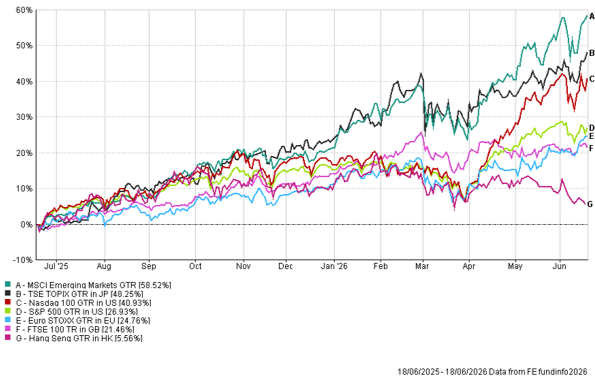
The rolling 12 month % cumulative returns in local currency from various indices is shown in the following chart:
Where are the portfolios up to?
The portfolio performance, net of fees, to close of business on Thursday is as follows:

As ever, if you would like to discuss any aspect of your portfolio, please do not hesitate to contact us on service@blythefinancial.com.