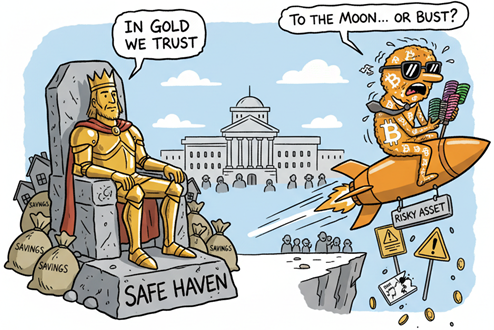
In the US trading session following our last update, Gold and Silver experienced a huge price crash, wiping $7 trillion of combined market value across precious metals. It is possible that our views are held in such high esteem that the market reacted as we made them public – of course I jest.
The real catalyst is widely reported to be the nomination of Kevin Warsh for Federal Reserve Chair whose appointment, if confirmed by the Senate, would reduce the prospect of ultra-loose interest rate policy and may even seek to shrink the central bank’s balance sheet – Two components of gold’s bullish thesis and a potential positive for the dollar, yet another component of that story.
Looking under the hood, what may have been missed is that the Chicago Mercantile Exchange actually increased the margin requirement for trading on these metals which served to halt what appeared to be excess speculation.
While many retail traders consider this to be a concerted effort by ‘elites’ to rig the market, these are the same individuals that hoped to profit out of squeezing an asset, the use of which has real world consequences. Those who run exchanges must act to manage risk, which judging by the scale of the subsequent fall, had indeed greatly increased.
Despite the massive scale of these drawdowns, prices settled around the levels they were at the start of the year and have recovered a little into the new month. Copper, on the other hand, has held up well through this volatility and, as we asserted last week, looks to be well positioned.
One asset that has disappointed throughout 2025 and this period included is Bitcoin which, despite surviving a sell-off in fringe cryptocurrencies last year, is now priced at half its peak value. The alternative anti-fiat-currency ‘digital gold’ has failed to hold up to its real-world counterpart and has acted more akin to a risk asset than as a safe-haven.
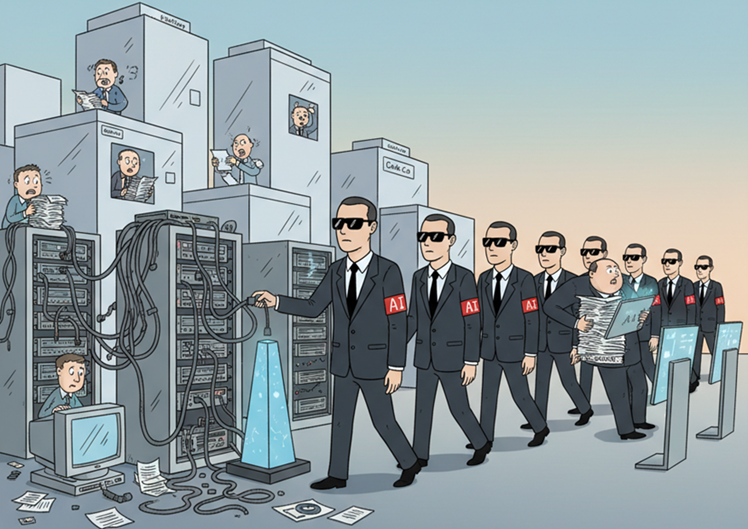
This week it is Software companies that are having their own meltdown. US job layoffs surged in January with the technology sector contributing more than any other if excluding a huge restructuring for US logistics giant UPS. There is also a lack of entry level technology job openings, indicating that AI is beginning to trouble the jobs market.
So, when Anthropic released Claude Cowork, a specialised automation tool that directly threatens incumbents in financial research and legal services, the narrative flipped for the sector from the obvious tailwind to the imminent disruption and need for evidence AI efficiency gains or revenue expansion.
ServiceNow was a prime example of the shift in sentiment from analysts. Despite beating estimates on both revenue and profits, and raising its guidance for 2026, the stock fell due to its per-seat pricing model. If an AI agent can pull together the work of five people who use the software, then these multiple-subscription models become obsolete.
Many in the enterprise software arena think the sell-off may be extreme as many companies are heavily integrated into other businesses with many components of software offerings unlikely to be replaced by AI “vibe” coding. They also note that the responsibility shift of doing some of these things in-house is significant.
Multi-faceted, mission critical software providers for whom their customers have already heavily integrated their software, may be less likely to see sweeping change. We think cybersecurity may be the best example of this. Those companies who are more focused and have customers who only use one or two components of their offering may struggle.
The weak jobs data resulted in 10-year Treasury Yields falling by 0.10%, a sign of caution but not without other signs of economic resilience. The ISM Services PMI held steady at 53.8%, marking nineteen straight months of expansion, and business activity accelerated, suggesting the consumer side of the economy is still healthy.
AI could present a scenario in which the economy remains in good shape while unemployment rises. Employment data would pressure the Federal Reserve, interest rates and yields may fall, providing cheaper capital for infrastructure expansion while also reducing the discount rate for growthier assets. This would be a boon for AI hyperscalers, yet despite that potential and the disruption of near $1tn of value from software companies, there is still an air of caution.
The main concern is whether AI can be sufficiently monetised sufficiently soon. We are still confident in the outlook for the hyperscalers based on these developments – it’s also worth noting that Amazon and Google are both invested in Anthropic.
At the same time, forecasted small-cap earnings growth reached its strongest level since 2022. Propelled by fiscal stimulus, the ability to slash operating costs using AI while big tech fails to monetise their exploits bodes well for everyone, except investors, but as the evidence of its value becomes clearer so too will the price tag.
One other hurdle the AI revolution needs to overcome is an emerging memory bottleneck which means that these high-end processors may be inefficiently waiting for the information they need to process to arrive. This issue is the real reason for the significant rally in Korean stocks as two of the largest companies in the Korea index, Samsung and SK Hynix, which accounted for most of the index’s gains in 2025, are titans in this space matched only by Micron Technology in the US.
Iranian altercations with the US have pushed oil prices higher, albeit subsequent peace talks have moderated the rise. An Iranian drone was destroyed after approaching the USS Abraham Lincoln and a US flagged tanker had to be provided with a military escort after an altercation with two Iranian fast-attack craft.
The week also saw the expiry of the New Strategic Arms Reduction Treaty which marks the first time in over 50 years that there are no legally binding limits on the nuclear arsenals of the US and Russia. While disconcerting, the US will instead push for a trilateral deal which would include China, so the ultimate conclusion may be better all-round.
The Bank of England held interest rates steady this week but not without a surprisingly close vote which has it looking like the BoE will enter a cutting cycle. UK GDP growth has been downgraded, and inflation expectations have been significantly scaled back giving reasonable scope for monetary easing, but robust wage growth tipped the balance in favour of waiting this time round. The pound has fallen in response.
It also looks like UK politics is in the thick of it again, with Leader of the Opposition Kemi Badenoch appealing to Labour MPs to call a no confidence vote against Keir Starmer in response to the scandal around his vetting and hiring of [Lord] Peter Mandelson in light of his ties to Jeffrey Epstein.
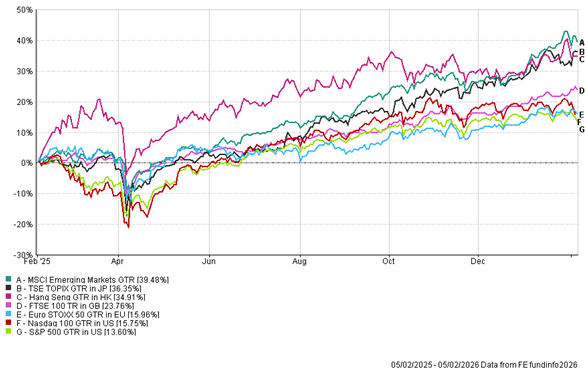
Where are markets up to?
The rolling 12 month % cumulative returns in local currency from various indices is shown in the following chart:
Where are the portfolios up to?
The portfolio performance, net of fees, to close of business on Thursday is as follows:

As ever, if you would like to discuss any aspect of your portfolio, please do not hesitate to contact us on service@blythefinancial.com