In a week in which the actions by the Federal Reserve were relatively unimportant, where Chair Jerome Powell kept things steady or dare I say it mundane in both his rhetoric and the decision to keep interest rates unchanged; we may be thankful – for a change – that President Trump chimed in to provide some interest by announcing his nomination for Chairman, Kevin Warsh.
Warsh is well respected having played a pivotal role as the Fed’s liaison to Wall Street during the 2008 financial crisis and considered likely to safeguard the Fed’s independence. He has historically preferred to keep interest rates higher to keep prices stable but has recently adopted the view that AI-related productivity gains will keep inflation low, allowing for slightly looser monetary policy, thereby aligning him with President Trump’s ambitions to some degree.
There was a hope that 2026 would provide easy monetary policy which alongside expansionary fiscal policy would provide a “goldilocks” environment for US economic growth but with Warsh’s appointment – which still needs to be confirmed by the Senate – and as jobless claims remain low, market expectations may need to be tempered slightly.
Treasury yields have moved higher as a result, and we could see a reversal in some of the dollar weakness which has accelerated again this week as the US trade deficit widened, the EU and India signed a landmark free trade agreement, and amid rumours of coordinated currency market intervention by the New York Fed and Bank of Japan.
Despite Treasury Secretary Scott Bessent’s explicit denial of US intervention, the dollar seems to have instead taken its cue from President Trump who expressed comfort with recent weakness.
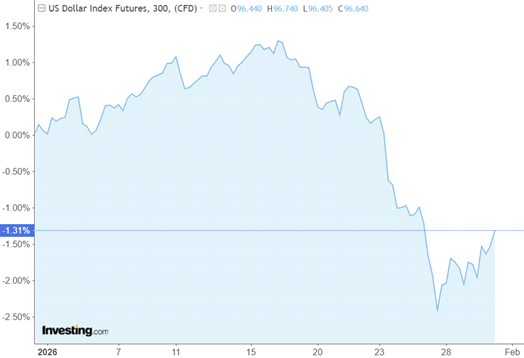
It was widely cited in the run up to Trump’s presidency that he would prefer a weaker dollar to help improve US manufacturing competitiveness, but his actions have focused more attention on using trade policy to achieve these goals. If his wings are to be clipped by the Senate and Supreme Court this year, and possibly the mid-term elections too, it’s maybe no surprise the market remains cautious on the dollar; thus there has yet to be any meaningful reversion.
Dollar weakness is another wind in the sail for gold which has continued to strengthen into 2026, but it is its less colourful counterpart that has been hitting headlines this week. Silver has been on a tear over the past 6 months, reaching all-time highs with Solar and AI demand booming.
The situation represents more of a squeeze than a full-blown shortage and this is because the metal is not in a shortage when excluding demand from Jewellery and bullion, despite the media purporting that there has been a shortage for half a decade. The world may need to find and develop more reserves, but this doesn’t appear to be a short-to-medium-term issue.
There has been a price differential between western paper (silver contract) markets and Asian physical-only markets which originally served to bolster the narrative of shortages. However, major mints have since reported the global shortage of silver coins and bars is due to unprecedented retail hoarding, and the narrative is shifting to silver merely being today’s “meme stock” asset.
At the beginning of the week silver notched its biggest daily advance in history only to have lost it all before the market closed. That signalled a possible end to the squeeze – at least for now.
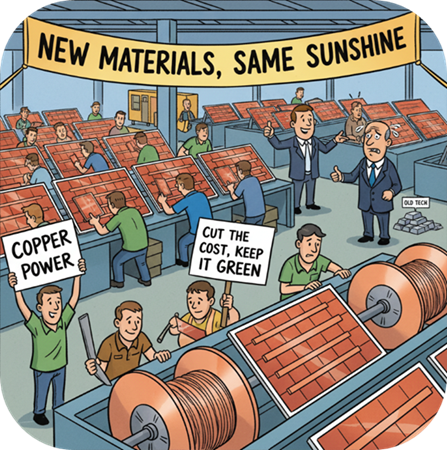
The piece of news that has gone under the radar in all this is that solar panel makers, which make up the largest segment of industrial users, are already shifting to copper as a substitute. This dramatically undermines the shortage of silver narrative, albeit there may be an argument that increased use for AI infrastructure may increase its relative industrial value.
With none of the buffers that silver has, and few substitutes, the copper shortage is much more real, and likely to persist for the foreseeable future. The addition of solar panels as a demand driver is insignificant with respect to total demand; more than a thousand times more copper is used for industrial applications than silver. Copper is also approximately 250 times cheaper than silver by weight, thus the dynamics for a long-term structural bull market are in place.
Why, therefore, are gold and silver stealing all the headlines? Well, partly because to fuel a squeeze, you need as many people on board as possible, so the media is a valuable tool, and the anti-establishment, anti-fiat currency (anti-dollar) and inflation narratives help feed this frenzy, with precious metals offering a hedge to these concerns.
Copper by contrast is typically very cyclical, by which we mean it responds to the changes in the fortunes of the economy, and as such investors have a history of avoiding it because equities would do that job for them. Now far too scarce, could this be a changing of the guard? Could copper become the next best safe-haven asset? Such a conclusion would have to assume no major disruption to its industrial megatrend uses.
The cynic in me ponders whether some very astute holders of silver have orchestrated this squeeze in order to provide the best opportunity to sell their own stash.
The metals story continues momentum in 2026, but is not a new story having been the case for most of last year. Until this week broad commodity prices were held down by very, very cheap crude oil but prices are heading higher with the arrival of the USS Abraham Lincoln aircraft carrier strike group in the Arabian Sea stoking fear of further escalation with Iran.
There has been much talk of where oil prices would be if Iran were to take the “nuclear” option of blockading the straits of Hormuz but any further run-up in commodity prices won’t be welcomed by the US administration if they start to feed into consumer prices, given voter sensitivity with respect to affordability as we head towards the mid-terms.
AI investment continues to offset the negative impacts of the trade war. This is now being reflected in Purchasing Manager’s Indices, with the US and Southeast Asia in solid expansion while Europe and Japan remain laggards.
In a slew of major tech earnings reported this week, Meta was rewarded for its revenue growth, Microsoft was treated with caution owing to its high capital expenditures, while Apple was appreciated for its AI spending discipline. Technology stocks’ share price performance has lagged the rest of the market but a surge in enterprise software earnings has revealed that businesses are now paying for autonomous AI agents rather than just chatbots:
In a year in which debt will fuel the AI infrastructure buildout, we may just start to see some of the revenue from AI come to fruition… just in time…
Where are markets up to?
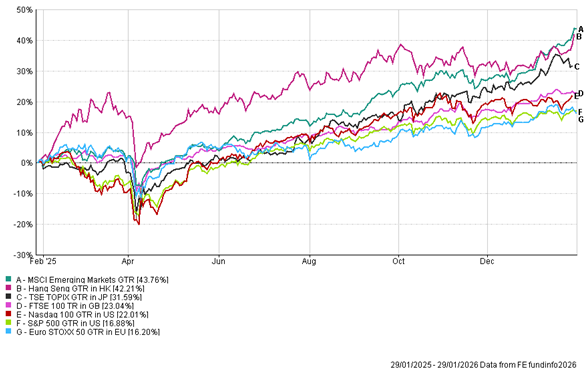
The rolling 12 month % cumulative returns in local currency from various indices is shown in the following chart:
Where are the portfolios up to?
The portfolio performance, net of fees, to close of business on Thursday is as follows:

As ever, if you would like to discuss any aspect of your portfolio, please do not hesitate to contact us on service@blythefinancial.com.