If you are having an emotional response to the new years’ fresh round of brouhaha from President Trump, then I’m afraid you are already playing into his non-clandestine negotiation tactics.
With the World Economic Forum in Davos and in particular Trump’s speech firmly in the spotlight this week and high anticipation that history was about to be made, instead we saw the beginnings of a climbdown on Greenland with an explicit ruling out of the use of American force to seize the island from Denmark.
He followed with a post on Truth Social which dialled back any tariff escalation with Europe, in light of a meeting with Secretary General of NATO, Mark Rutte. Markets have had a volatile week as a result but are well on their way to recovering their losses, but the sell-America trade has resurfaced and may need more time to resolve.
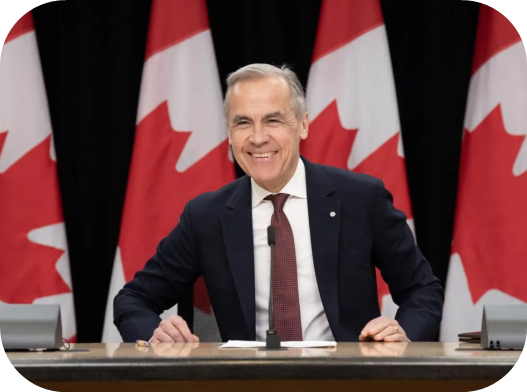
Trump was clearly riled by Canadian prime minister Mark Carney’s Speech, which was a stirring call for middle powers to resist coercion by great powers. A consequence of Trump’s nature is that he is bringing other strong political leaders to the fore, and this was certainly an example of cream rising to the top.

The reason that Carney’s speech resonated so widely was that it was an explicit acknowledgment that the old order, based on a benign US, has gone. It was a call to action that many in Davos found inspiring. When Carney finished speaking, he was greeted with a standing ovation. Trump, by contrast, got a tepid round of applause. That contrast spoke volumes.
Yet, discussions are ongoing about a “future deal” with Denmark over Greenland, possibly a compromise where the US would be granted sovereignty over specific pockets of land for missile interceptors and radar stations for its Golden Dome missile defence network. A deal could also include a new role for NATO in the Arctic.
For domestic cynics who loathe the pace at which European bureaucrats seem to get things done, Trump’s negotiation tactic appears once again to have been highly effective.
Japanese bond yields accelerated higher this week in the aftermath of prime minister Sanae Takaichi’s announcement of a snap election with which she seeks public backing for her “Sanaenomics” policy mix of aggressive fiscal expansion and state-led investment.
It makes sense for markets to promptly reassess bond yields given the shift in regime; from one in which the Bank of Japan had room to gradually normalise interest rates to a more inflationary one in which it may be forced to do so more rapidly, but there was an air of a Japanese Liz Truss moment about these dynamics, and wonder amongst observers as to whether bond markets were beginning to question fiscal sustainability.
Regardless of the pace, yields are repositioning themselves close to where they should be ahead of the central bank adjusting them itself. The Bank of Japan met and kept interest rates steady, with Governor Ueda signalling that while the bank is ready to hike again, the timing remains “data-dependent,” much to the disappointment of those who hoped for a clear signal of a March or April move.
The events in Japan are important globally with the country leading developed markets in terms of the debt-to-GDP ratio, which for Japan is an astonishing 240%. If fiscal concerns develop into a loss of confidence, it may just be Japan that is the first domino to fall.
However, the debt situation is nuanced with its government and private sector carrying a significant amount of foreign assets serving to offset the high amount of debt in absolute terms.
The yen also weakened in response to looser fiscal policy but there were hints of possible intervention early Friday morning as the currency snapped back from close to the 160 USD/JPY mark, which is seen as a critical threshold for Japan’s Ministry of Finance.
While the yen is expected to weaken and yields are heading higher, there isn’t a great impetus to invest in Japanese bonds, but when those dynamics begin to roll over, there could be a significant repatriation of capital, most likely out of US Treasuries. That could roil bond markets while any unwind in the yen carry trade which would likely occur in parallel could roil US equity markets. Quite when something like this might occur is not yet apparent.
It’s possible that the US economy has a strong year powered by fiscal stimulus and a corporate debt fuelled AI infrastructure build out. JP Morgan and Vanguard in combination confirm the notion that AI is the primary driver of the US economy in highlighting that AI-integrated sectors are seeing 15% earnings growth while non-AI sectors are stagnating.
Developments this week point to Lisa Cook keeping her job at the Federal Reserve and the hope of a reliable Trumpist majority is reduced. Without influence over the Fed, interest rates may not begin to fall as had been more greatly anticipated over the course of last year. The combination of a strong economy and higher interest rates could result in good conditions for the dollar, contrary to the sell-America narrative.
The one risk to this view is that if the Supreme Court restricts Trump’s ability to impose tariffs, which it is expected to do so imminently, then he may focus primarily on weakening the dollar as an alternative strategy to bring back domestic manufacturing.
We expect 2026 to be a year in which President Trump’s powers are curtailed by the republic and could see recent trends and narratives begin to dissipate as a result.
Where are markets up to?
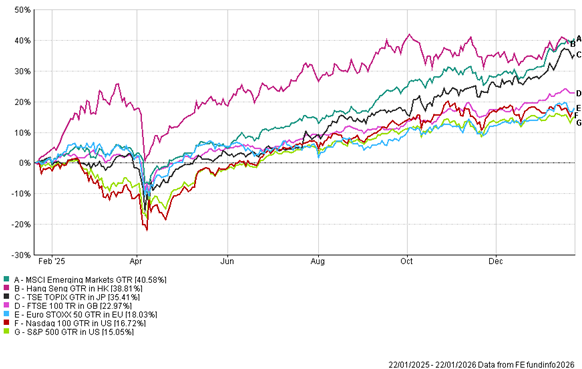
The rolling 12 month % cumulative returns in local currency from various indices is shown in the following chart:
 Where are the portfolios up to?
The portfolio performance, net of fees, to close of business on Thursday is as follows:
 As ever, if you would like to discuss any aspect of your portfolio, please do not hesitate to contact us on service@blythefinancial.com.