There’s no doubt most readers will already be fully aware of the key geopolitical developments into the new year, but with these in mind it is worth framing these events with the reaction from portfolios which find themselves at record highs.
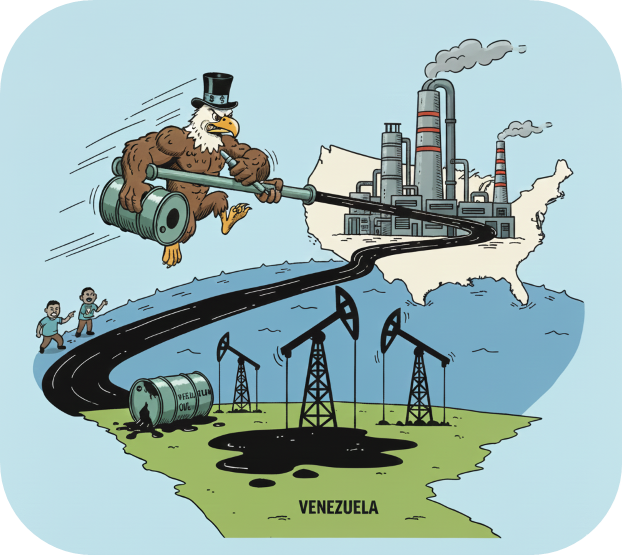
The most striking development has been the effective revival of the Monroe Doctrine, culminating in the removal of Nicolás Maduro in Venezuela. A direct US military intervention to seize the leader of a sovereign state and bring an authoritarian and deeply mismanaged regime to an abrupt end is an extraordinary event. Yet markets have responded with notable composure and the reason is that Venezuela, despite its vast oil reserves, is otherwise economically inconsequential in a global context.
Venezuela’s decline has been long and severe. In the 1970s it produced around 3.5 million barrels of oil per day, close to 8% of global supply. Today it represents barely 0.1% of world GDP and produces only 1 million barrels per day, just 1% of global output, ranking it only 18th among oil producers, despite having more proven reserves than any of them.
This is not a full-scale invasion; the US will use its leverage over the country’s oil exports to keep Venezuela in line from afar. There is currently a bipartisan bill making its way through Congress that seeks to prohibit any further military action in Venezuela, an indication of the intent of the administration beneath Trump.
The consequential impact on oil prices has been relatively marginal, a slight softening in an already oversupplied oil market.
More broadly, this episode underlines a deeper shift in the international system. The rules-based global order is giving way to a looser arrangement in which major powers assert control over their own spheres of influence while largely tolerating one another elsewhere. Europe is increasingly sidelined.
US strategic focus is narrowing decisively toward the Western Hemisphere, from South America to the Arctic, where the Monroe Doctrine opposed any foreign interference, and its most critical alliances external to this region will likely be Japan and South Korea, not Europe, given their proximity to and concern over China.
Viewed through this lens, the intervention in Venezuela is less impulsive than it appears. China, through its largely state-owned oil majors, has been edging toward deeper involvement in Venezuelan energy assets, while Caracas had also been pressing claims over oil-rich territory in neighbouring Guyana. Venezuelan heavy, sour crude is well suited to US refinery configurations while Russia and Iran also had interests.
Crucially, Washington is no longer constrained by fears that its military action will trigger energy price shocks. The US now holds leverage over both allies and adversaries across the oil complex, from Saudi Arabia and Nigeria to Iran and Russia which fundamentally alters the calculus of intervention.
This strategic confidence extends beyond energy; US policy has pivoted away from a diffuse focus on green energy minerals toward a sharper emphasis on defence-critical metals, notably antimony and tungsten. China and Russia currently control close to 80% of global supply for key alloys used in munitions, semiconductors and flame retardants. Securing alternative sources has become a core national security priority.

That priority is most visibly expressed in Greenland. The Trump administration has elevated the island’s “acquisition” to a top-tier security objective, appointing Louisiana Governor Jeff Landry as Special Envoy and signalling a willingness to combine diplomatic pressure with potential executive action.
For all the criticism of Trump he has certainly managed to achieve something few have before him: The reaction from Europe has been swift. This week, the six largest EU nations issued a joint statement affirming that “Greenland belongs to its people” and rejecting any US claim. It is evident that any US military action in Greenland would spell the end of NATO.
To emphasise the direction of travel, the Republican administration announced the withdrawal from 66 international organisations, half of which were UN-affiliated. While many of these appear to be associated with green/sustainability policy or just excess bureaucracy, I highlight five for effect:
International Institute for Justice and the Rule of Law
Partnership for Atlantic Cooperation
Regional Cooperation Council
Peacebuilding Commission
U.N. Alliance of Civilizations
Greenland’s importance extends beyond minerals. Its geographic position, proximate to both Russia and China, makes it central to the proposed “Golden Dome” missile defence system, the centrepiece of the second Trump administration’s security doctrine.
Unsurprisingly, the policy consequence of these developments is that defence spending is rising sharply. The US has proposed a 60% increase to its defence budget for 2027, taking it to $1.5 trillion, while Germany, Japan and Taiwan have all announced significant military expansions of their own.
The other key political development is that the US Supreme Court is poised to issue a landmark ruling that could dismantle a core pillar of the US administration’s economic policy. If post Liberation Day taxes are to be repaid, the US government will have to reconsider how it intends to pay for its stimulus packages, fiscal largess concerns will return and borrowing costs could begin to rise again.
A forced reversal of trade policy does not mean the end of tariffs outright, however, as there are alternate routes to achieving the same goal.
And finally, I thought this was a little humorous: The UK Financial Services Regulation Committee published a report on “Unknown Unknowns” in private credit. You couldn’t make this up – well you kind of have to…
Where are markets up to?
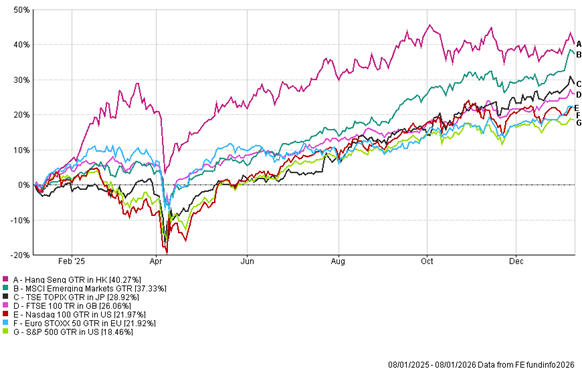
The rolling 12 month % cumulative returns in local currency from various indices is shown in the following chart:
Where are the portfolios up to?
The portfolio performance, net of fees, to close of business on Thursday is as follows:
 As ever, if you would like to discuss any aspect of your portfolio, please do not hesitate to contact us on service@blythefinancial.com.