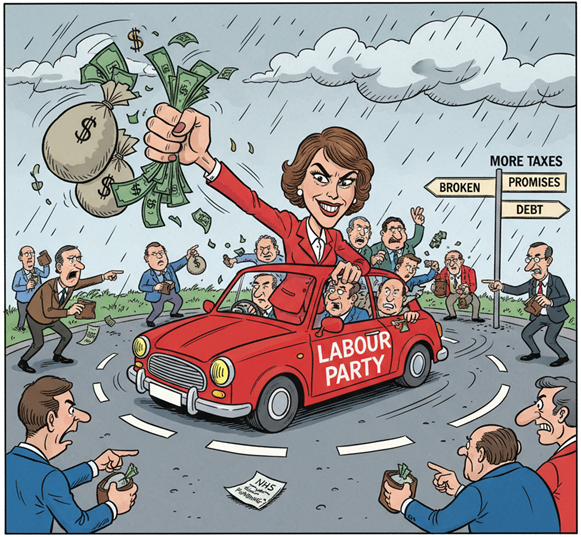
In another bombshell U-turn, the UK Labour government has abandoned its manifesto-breaking Budget plan to increase rates of income tax. This move comes after weeks of Chancellor Rachel Reeves guiding markets towards such an eventuality, arguing that tax increases aimed at reducing inflation could restore confidence and reduce the UK’s elevated borrowing costs.
While slowing the economy on one hand is not the ideal outcome, inflation busting taxes could hand the Bank of England the capacity to reduce interest rates which ultimately has a positive impact on the wealth effect which is a key driver for the UK economy – higher asset values stimulate spending.
The government’s decision marks a significant reversal ahead of the Autumn Budget in just over two weeks’ time and appears to be underpinned by fears that increasing income tax rates would further anger the public and MPs within the party. This week saw a reckless attempt to fire a warning shot at potential leadership rivals backfire forcing Kier Starmer to personally apologise to Health Secretary, Wes Streeting, and mounting pressure on him to fire his own Chief of Staff for orchestrating it.
Downing street aides launch an “extraordinary” pre-emptive briefing operation this week warning that Health Secretary Wes Streeting was plotting a leadership coup against Prime Minister Keir Starmer, which they argued would destabilise the government. This backfired spectacularly, forcing Starmer to personally apologise to Streeting and face intense pressure to fire his own Chief of Staff for orchestrating the “reckless” and damaging internal attack.
This about-turn is fresh, rapid and was only communicated to the Office for Budget Responsibility on Wednesday, leaving open the question of how Reeves may try to fill a budget gap of c. £30bn. The government may instead try to plug the gap by cutting the thresholds at which workers start paying income tax, while keeping the rates unchanged, but can they really spin this as not breaking a manifesto promise?
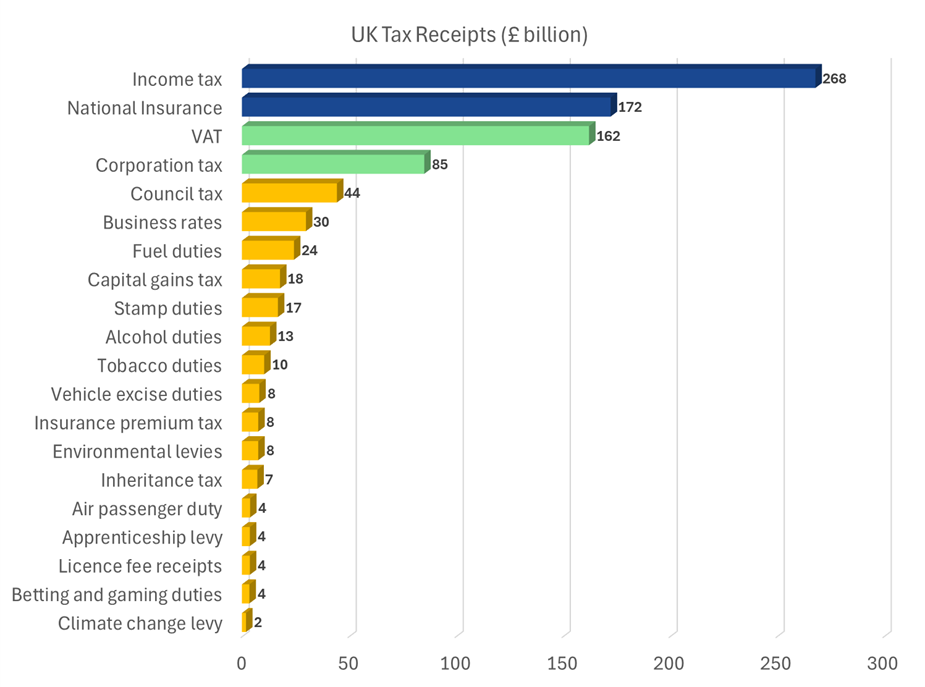
Raising the 20% income tax rate by 2% could have raised £15–20bn. The Chancellor must now rely on a mosaic of smaller more targeted measures, a difficult task as illustrated above. Having pledged to cap corporation tax for the entire parliament what remains is a long tail of smaller taxes which would each need to increase significantly, or indeed the situation puts VAT in the crosshairs.
Reeves needs to take the opportunity at this budget to restore Britain’s credibility and an increase in income tax would have been a signal to the market that the government is willing to do what is required. Peel Hunt Chief Economist, Kallum Pickering, points out that periods of UK real economic growth outperformance since 1980 have coincided with three periods of commitment to such “sound money” policies. The most recent news reflects a deteriorating picture instead, and Gilt yields are rising as a result.
Stateside, President Trump wasn’t winning hearts either after contradicting his America First rhetoric by defending the need to “bring in talent from around the world” to fill critical skill gaps, specifically pointing out that the US does not have enough “talented people” in certain fields.
At least he managed to end the longest US government shutdown in history on Wednesday, passing a temporary funding measure that will fund most federal agencies until January 30th 2026.
What was maybe most surprising was that it was the Democrats, not Republicans, who conceded to push the bill through. Just a week ago they’d won big in midterm elections, a victory widely attributed to the shutdown. Gaining ground in the political battle, many Democrats were baffled, some infuriated, that eight of their senators had decided to yield – the timing of such concessions is close to inexplicable. Only time will tell if taking the moral high ground matters in matters of politics.
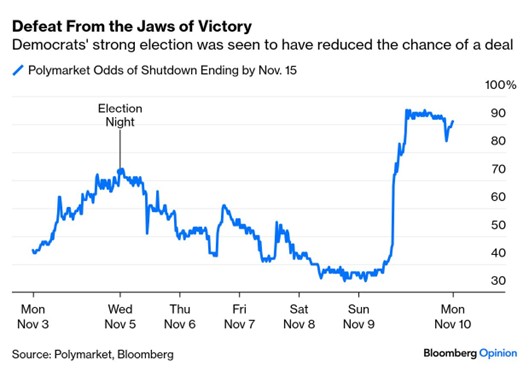
The equity market rebounded in response, taking its cue from history, but unlike history the shutdown hadn’t really had any negative impact on capital markets so it’s maybe not surprising to see this froth come off into the weekend.
Much of the economic data from this period will be delayed.
China announced export licensing requirements for EV batteries signalling a strategic decoupling of critical technology supply chains but for now suspended until November 2026 as part of the current trade truce.
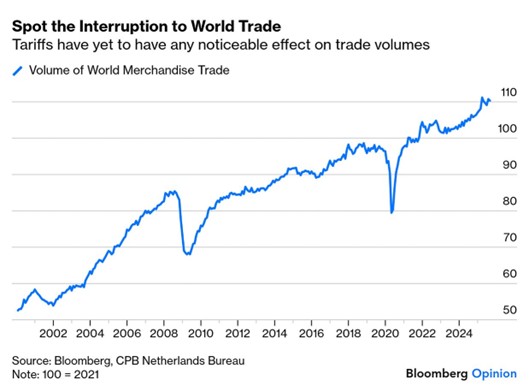
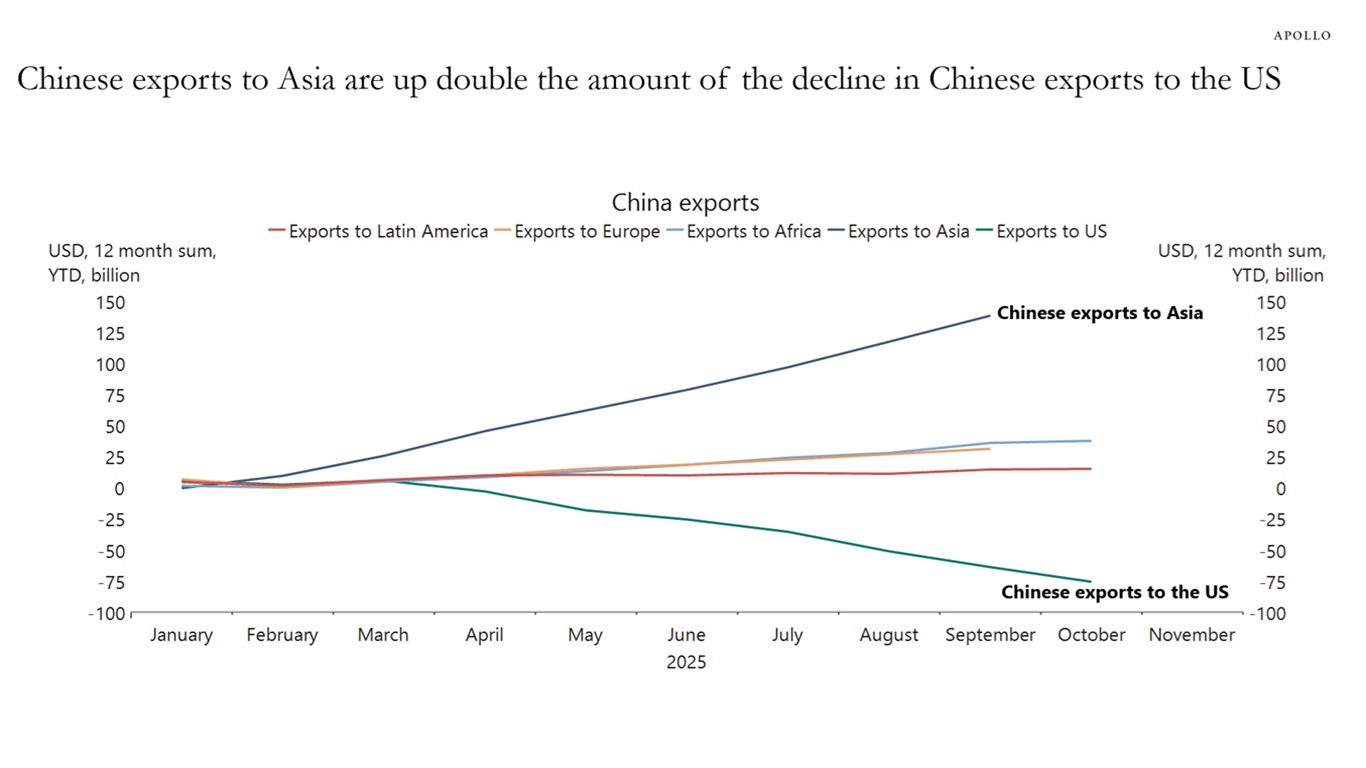
Recent economic data releases from China have been weak and while the volume of world trade is yet to be impacted by trade policy in 2025, the re-routing of Chinese exports from the US to the rest of Asia could be the root cause of ongoing deflationary pressures.
Emerging markets have been performing well this year as an alternative to US exceptionalism and favoured over other developed markets due to resilient and strong economic growth, reasonable valuations and higher exposure to technology. They have also benefitted from a weakening dollar and selectively don’t exhibit as high levels of debt as other developed economies.
Much of this sentiment shift has been driven by the bond market which will now lend to emerging markets in US dollars at record lows, in relative terms, in recent times.
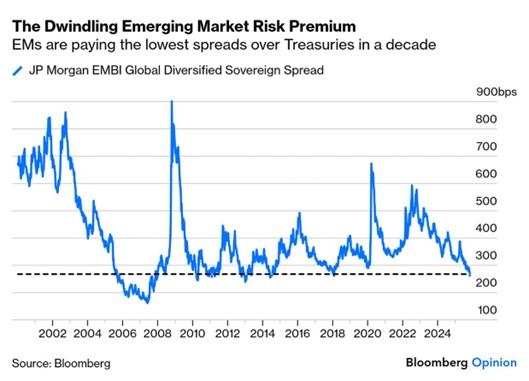 The spread over Treasuries is the extra amount a borrower must pay above that which the US government pays for borrowing dollars and is determined by their perceived creditworthiness. It is much more volatile for emerging market borrowers than domestic borrowers as their economic exposure to dollars is much lower and therefore changes in foreign exchange rates can dramatically change their ability to meet their obligations. With the dollar perceived to be a currency that is likely to weaken, a prevailing narrative into 2025, emerging market bonds are in demand.
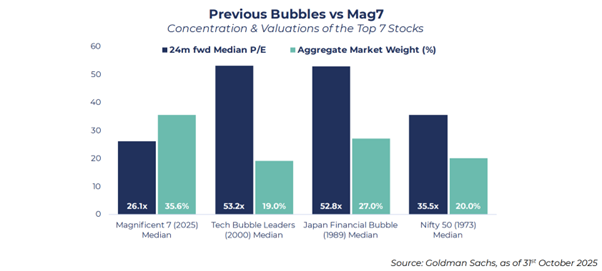
There is still talk of an AI bubble and markets coming off a little into the weekend will reinvigorate this story. We remain of the view that it is simply too early to call an end to this cap-ex boom. I add this chart to the illustrations we have already made as to why this is not yet a mirror of the Dot-Com bubble:
It was reported this week that Softbank is selling its stake in Nvidia and intends to reallocate capital toward what it views as the next, higher-growth phase of the AI value chain. While this could be taken as positive reinforcement for the theme, this is also the company that invested in shared office-space leaser WeWork at its peak valuation of $47 billion before its spectacular fall from grace.
And finally, Barwon’s latest analysis of around 300 listed private equity portfolio exits shows that average uplifts on exit have fallen sharply from about 30% in 2013–22, to roughly 10% since 2023, challenging the long-held view that private equity valuations are inherently conservative.
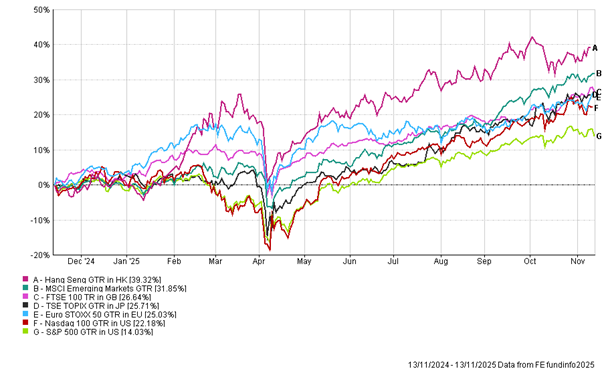
Where are markets up to?
The rolling 12 month % cumulative returns in local currency from various indices is shown in the following chart:
Where are the portfolios up to?
The portfolio performance, net of fees, to close of business on Thursday is as follows:

As ever, if you would like to discuss any aspect of your portfolio, please do not hesitate to contact us on service@blythefinancial.com.